
Animal Migration: Why Millions of Creatures Move Across the Planet Each Year
From Arctic terns to wildebeest, explore the science behind one of nature's most remarkable seasonal phenomena.
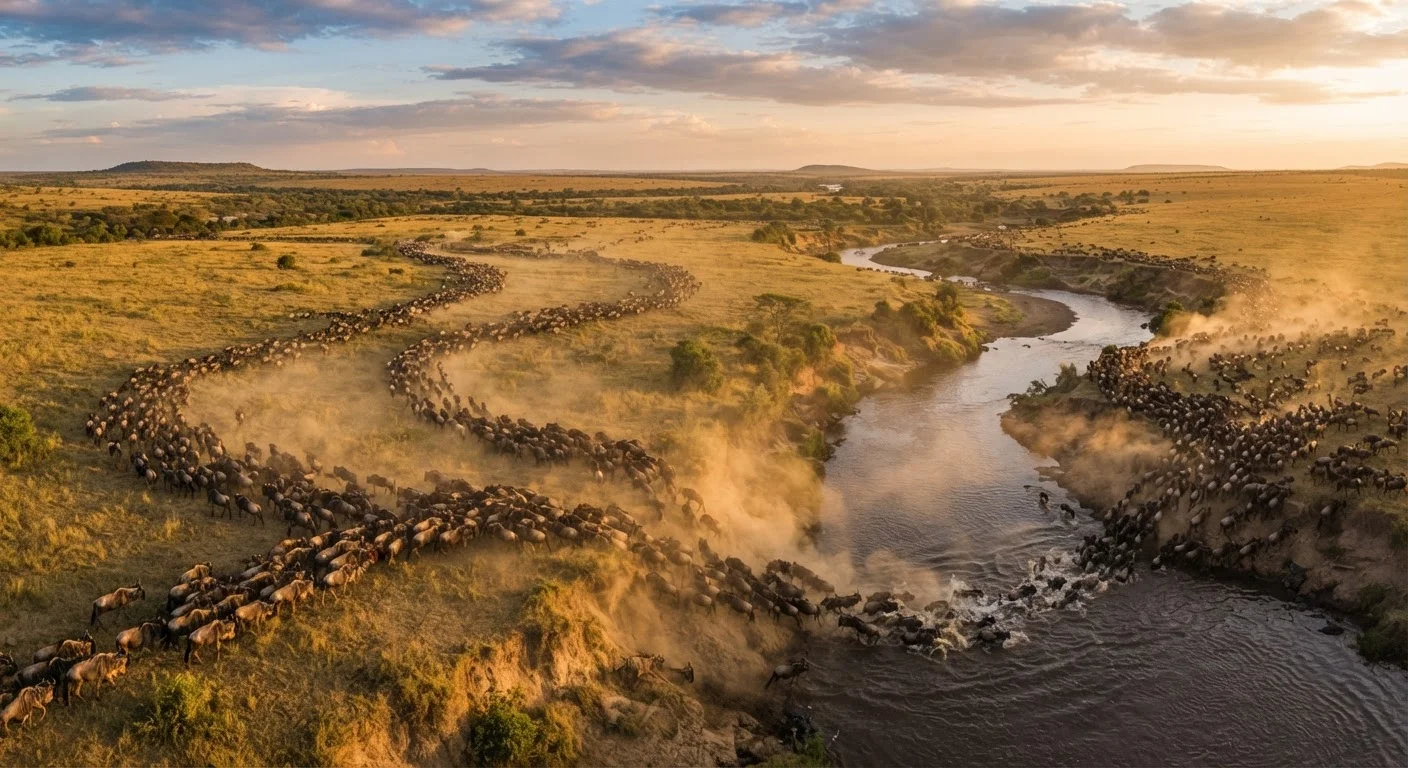
Photo: CoralScripts.com | Explore, Discover, Engage editorial
—— In This Article
Key Takeaways
- Migration is a cyclical, instinct-driven movement found across nearly every major animal group.
- Animals use multiple navigational tools, including Earth's magnetic field, star patterns, and olfactory cues.
- The Arctic tern travels the longest annual migration route of any known animal - up to 44,000 miles round trip.
- Climate change, habitat fragmentation, and light pollution are disrupting ancient migratory routes worldwide.
- Migratory animals often function as keystone species, redistributing nutrients and supporting entire ecosystems.
What Drives the Urge to Move
At its core, migration is a survival strategy refined over millions of years. When resources in one location become seasonally scarce - as plant life dies back in winter or breeding sites dry up - remaining in place carries an escalating cost. Moving, despite its enormous energetic demands, often offers a higher probability of survival and reproductive success.
The physiological machinery behind this urge is complex. In birds, shortening daylight hours trigger the hypothalamus to release hormones that stimulate hyperphagia - a period of accelerated eating that builds fat reserves to fuel long flights. Migratory restlessness, known as Zugunruhe in scientific literature, causes captive migratory birds to hop and flutter in the direction of their intended route, demonstrating that the drive is encoded internally, not purely learned. For a deeper look at how biological clocks orchestrate these seasonal behaviors, see Migration, Hibernation, and Seasonal Instincts.
44,000 mi
Arctic tern annual round-trip migration distance
Satellite tracking studies have documented individual Arctic terns covering distances equivalent to three lunar round trips over a lifetime.
1.5 million
Wildebeest in the Serengeti annual migration
The Serengeti-Mara ecosystem hosts one of the largest overland animal migrations, sustaining an entire predator-prey food web.
~600 species
Migratory bird species in North America
The Cornell Lab of Ornithology estimates roughly 600 bird species regularly migrate through or within North America each year.
The Remarkable Diversity of Migratory Species
Migration is not the exclusive domain of birds. The breadth of species involved spans nearly every major animal phylum, and some of the most extraordinary journeys occur below the ocean's surface or on six legs.
Humpback whales travel up to 5,000 miles between polar feeding grounds and tropical breeding waters, one of the longest migrations of any mammal. Leatherback sea turtles cross entire ocean basins, guided by magnetic sensing. Wildebeest complete a circular, 1,800-mile loop across the Serengeti ecosystem in pursuit of seasonal rains and fresh grass - a movement so significant it helps maintain the grassland itself. Many of these migratory species also function as ecosystem engineers; to understand why their presence matters so profoundly, the article on keystone species provides essential context.
Navigation: How Animals Find Their Way
Perhaps the most scientifically astonishing aspect of migration is navigational precision. Many species return to within meters of their previous breeding sites after journeys spanning continents or ocean basins - without GPS, landmarks, or learned instruction on the first journey.
Research has identified several overlapping navigational systems. Birds possess magnetite crystals in their beaks and specialized photoreceptors in their eyes that allow them to detect the inclination and intensity of Earth's magnetic field - effectively an internal compass. Nocturnally migrating species also calibrate their magnetic sense against star patterns during development, using the night sky as a secondary reference. The interplay between light and biological orientation is also explored in our article on nocturnal vs. diurnal animals.
Salmon rely almost entirely on olfaction, memorizing the chemical fingerprint of their birth river as juveniles, then following that scent gradient upstream years later as adults. This cross-sensory sophistication - magnetic fields, celestial cues, smell, and even infrasound - illustrates that migration is not simple instinct but a layered cognitive and physiological achievement.
“Migration is one of the most complex behaviors in the natural world - animals integrate information from multiple sensory systems simultaneously to navigate over distances that still astonish researchers who have studied them for decades.”
— Dr. Frank Moore, Professor of Biological Sciences and migration ecologist, University of Southern Mississippi
Threats to Migratory Pathways and What They Mean for Ecosystems
Migratory routes evolved over millennia in landscapes that have changed dramatically within decades. Habitat fragmentation now interrupts key stopover sites where animals must rest and refuel. Light pollution disorients nocturnal migrants - hundreds of millions of birds are estimated to collide with buildings in North America annually, many during migratory flights. Climate change is advancing spring phenology faster than many species can adapt, decoupling the timing of migration from the resource pulses - insect hatches, flowering plants - that animals depend on at their destinations.
The ecological consequences extend beyond individual species. Migratory animals redistribute nutrients across landscapes on a continental scale. Salmon carcasses, for instance, carry marine-derived nitrogen deep into inland forest ecosystems, fertilizing trees miles from the coast. When migration falters, these nutrient subsidies shrink and cascade through food webs in ways researchers are still documenting. Scientists track these effects using a range of methods described in our guide to how animal populations are counted in the wild.
Observing Migration Responsibly
If you visit a migratory stopover site - whether a shorebird estuary or a monarch butterfly grove - maintain distance and minimize disturbance. Animals at stopovers are often in an energy-critical state, and flushing them repeatedly can deplete the fat reserves they need to complete their journey. Follow posted guidelines and guidance from local conservation organizations.
For readers interested in witnessing migration firsthand, many US locations offer seasonal viewing windows tied to migratory cycles - planning around these natural events is covered in our guide to US seasonal landscapes.
Frequently Asked Questions

Pets & Animal Life Editorial Team
Pets & Animal Life Editorial Team is the collective byline for our editorial team and contributor network. Articles published under this byline or an editorial pen name are researched, written, and reviewed according to our editorial standards for clarity, consistency, and independence before publication.
View author profile