
Migration, Hibernation, and Seasonal Instincts: How Animals Track Time
How do animals know when to migrate or hibernate? From circadian rhythms to photoperiodism, explore the biological clocks driving seasonal behavior.
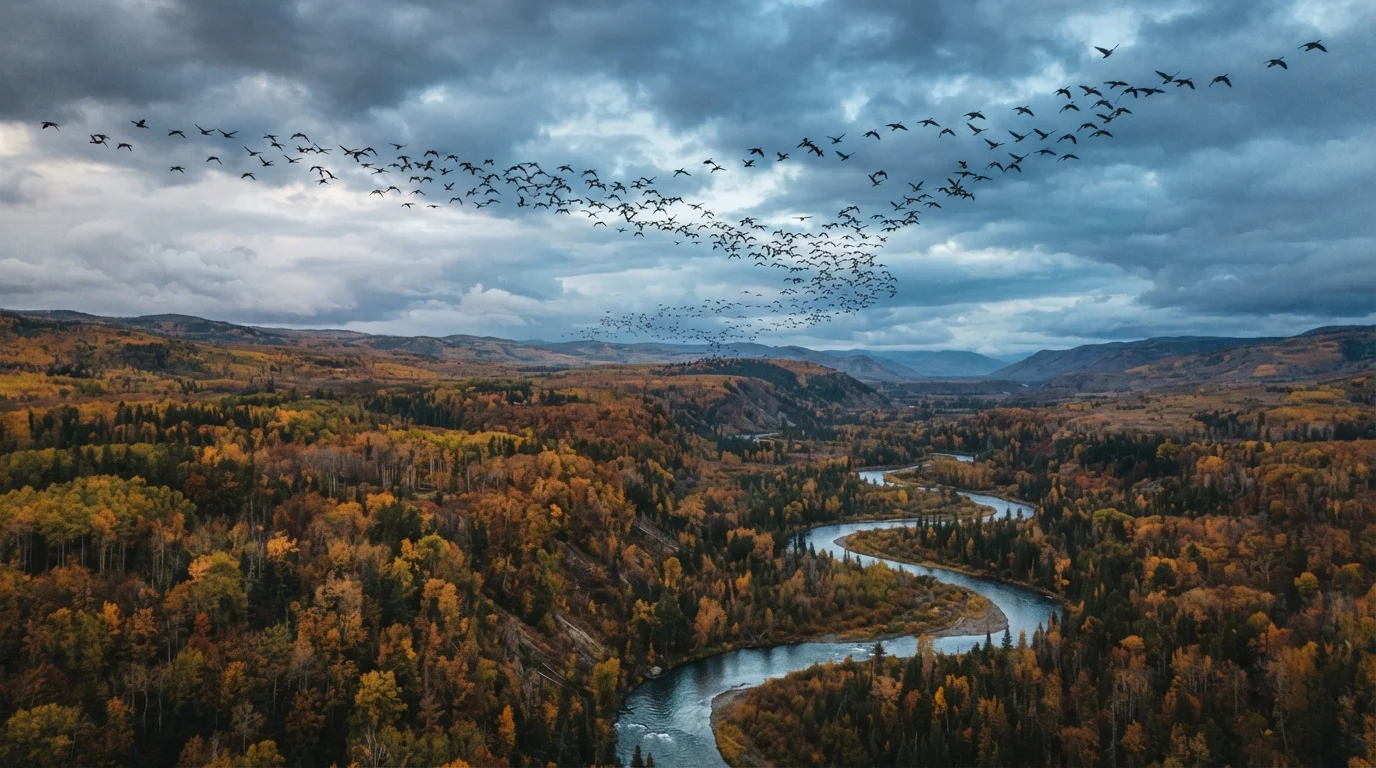
Photo: CoralScripts.com | Explore, Discover, Engage editorial
—— In This Article
Key Takeaways
- Animals don't guess when seasons change - they measure daylight length with remarkable precision.
- Circadian rhythms form the foundation of all seasonal biological timekeeping.
- Hibernation is a metabolically active state, not simply deep sleep.
- Migration timing is influenced by both inherited genetic programs and environmental feedback.
- Climate change is already disrupting the environmental cues that biological clocks rely on.
The Master Clock: Circadian Rhythms and Photoperiodism
At the core of every animal's seasonal awareness is the circadian rhythm - an internal oscillating clock cycling roughly every 24 hours. This molecular mechanism, driven by interlocking gene feedback loops, governs daily patterns of activity, hormone release, and metabolism. But circadian clocks do more than track days; they enable animals to measure the length of daylight with extraordinary precision, a process called photoperiodism.
As days shorten in autumn, photoreceptors - located in the eyes and, in some vertebrates, directly within hypothalamic brain tissue - detect the shrinking photoperiod (daylight window). This signal suppresses melatonin production at certain points in the cycle and activates the hypothalamic-pituitary axis, triggering hormonal cascades that reorganize the animal's physiology entirely. The result is not a reaction to cold or food shortage but an anticipatory response, preparing the body before conditions become critical.
This distinction is crucial: animals don't wait until food runs out to begin storing fat or until temperatures drop to begin moving south. The biological clock gives them a head start, often weeks ahead of the environmental change itself. For a deeper look at how light shapes animal physiology across daily cycles, see our article on how light shapes wildlife behaviour.
11,000 mi
Round-trip migration of the blackpoll warbler
This small North American songbird makes one of the longest overwater migrations of any land bird, a feat documented through geolocator tagging research.
~2%
Metabolic rate during deep hibernation vs. normal
Research on ground squirrels and other true hibernators shows oxygen consumption dropping to roughly 2% of basal waking levels during torpor bouts.
3 weeks
Typical interval between hibernation arousal bouts
Studies of hibernating rodents show interbout arousal episodes occurring every one to three weeks throughout the winter dormancy period.
Hibernation: More Than Just a Long Nap
True hibernation - observed in ground squirrels, hedgehogs, woodchucks, and some bat species - is a physiologically active state, not passive unconsciousness. Core body temperature can drop to within a few degrees of ambient temperature, heart rate slows to single digits per minute, and oxygen consumption falls to as little as 2% of normal waking levels. This profound metabolic suppression allows animals to survive months without food or water by burning stored fat at an extremely slow rate.
Interestingly, hibernating animals don't sleep through the entire winter. They undergo periodic interbout arousals - brief warming episodes every one to three weeks - during which they return to near-normal body temperature before cooling again. The energetic cost of these arousals is substantial, consuming a significant portion of fat reserves. Researchers have proposed that arousals serve essential functions including immune maintenance, sleep debt repayment, and neural repair, though the full picture remains an active area of investigation.
Bears present a related but distinct case. Their winter dormancy involves lowered metabolic rate and heart rate but without the dramatic temperature drops of true hibernation - a state sometimes called torpor or shallow hibernation. Female bears give birth and nurse cubs during this period, an extraordinary feat of metabolic multitasking.
Recognizing Torpor in Pet Mammals
Small domesticated mammals such as hamsters and ferrets retain partial torpor responses and may enter brief periods of reduced activity in cold or low-light conditions. This is generally normal, but a sudden, unresponsive torpor-like state in an indoor pet warrants a veterinary check to rule out illness. Ensuring stable temperatures and consistent light exposure helps minimize unintended torpor episodes in captive animals.
Migration: Genetic Maps and Environmental Fine-Tuning
Animal migration involves one of the most impressive intersections of genetics and environmental responsiveness in nature. Many migratory bird species demonstrate Zugunruhe - a German term meaning "migratory restlessness" - a period of increased nocturnal activity and directional orientation that emerges spontaneously even in captive birds kept under stable conditions. This confirms that the migratory urge has a strong genetic foundation independent of immediate environmental pressure.
Yet genes set only the rough schedule. Environmental cues calibrate departure timing with precision. A warmer-than-usual spring may accelerate the northward push; a cold snap can delay it. Stopover food availability influences how long birds linger and how much fuel they accumulate before continuing. Species that rely heavily on a narrow food source - such as insectivorous warblers dependent on caterpillar emergence - face mounting pressure as warming temperatures shift insect timing independently of the birds' inherited photoperiodic program.
Navigation during migration relies on a multimodal sensory toolkit: the sun compass, star map recognition, sensitivity to Earth's magnetic field, and olfactory and landmark cues learned over successive migrations. This redundancy makes migration robust against the failure of any single cue. See our companion piece on instinct versus learned behavior for a broader treatment of how fixed and flexible programming interact in animal action.
When Clocks Fall Out of Sync: Climate Change and Phenological Mismatch
Biological clocks evolved in stable, predictable seasonal environments. As global temperatures rise and seasonal patterns shift, the environmental cues that animals track - particularly temperature-dependent events like plant flowering and insect emergence - are changing faster than the genetic programs that govern arrival times and breeding schedules.
This creates phenological mismatch: a growing temporal gap between when animals arrive at breeding grounds and when their key food resources peak. Studies of pied flycatchers in Europe have documented declining populations linked to mismatches with peak caterpillar abundance. Similar patterns are emerging across taxa, from monarch butterflies and their milkweed timing to marine mammals and prey fish availability.
Some species show plasticity - the ability to adjust timing through behavioral flexibility or rapid evolutionary response. Others, particularly long-distance migrants whose photoperiodic cues originate thousands of miles from their breeding grounds, have far less room to adapt. Understanding these dynamics has direct implications not only for conservation but for nature-based travel and observation; timing a visit to witness migration or emergence events is becoming more complex as US seasonal landscapes shift. The stability of these natural spectacles depends on the biological clocks that orchestrate them remaining synchronized with the world they evolved to read.
“The biological clock is not just a metaphor - it is a real, biochemically grounded mechanism that allows organisms to anticipate the future state of their environment rather than simply react to the present one.”
— Russell Foster, Professor of Circadian Neuroscience, University of Oxford
Frequently Asked Questions

Pets & Animal Life Editorial Team
Pets & Animal Life Editorial Team is the collective byline for our editorial team and contributor network. Articles published under this byline or an editorial pen name are researched, written, and reviewed according to our editorial standards for clarity, consistency, and independence before publication.
View author profile