
Nocturnal vs. Diurnal Animals: How Light Shapes Wildlife Behaviour
What separates creatures of the night from those active by day? A look at physiology, senses, and survival strategies.
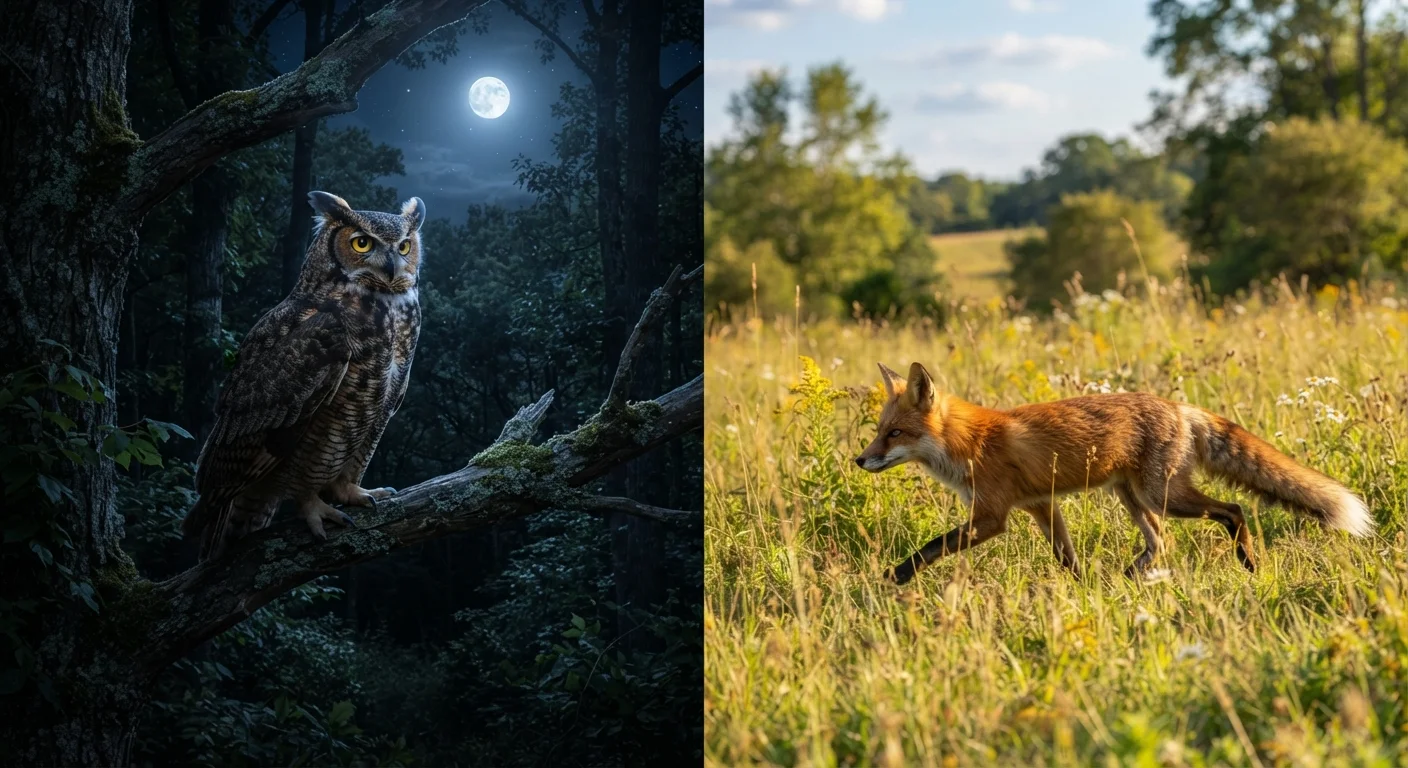
Photo: CoralScripts.com | Explore, Discover, Engage editorial
—— In This Article
Key Takeaways
- Circadian rhythms — internal biological clocks — are the foundation of both nocturnal and diurnal activity patterns.
- Nocturnal animals typically possess enlarged eyes, heightened hearing, or acute olfaction to compensate for low-light conditions.
- Diurnal species often rely on color vision and visual social signals, advantages that vanish in darkness.
- Activity timing is an evolutionary strategy: separating competitors and predators across the day reduces direct conflict.
- Some species are crepuscular or cathemeral, blurring the boundary between night and day activity.
- Light pollution is reshaping the behavior of both groups, with measurable ecological consequences.
The Biological Clock Behind Activity Timing
Every animal — whether a barn owl hunting at midnight or a chimpanzee foraging at noon — operates on a circadian rhythm, an internal biological clock cycling roughly every 24 hours. These clocks are synchronized primarily by light, specifically the detection of blue-spectrum wavelengths by specialized photoreceptive cells. In vertebrates, the suprachiasmatic nucleus (SCN) in the hypothalamus serves as the master pacemaker, coordinating hormone release, body temperature, and metabolic rate to align with an animal's expected period of activity.
The designation of an animal as nocturnal or diurnal is therefore not merely behavioral — it is deeply physiological. Melatonin, a hormone produced in the pineal gland, rises at night and suppresses activity in diurnal species while triggering alertness in nocturnal ones. This hormonal inversion means the same environmental cue — darkness — produces opposite behavioral responses depending on an animal's evolutionary heritage.
Understanding these rhythms is inseparable from understanding seasonal behavior. As explored in our piece on migration, hibernation, and seasonal instincts, the same light-detecting machinery that separates day from night also helps animals track the lengthening and shortening of days across seasons — a process called photoperiodism.
| Criterion | Nocturnal Animals | Diurnal Animals |
|---|---|---|
| Primary activity period | Night (darkness) | Day (daylight) |
| Dominant retinal cells | Rods (low-light sensitivity) | Cones (color, detail) |
| Color vision | Rare or absent | Common; often trichromatic |
| Non-visual senses | Highly developed (hearing, smell, echolocation) | Moderate; vision dominant |
| Typical social structure | Solitary or small groups | Often large, coordinated groups |
| Tapetum lucidum (eye shine) | Present in many species | Generally absent |
| Melatonin effect | Triggers alertness | Suppresses activity |
| Light pollution vulnerability | High | Moderate (indirect effects) |
Sensory Adaptations: Two Very Different Toolkits
The most striking differences between nocturnal and diurnal animals are sensory. Each strategy demands a specific suite of perceptual tools shaped by millions of years of selection pressure.
Nocturnal Sensory Specializations
Low-light vision is the signature adaptation. Many nocturnal mammals and birds possess a tapetum lucidum — a reflective layer behind the retina that bounces light back through photoreceptors, effectively doubling the eye's sensitivity. Their retinas are also rod-dominant; rods detect dim light but cannot distinguish color, which is why the nocturnal world is largely monochromatic. Tarsiers take this further with eyes so large relative to body size they are physically fixed in the skull, requiring a near-360-degree neck rotation to compensate.
Where vision reaches its limits, other senses fill the gap. Bats use echolocation — emitting ultrasonic pulses and interpreting the returning echoes — to navigate and catch insects in total darkness with extraordinary precision. Many nocturnal mammals, including foxes and raccoons, rely heavily on olfaction, possessing olfactory epithelium surface areas many times larger than those of comparably sized diurnal species.
Diurnal Sensory Specializations
Diurnal animals, particularly birds and primates, frequently possess trichromatic or even tetrachromatic color vision — seeing the world in hues that are invisible to most nocturnal competitors. Raptors like red-tailed hawks have retinal cone densities roughly five times higher than humans, producing visual acuity that allows prey detection from hundreds of meters. Color vision enables complex social communication: the vivid plumage of birds-of-paradise, the facial flushing of mandrills, and the threat displays of many lizards are all predicated on receivers who can see and interpret color accurately.
~70%
Mammal species that are nocturnal
Estimates from comparative mammalogy research suggest the majority of mammal species are primarily nocturnal, a legacy of early mammalian evolution under dinosaur predation pressure.
5×
Raptor cone density vs. human retina
Studies of avian retinal anatomy indicate birds of prey have roughly five times more cone photoreceptors per unit area than the human fovea, enabling exceptional daylight acuity.
100×
Sensitivity advantage of the tapetum lucidum
The reflective tapetum lucidum layer in nocturnal vertebrates can increase light capture by up to 100 times compared to eyes without this structure, according to comparative ophthalmology research.
These divergent sensory architectures also shape vulnerability. A nocturnal animal caught in broad daylight is often compromised — its rod-heavy retina overwhelmed, its behavioral repertoire misaligned. The reverse is equally true, which is why misreading animal behaviour is so common when humans observe species outside their natural activity window.
Ecological Logic: Why Splitting the Day Works
From an evolutionary standpoint, the nocturnal-diurnal divide is as much about avoiding conflict as exploiting resources. Temporal niche partitioning — the separation of competing species across time rather than space — reduces direct competition for food, mates, and territory without requiring geographic separation.
In African savannas, lions hunt most effectively at night, while cheetahs depend on daylight for the visual precision their high-speed pursuit demands. Both are large felid predators occupying the same landscape, but their temporal separation substantially reduces direct contest. Similarly, many owl species take over the aerial insectivory niche vacated by swallows and swifts at dusk — the same prey, the same airspace, but a different clock.
This temporal layering means ecosystems are rarely idle. A coral reef, for example, sees a dramatic species turnover at dawn and dusk as diurnal fish retreat to shelter and nocturnal species — moray eels, basket stars, many crustaceans — emerge to forage. These transitions, sometimes called crepuscular windows, represent the highest-risk moments for many prey species, which is why a distinct third category — crepuscular animals, active primarily at dawn and dusk — exists and is often overlooked.
For deeper context on how habitat shapes these survival pressures, see our comparison of rainforest vs. savanna ecosystems, where light penetration, canopy structure, and predator communities create vastly different selective environments for nocturnal and diurnal strategies alike.
The Cathemeral Exception
Not every animal fits neatly into nocturnal or diurnal categories. Cathemeral species — such as some lemurs, fossa, and lions under certain conditions — distribute activity irregularly across both day and night. Their patterns often shift with season, prey availability, or human disturbance, making them useful indicators of environmental pressure on fixed activity rhythms.
Activity timing also intersects with social structure. Diurnal species are far more likely to live in large, coordinated groups — a pattern explored thoroughly in solitary vs. social animal behavior. Sustained group coordination depends on visual signaling, which is compromised in darkness, nudging nocturnal species toward more solitary or small-group arrangements.
Light Pollution: A Modern Disruption
The nocturnal-diurnal divide, stable for hundreds of millions of years, is now under pressure from an entirely novel force: artificial light at night (ALAN). Research published in peer-reviewed ecology journals documents measurable shifts in foraging behavior, reproductive timing, and predator-prey dynamics in species ranging from insects to large mammals.
Nocturnal animals bear a disproportionate burden. Artificial lighting suppresses melatonin production, delays activity onset, and can render previously safe dark zones functionally inhospitable. Sea turtle hatchlings, which navigate by the brightness of the ocean horizon, are fatally disoriented by coastal lighting. Migratory birds, which use star patterns for orientation, collide with illuminated structures at enormous scale. Even the seemingly minor extension of ambient light into forest edges compresses the effective habitat of light-sensitive nocturnal species.
Diurnal species are not immune. Altered insect availability — because nocturnal insects are drawn to and killed by artificial lights — cascades upward, reducing prey for insectivorous bats and birds alike. Dawn chorus timing in songbirds has shifted measurably earlier in urban environments with high light pollution, with downstream effects on territory establishment and mate selection.
The complexity of these interactions reinforces why the nocturnal-diurnal framework matters beyond taxonomy. It is a lens through which light itself — as both resource and constraint — organizes the entire architecture of animal life. Understanding it is foundational to animal behavior science more broadly, and increasingly, to conservation practice.

Pets & Animal Life Editorial Team
Pets & Animal Life Editorial Team is the collective byline for our editorial team and contributor network. Articles published under this byline or an editorial pen name are researched, written, and reviewed according to our editorial standards for clarity, consistency, and independence before publication.
View author profile