
Petrol, Diesel, Hybrid, and Electric: How Each Powertrain Works
A clear breakdown of how petrol, diesel, hybrid, and electric powertrains differ in operation, efficiency, and everyday driving experience.
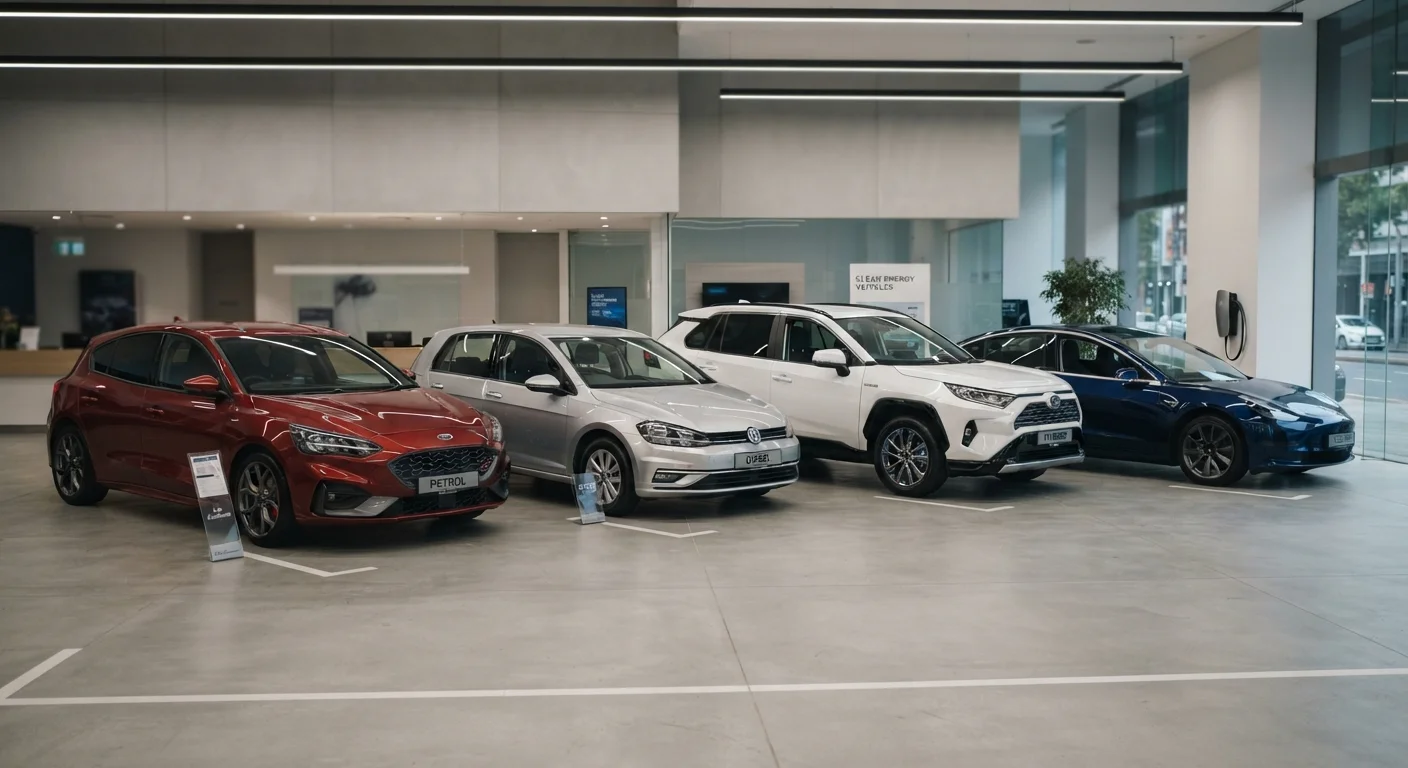
Photo: CoralScripts.com | Explore, Discover, Engage editorial
—— In This Article
Key Takeaways
- Petrol engines rely on spark ignition and excel at high-revving performance, but are less fuel-efficient than diesel at steady highway speeds.
- Diesel engines use compression ignition, delivering more torque and better fuel economy for long-distance and towing applications.
- Hybrid systems combine an internal combustion engine with an electric motor, recapturing braking energy to improve city fuel economy.
- Battery electric vehicles (BEVs) use no combustion at all, delivering instant torque and zero tailpipe emissions but require charging infrastructure.
- Maintenance requirements and running costs differ significantly across all four powertrain types.
How Petrol Engines Generate Power
A petrol (gasoline) engine is an internal combustion engine (ICE) that uses spark ignition. Fuel and air are drawn into a cylinder, compressed by a rising piston, then ignited by a spark plug. The resulting combustion forces the piston downward, converting chemical energy into mechanical rotation through the crankshaft. For a more detailed look at what's happening inside, see our guide to the anatomy of a car engine.
Petrol engines typically operate at higher RPM (revolutions per minute) than diesel units, which shapes their power delivery - peaking at mid-to-high revs. This makes them responsive for overtaking and sporty driving but less efficient at sustained low-speed loads. Modern designs incorporate direct fuel injection, variable valve timing, and turbocharging to extend efficiency across a broader RPM range. Oil quality matters significantly in these engines; synthetic versus conventional oil choices can meaningfully affect wear protection under high-heat, high-rev conditions.
How Diesel Engines Differ in Operation
Diesel engines also use the four-stroke combustion cycle - intake, compression, power, exhaust - but there is no spark plug. Instead, air alone is compressed to a much higher ratio (typically 14:1 to 25:1, versus 8:1 to 12:1 for petrol), raising its temperature enough to ignite diesel fuel injected directly into the cylinder. This compression ignition process is more thermally efficient and extracts more energy per unit of fuel.
The practical result is a higher torque output at lower RPM, which is why diesel engines are favored for trucks, SUVs towing trailers, and vehicles covering high annual mileage on motorways. Fuel consumption at steady highway speeds is generally lower than an equivalent petrol engine. The trade-off includes greater mechanical complexity in modern emissions control systems - DPFs and SCR systems add maintenance considerations, and short-trip city driving can cause DPF blockages if the filter never reaches regeneration temperature.
| Petrol | Diesel | Hybrid (HEV) | Electric (BEV) | |
|---|---|---|---|---|
| Ignition method | Spark ignition | Compression ignition | Spark ignition + electric motor | No combustion |
| Torque delivery | High RPM peak | Strong at low RPM | Assisted at low speeds | Maximum from 0 RPM |
| Fuel/energy source | Gasoline | Diesel fuel | Gasoline + regenerated electricity | Grid electricity |
| Tailpipe emissions | CO₂ + NOx | CO₂ + higher NOx/PM | Lower CO₂ than ICE alone | Zero tailpipe emissions |
| City fuel efficiency | Moderate | Lower (DPF risk) | High (regenerative braking) | Highest |
| Highway efficiency | Good | Best among ICE types | Good | Reduced at high speeds |
| Maintenance complexity | Moderate | Higher (DPF, AdBlue) | Moderate | Lower (fewer moving parts) |
| Refuel/recharge time | ~5 minutes | ~5 minutes | ~5 minutes (PHEV: hours to charge) | 30 min-12+ hours |
Hybrid Systems: Bridging Combustion and Electric Drive
Hybrid vehicles integrate an internal combustion engine with one or more electric motors and a battery pack. The defining feature is regenerative braking - kinetic energy that would otherwise be lost as heat during deceleration is captured by the motor acting as a generator, storing electricity in the battery. That stored energy is then used to assist the ICE during acceleration or to power the vehicle at low speeds.
There are several hybrid configurations worth distinguishing:
- Full hybrid (HEV): Can drive on electric power alone for short distances at low speeds. The battery recharges entirely through regenerative braking and the engine - no plug required.
- Plug-in hybrid (PHEV): Carries a larger battery that can be charged from an external power source, enabling longer electric-only range (typically 20-50 miles depending on the model).
- Mild hybrid (MHEV): The electric motor assists the engine but cannot drive the wheels independently. Primarily reduces load on the engine during acceleration and recovers braking energy.
Hybrids are particularly well-suited to stop-and-go city traffic, where regenerative braking delivers the greatest efficiency gains. For a clear explanation of the terminology involved, our automotive terminology guide covers regenerative braking and related concepts in depth.
Maximising Hybrid Efficiency in Daily Use
Hybrids return their best efficiency in stop-and-go traffic where regenerative braking has frequent opportunities to recover energy. Gentle, progressive braking maximises the energy captured by the motor-generator. Sustained motorway driving at high speeds reduces the hybrid system's advantage, as the electric motor contributes less and the ICE carries most of the load.
Battery Electric Vehicles: No Combustion Required
A battery electric vehicle (BEV) stores energy in a large high-voltage lithium-ion battery pack and drives the wheels using one or more electric motors. There is no combustion cycle, no fuel tank, and no exhaust system. Electric motors deliver maximum torque from zero RPM, which accounts for the rapid acceleration characteristic of EVs regardless of vehicle class.
Energy efficiency in a BEV is substantially higher than any combustion architecture - electric drivetrains convert roughly 85-90% of stored energy into wheel motion, compared to roughly 20-40% for internal combustion engines. However, the total range available is governed by battery capacity (measured in kilowatt-hours), ambient temperature, driving speed, and accessory load. Cold weather in particular reduces usable range because lithium-ion cells deliver less power at low temperatures and cabin heating draws from the same battery.
Charging infrastructure and home charging capability are practical considerations that don't apply to combustion vehicles. Understanding battery health and electrical systems becomes directly relevant to EV ownership, as high-voltage pack longevity depends on charging habits and thermal management.
Understanding how torque and horsepower figures apply to electric motors also requires some recalibration - our explainer on torque vs. horsepower provides useful context for reading EV spec sheets accurately.
85-90%
Electric drivetrain energy efficiency
Electric motors convert approximately 85-90% of stored battery energy into motion, compared to roughly 20-40% for internal combustion engines.
25:1
Maximum diesel compression ratio
Diesel engines can use compression ratios up to approximately 25:1, compared to 8:1-12:1 for typical petrol engines, enabling compression ignition without a spark plug.
Maintenance and Running Cost Differences
Powertrain choice directly shapes what a vehicle needs over its service life. Petrol engines require regular oil and filter changes, spark plug replacement, and coolant maintenance. Diesel engines share most of those needs but add DPF monitoring, injector care, and periodic AdBlue (DEF) top-ups on SCR-equipped vehicles.
Hybrids broadly follow ICE maintenance schedules for their combustion components, though the electric motor and regenerative braking system reduce wear on conventional brake components - brake pad longevity is often noticeably extended in hybrid and electric vehicles. The high-voltage battery pack requires no routine servicing but degrades gradually over time.
BEVs have the fewest mechanical wear components - no oil changes, no spark plugs, no exhaust system - but electrical system health and tyre wear become proportionally more important. Heavier battery packs and instant torque delivery can accelerate tyre wear faster than comparable combustion vehicles. Drive layout also interacts with these dynamics; understanding FWD, RWD, and AWD differences helps explain why powertrain and drivetrain choices often go hand in hand.

Cars & Driving Editorial Team
Cars & Driving Editorial Team is the collective byline for our editorial team and contributor network. Articles published under this byline or an editorial pen name are researched, written, and reviewed according to our editorial standards for clarity, consistency, and independence before publication.
View author profile