
The Anatomy of a Car Engine
From pistons to camshafts, explore the key components inside a combustion engine and understand what each one does.
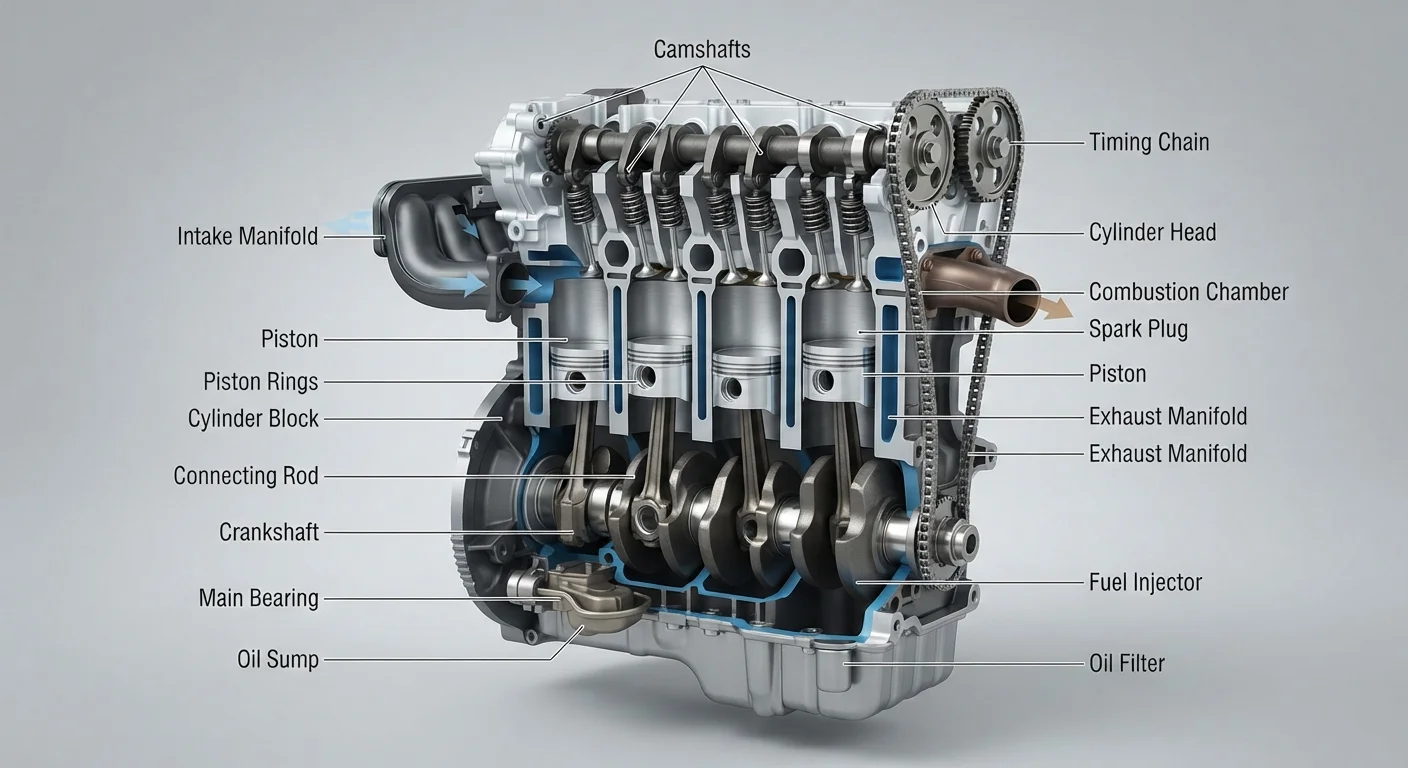
Photo: CoralScripts.com | Explore, Discover, Engage editorial
—— In This Article
Key Takeaways
- A four-stroke cycle - intake, compression, power, exhaust - repeats thousands of times per minute inside every cylinder.
- The crankshaft converts the up-and-down piston motion into the rotational force that ultimately drives the wheels.
- Camshaft timing controls exactly when valves open and close, directly affecting engine output and efficiency.
- Engine displacement, cylinder count, and configuration all influence how power and torque are delivered.
- Lubrication and cooling systems are as critical to engine longevity as any mechanical component.
How a Combustion Engine Works: The Big Picture
The internal combustion engine (ICE) is built around one deceptively simple idea: burn fuel inside a sealed chamber, harness the expanding gases, and convert that energy into rotational motion. Every mechanical component in the engine exists to make that process repeatable, efficient, and controllable - tens of thousands of times per hour.
The foundational sequence is the four-stroke cycle, often called the Otto cycle after engineer Nikolaus Otto. Each cylinder completes four distinct piston strokes: intake (air and fuel enter), compression (the mixture is squeezed), power (the spark plug ignites the mixture, forcing the piston down), and exhaust (spent gases exit). This cycle governs petrol engines almost universally; diesel engines follow the same strokes but rely on heat from compression rather than a spark plug to ignite the fuel. For a broader comparison of how these designs differ in practice, see our guide on petrol, diesel, hybrid, and electric powertrains.
4,000-7,000
Typical RPM range for a passenger car engine
At 6,000 rpm, each cylinder in a four-cylinder engine completes the full four-stroke cycle 3,000 times per minute.
~30%
Thermal efficiency of a typical petrol engine
Most of the energy in the fuel is lost as heat; advanced diesel and hybrid systems can push efficiency closer to 40-45% under optimal conditions.
2,000°C+
Peak combustion temperature inside a cylinder
Engineering challenges at these temperatures drive material choices from aluminum alloys to ceramic-coated pistons in high-performance applications.
The Engine Block and Cylinder Configuration
The engine block - typically cast from iron or aluminum alloy - is the structural foundation of the entire assembly. Machined into it are the cylinders, the hollow bores within which pistons travel. The number and arrangement of those cylinders define much of an engine's character.
- Inline (I): Cylinders arranged in a single row. The inline-four (I4) is the most common configuration in passenger cars worldwide, balancing compactness with smooth power delivery.
- V-configuration: Cylinders split into two banks set at an angle (commonly 60° or 90°). A V6 or V8 delivers more displacement in a shorter block length, making it well-suited to rear-wheel-drive platforms.
- Flat (Boxer): Cylinders lie horizontally opposed on either side of the crankshaft. This lowers the center of gravity - a meaningful handling advantage.
- W-configuration: Two narrow-angle V banks merged, allowing very high cylinder counts in a compact footprint.
Displacement - measured in liters or cubic centimeters - describes the total swept volume of all cylinders combined. It is one of the most commonly cited engine specifications, though it alone does not determine power output.
Pistons, Connecting Rods, and the Crankshaft
The piston is a cylindrical slug, typically forged or cast from aluminum alloy, that slides up and down inside the cylinder bore. Piston rings seal the combustion chamber above and scrape oil from the cylinder walls below - maintaining compression while controlling lubrication.
Each piston connects to the crankshaft via a connecting rod (conrod). The conrod's upper end (small end) attaches to the piston pin; its lower end (big end) clamps around a crankshaft journal. As combustion forces the piston downward, the conrod translates that linear thrust into a rotational torque on the crankshaft - exactly as your leg pushing down on a bicycle pedal turns the crank. The crankshaft itself is a precision-balanced, hardened steel shaft with offset journals (called crank throws) timed to fire cylinders in a sequence that minimizes vibration.
When evaluating engine condition in a used vehicle, ask for a compression test result. Uneven compression between cylinders is one of the earliest indicators of worn piston rings or valve-seat deterioration - problems that external visual inspection will never reveal.
Compression readings provide a direct measure of the sealing integrity of the combustion chamber, making them far more diagnostic than listening for noise or checking for smoke alone.
If your engine develops a rhythmic ticking at idle that quickens with engine speed, don't assume it's always valve lash. On engines with variable valve timing, a worn VVT actuator or low oil pressure reaching the phaser can produce an almost identical sound - and the fix is entirely different.
Misdiagnosing VVT actuator noise as a simple valve adjustment wastes time and money; oil pressure and VVT solenoid operation should be checked first.
At the rear of the crankshaft sits the flywheel, a heavy rotating disc that stores rotational energy to smooth out the pulses between power strokes and provides the interface for the clutch or torque converter.
The Valvetrain: Camshafts, Valves, and Timing
Each cylinder needs precisely timed openings to admit the air-fuel charge and expel exhaust gases. This is the job of the valvetrain. Intake valves open to let the mixture in; exhaust valves open to let combustion gases out. Both are held shut by stiff valve springs and opened by the lobes of a camshaft.
The camshaft - driven by the crankshaft via a timing belt, chain, or gear set at exactly half crankshaft speed - rotates and its egg-shaped lobes push against the valves (directly or through intermediate components such as rocker arms or followers). Overhead camshaft designs (OHC) place the cam above the valves in the cylinder head, reducing reciprocating mass and allowing higher engine speeds. Dual overhead cams (DOHC) use separate camshafts for intake and exhaust, enabling more precise independent tuning of each.
Many modern engines feature variable valve timing (VVT) systems that alter the phase relationship between the camshaft and crankshaft under electronic control, optimizing valve events for low-end torque or high-rpm power depending on conditions. This is a key reason modern smaller-displacement engines can rival the output of older, larger units.
Interference vs. Non-Interference Engines
Engines are classified as interference or non-interference based on whether the piston and valve paths physically overlap at any point in their travel. In an interference engine, a broken timing belt will almost certainly cause piston-to-valve contact - an expensive internal failure. Non-interference designs have geometric clearance that prevents contact even if timing is lost. Check your owner's manual or a reputable service guide to determine which type your engine is before evaluating maintenance priority.
For a glossary of related terms - from compression ratio to valve lift - the automotive terminology guide is a useful companion reference.
Supporting Systems: Lubrication, Cooling, and Fuel Delivery
The mechanical components described above depend on three essential support systems to survive the extreme conditions inside a running engine.
Lubrication
The oil pump draws engine oil from the sump (oil pan) and forces it under pressure through galleries machined into the block and head, reaching crankshaft bearings, camshaft journals, and valve gear. A thin, continuous film of oil prevents direct metal-to-metal contact. Oil also carries heat away from components the coolant circuit cannot directly reach. This is why oil condition - viscosity grade, contamination, and service interval - directly determines long-term engine health. The car maintenance hub covers oil service schedules and specifications in detail.
Cooling
Combustion temperatures can briefly exceed 2,000 °C (3,600 °F). The cooling system circulates a water-glycol coolant mixture through passages in the block and head, absorbing heat and transferring it to the radiator, where airflow dissipates it. A thermostat regulates coolant flow to help the engine reach and maintain its optimal operating temperature.
Fuel and Air Delivery
Modern engines use direct injection or port injection (or both) to atomize fuel precisely into the combustion chamber or intake port. The throttle body controls airflow volume in response to accelerator input, while sensors for airflow, oxygen content, and temperature feed data to the engine control unit (ECU), which calculates and commands injection timing, duration, and ignition advance in real time.
Check Oil Before Long Trips
A quick dipstick check before any long journey takes under two minutes and can prevent the kind of oil starvation that damages bearing surfaces in minutes of running. Keep the level between the minimum and maximum marks, and note the oil's color - jet black oil in a petrol engine that hasn't reached its change interval can signal blow-by from worn rings. If in doubt, have a qualified mechanic assess the engine.
How Engine Design Affects Performance and Efficiency
Understanding the anatomy of an engine makes the specification sheet on any vehicle far more meaningful. Compression ratio - the ratio of cylinder volume at bottom dead center to volume at top dead center - is a key indicator: higher ratios extract more energy from each combustion event but require higher-octane fuel to prevent premature detonation (knock). Turbocharged engines use a turbocharger, an exhaust-driven compressor, to force more air into the cylinders, effectively increasing power density without enlarging displacement.
Engine architecture also leaves a fingerprint in motorsport. The flat-plane crankshaft common in high-revving V8 racing engines produces a distinctive exhaust note and allows faster throttle response - a direct result of reduced reciprocating mass. Those engineering philosophies flow from the track to the road, as explored in our piece on how motorsport heritage shapes road cars.
As electrification advances, the internal combustion engine increasingly appears as one element within a hybrid powertrain rather than the sole source of motivation. Even so, the core mechanical principles described here remain central to understanding how modern vehicles generate, manage, and deliver power.
The Engine Is One Part of a Larger System
The engine produces power, but it works alongside the transmission, driveshaft, differentials, and wheels to actually move the vehicle. Understanding how engines function is most useful when combined with knowledge of the full powertrain. Our overview of petrol, diesel, hybrid, and electric powertrains explains how different engine types integrate with the rest of the drivetrain.

Cars & Driving Editorial Team
Cars & Driving Editorial Team is the collective byline for our editorial team and contributor network. Articles published under this byline or an editorial pen name are researched, written, and reviewed according to our editorial standards for clarity, consistency, and independence before publication.
View author profile