
Front-Wheel, Rear-Wheel, and All-Wheel Drive: What Changes Behind the Wheel
Drive layout shapes how a car handles, accelerates, and responds in different conditions. Here's what distinguishes FWD, RWD, and AWD.
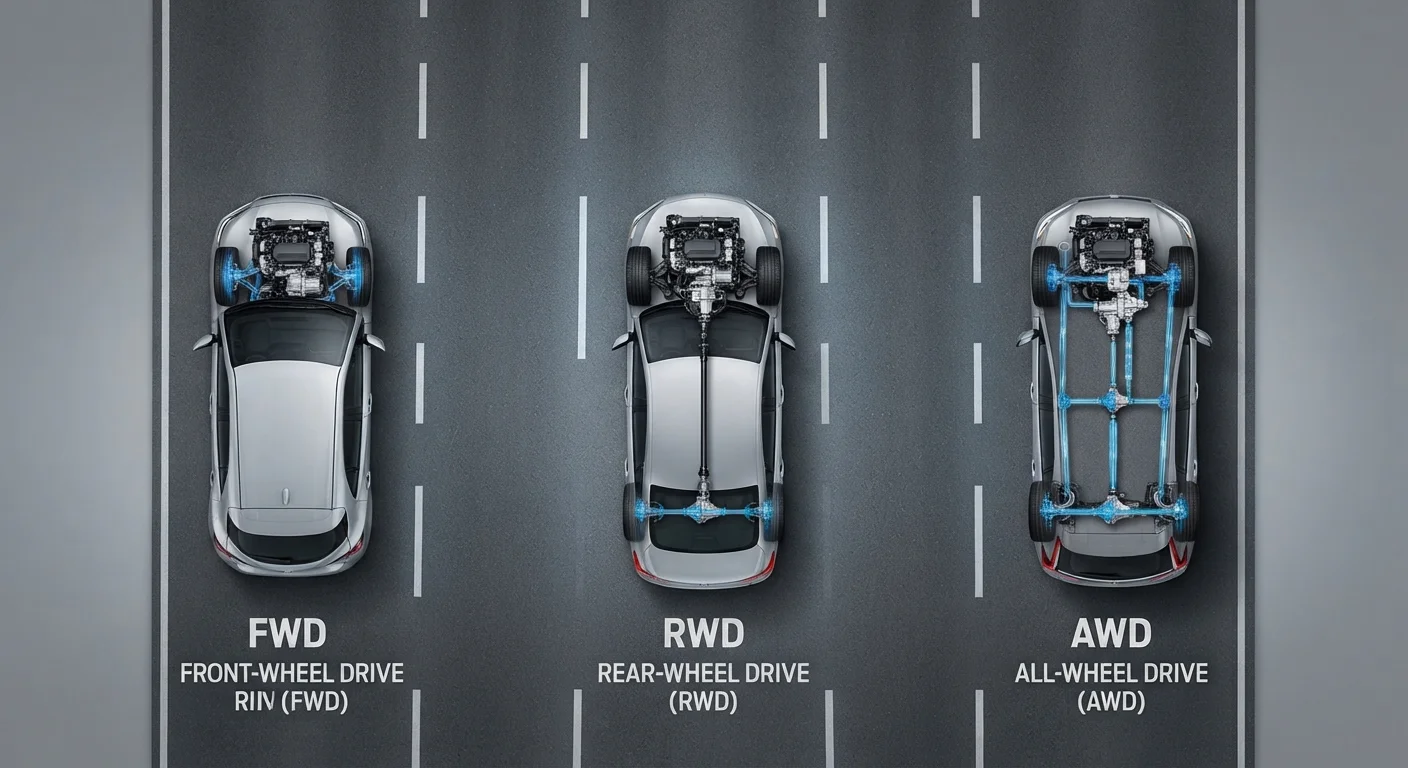
Photo: CoralScripts.com | Explore, Discover, Engage editorial
—— In This Article
Key Takeaways
- Front-wheel drive consolidates power and steering into the front axle, improving packaging efficiency and wet-weather traction at low speed.
- Rear-wheel drive separates acceleration and steering duties, enabling more balanced weight distribution and sharper handling dynamics.
- All-wheel drive distributes torque across multiple wheels simultaneously, improving grip in slippery or off-road conditions at the cost of added weight and complexity.
- No single drive layout is universally superior - the right choice depends on driving environment, vehicle type, and intended use.
Why Drive Layout Matters More Than You Might Think
A vehicle's drive layout - meaning which wheels receive engine torque - fundamentally shapes how it accelerates, corners, recovers from slides, and behaves at the limits of grip. It's one of the earliest and most consequential decisions engineers make during platform development, influencing weight distribution, component packaging, suspension geometry, and even fuel economy.
For drivers, understanding this distinction goes well beyond badge-shopping. It explains why a front-wheel-drive compact sedan understeers in a tight corner, why a rear-wheel-drive sports car can break traction more dramatically under hard acceleration, and why an all-wheel-drive crossover feels so planted on a snow-covered highway. These aren't just feel differences - they reflect real physics. For a solid grounding in the terminology involved, see our automotive terminology guide.
| Front-Wheel Drive | Rear-Wheel Drive | All-Wheel Drive | |
|---|---|---|---|
| Torque delivery | Front axle only | Rear axle only | All four wheels |
| Handling character | Tends to understeer | Can oversteer at limits | Generally neutral to understeer |
| Wet/snow traction | Good at low speeds | Reduced; requires skill | Strongest across conditions |
| Fuel economy impact | Most efficient | Moderate | Modest penalty vs. FWD |
| Mechanical complexity | Lowest | Moderate | Highest |
| Typical applications | Compact cars, sedans | Sports cars, trucks, performance vehicles | Crossovers, SUVs, performance sedans |
| Weight distribution | Front-heavy typical | Near 50/50 achievable | Varies by platform |
Front-Wheel Drive: Efficiency and Simplicity
Front-wheel drive (FWD) routes engine power to the front axle, which also handles steering. The engine, transmission, and differential are consolidated into a compact transverse package under the hood, freeing up cabin and cargo space while reducing drivetrain weight.
The practical advantages are considerable. FWD vehicles tend to be lighter, more fuel-efficient, and mechanically simpler than their RWD or AWD counterparts. Because the driven wheels carry the weight of the engine directly above them, FWD also provides useful traction when accelerating from a stop on wet or lightly snow-covered surfaces.
The limitation shows up at higher speeds and in dynamic cornering. When a FWD vehicle is pushed near its grip limits, the front tires are simultaneously asked to steer, transmit power, and generate cornering force - a condition called torque steer at lower speeds and understeer in tight corners. Understeer means the front of the car wants to push wide rather than follow the intended line, which is why performance-focused vehicles rarely use FWD layouts.
Managing FWD Understeer on the Road
If a front-wheel-drive car starts to push wide in a corner, the instinctive response of adding more steering lock often makes it worse. Easing off the throttle allows weight to shift forward, restoring front-tire grip and helping the car follow the intended line. Smooth, progressive inputs matter significantly more in FWD vehicles than in RWD platforms.
Rear-Wheel Drive: Balance and Driver Engagement
Rear-wheel drive (RWD) sends engine torque to the rear axle, leaving the front wheels responsible solely for steering. This division of labor allows engineers to optimize each axle independently - front tires for steering response, rear tires for traction and acceleration.
The result is a more neutral weight distribution (typically near 50/50 front-to-rear on purpose-built platforms) and a more intuitive handling balance. When a RWD vehicle approaches its limits, it tends to oversteer - meaning the rear steps out before the front loses grip. Experienced drivers can use throttle input to manage or control this, which is why RWD dominates in performance cars, track vehicles, and vehicles where driving engagement is a priority.
The trade-off is real-world vulnerability on slippery surfaces. Without the weight of the engine above the drive wheels, a RWD vehicle can break rear traction easily during hard acceleration on ice or snow, and recovery requires more active driver skill. RWD also typically requires a longer driveshaft running to the rear axle, which modestly reduces interior packaging efficiency. For a deeper look at how the suspension works alongside these layouts, see our guide on understanding your car's suspension system.
All-Wheel Drive: Breadth of Capability
All-wheel drive (AWD) distributes engine torque to all four wheels - either continuously or on demand - through a center differential or electronically controlled coupling. The key distinction from four-wheel drive (4WD) is that most AWD systems operate automatically without driver input and are optimized for on-road traction rather than extreme off-road use.
AWD's defining advantage is its ability to redistribute torque toward whichever wheels have the most available grip. On a snow-covered or rain-soaked surface, this translates to confident acceleration and stability that neither FWD nor RWD can fully match. Modern AWD systems - particularly those using electronically controlled multi-plate clutches - can react in milliseconds to changing conditions, often faster than a driver can consciously respond.
The costs are weight, mechanical complexity, and a modest fuel economy penalty compared to single-axle layouts. AWD also does not shorten braking distances - a critical point many drivers overlook. A vehicle with AWD can accelerate more confidently on ice, but it still stops with the same four tires as a FWD or RWD car. Overconfidence in AWD during winter driving is a documented contributor to accidents. The way these systems integrate with modern electronics is explored further in our article on modern driver-assistance systems.
~3-5%
Fuel economy penalty for AWD vs. FWD
U.S. EPA data consistently shows AWD variants of the same model consume modestly more fuel than their FWD equivalents across combined driving cycles.
0 ft
AWD advantage in braking distance
AWD improves acceleration traction but does not reduce stopping distances - braking performance depends on tire compound and ABS calibration, not drive layout.
Choosing Based on Real-World Conditions and Use
The most appropriate drive layout depends on where and how you drive. FWD is well-suited for drivers in mild climates who prioritize fuel economy and practicality. RWD is the engineers' choice for vehicles where chassis balance and driver feedback are paramount - performance sedans, sports cars, and many trucks and body-on-frame SUVs use RWD as a base. AWD justifies its cost premium for drivers in consistently snowy regions, those who cover significant off-pavement mileage, or anyone who regularly carries heavy loads in variable conditions.
Understanding powertrain type also overlaps meaningfully with drive layout choices. Electric vehicles, for instance, often use dual-motor AWD setups that behave differently from traditional mechanical AWD - and all-electric systems allow torque vectoring with a precision that mechanical differentials cannot match. For context on how powertrains interact with drive layouts, our piece on petrol, diesel, hybrid, and electric powertrains covers this terrain in depth.
Drive layout is not a quality indicator - it is an engineering tool. Understanding the trade-offs each layout entails will help you interpret how your current vehicle behaves and make a more informed assessment the next time you're evaluating a different platform.
AWD Does Not Eliminate Winter Risk
All-wheel drive is frequently misunderstood as a comprehensive winter safety system. It improves acceleration traction on slippery surfaces but provides no advantage during braking or cornering at the limits of grip. Winter or all-season tires rated for snow conditions have a far greater impact on cold-weather stopping distances than drive layout. Adjust your speed and following distance accordingly regardless of what your drivetrain configuration is.

Cars & Driving Editorial Team
Cars & Driving Editorial Team is the collective byline for our editorial team and contributor network. Articles published under this byline or an editorial pen name are researched, written, and reviewed according to our editorial standards for clarity, consistency, and independence before publication.
View author profile