
Retirement Villages vs. Aging in Place: Weighing Two Very Different Paths
A side-by-side look at moving into a retirement village versus staying in your own home as you age, covering community, cost, and lifestyle factors.
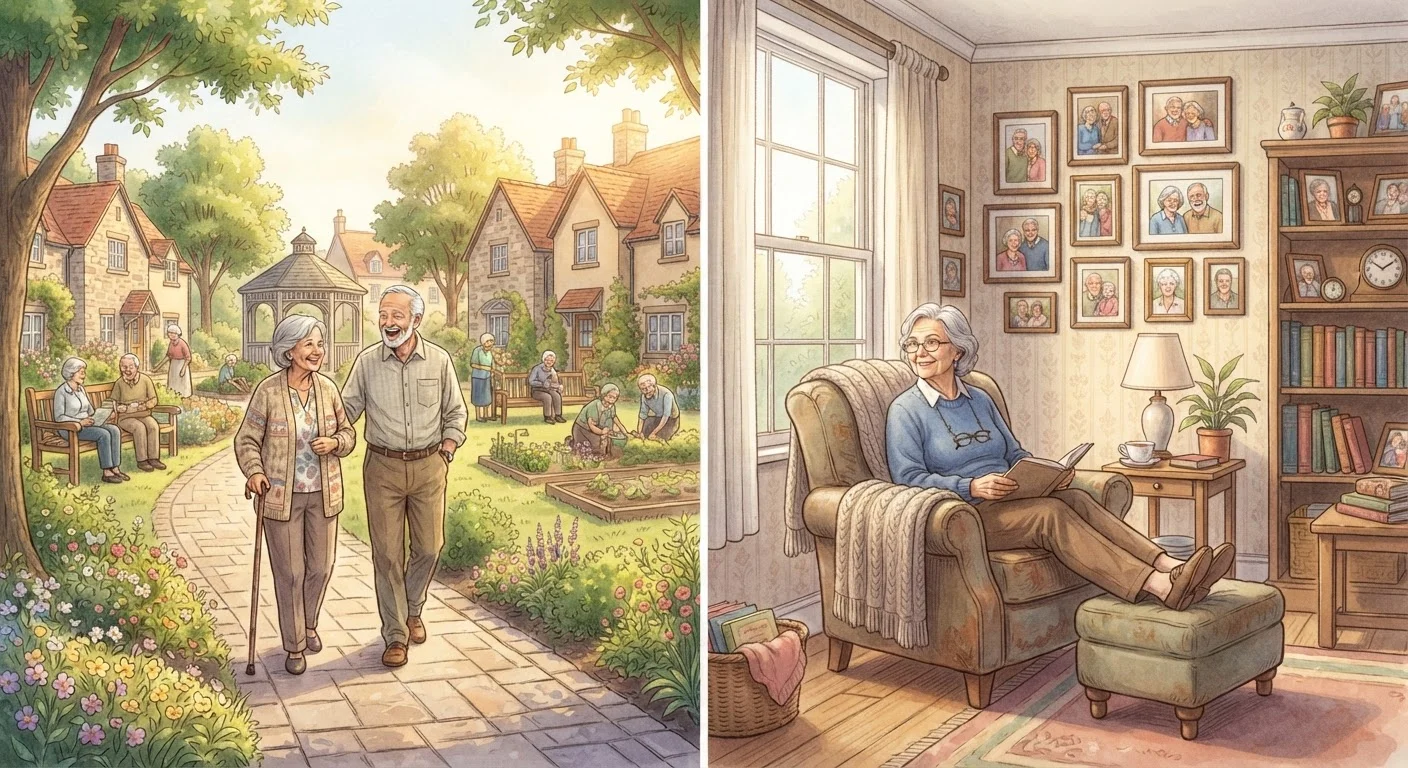
Photo: CoralScripts.com | Explore, Discover, Engage editorial
—— In This Article
Key Takeaways
- Retirement villages offer structured social life and on-site services, but involve significant financial and logistical commitment.
- Aging in place preserves independence and familiar surroundings, but may require proactive planning for care and isolation risks.
- Cost comparisons between the two paths are complex and highly individual - neither is universally cheaper.
- Social connection is achievable in both models, including through online senior communities that complement either choice.
- Home modifications and community support services can meaningfully extend the viability of aging in place.
- There is no one-size-fits-all answer - health trajectory, finances, and personal values all shape the right decision.
Understanding What Each Path Actually Means
The phrase "retirement village" covers a wide spectrum. Some are independent living communities centered on lifestyle and leisure; others are continuing care campuses that can support residents through significant health changes. To understand how these models differ in detail, explore the full landscape of senior living arrangements.
Aging in place, meanwhile, means remaining in your own home - not simply staying put passively, but actively adapting your environment and support network as needs evolve. This might involve home modifications like grab bars and ramp access, arranging transportation help, or coordinating in-home care. It's a more self-directed model, which is both its strength and its challenge.
| Criterion | Retirement Village | Aging in Place |
|---|---|---|
| Social environment | Built-in peer community, organized activities | Existing networks; requires active maintenance |
| Home familiarity | New environment; takes time to feel like home | Deep familiarity; strong sense of place |
| Upfront financial commitment | Often high - entry fees, moving costs | Lower disruption; modification costs vary |
| Ongoing care access | On-site or adjacent care services | Must be arranged independently |
| Maintenance burden | Typically handled by the community | Homeowner remains responsible |
| Autonomy and control | Community rules and shared spaces apply | Full control over home and routine |
| Adaptability to health changes | Many villages offer care continuity | Requires proactive planning and coordination |
Neither path is static. A retirement village resident still makes daily choices about how they engage. Someone aging in place can build rich community connections through local senior centers, neighbors, or online senior communities that offer real social and wellbeing value. The choice of physical setting does not determine how connected or fulfilled your later years will be.
Cost, Care, and Practical Realities
Cost is one of the first questions families ask - and also one of the hardest to answer cleanly. Retirement villages often involve entry fees (which can be substantial), ongoing monthly fees covering maintenance and amenities, and potentially complex deferred management fee structures. It's essential to review any contract carefully and consult a financial adviser familiar with senior living arrangements before committing.
77%
Older adults who prefer to age at home
According to AARP's research, a large majority of adults aged 50 and older report wanting to remain in their current home and community as they age.
$36,000+
Estimated annual median home care cost (US)
Genworth's Cost of Care Survey has tracked homemaker and home health aide services in the tens of thousands annually, varying significantly by region.
1 in 4
Adults 65+ experiencing social isolation
The U.S. Centers for Disease Control and Prevention (CDC) notes that roughly one in four community-dwelling older adults is socially isolated.
Aging in place carries its own costs: home modifications, in-home care services, and potentially higher utility and maintenance expenses as a household shrinks. Over a long time horizon, these costs can rival community living expenses - particularly if significant care is eventually needed.
On the care side, retirement villages have a structural advantage for residents who anticipate increasing health needs: on-site or nearby care services reduce the coordination burden on families. Aging in place requires more intentional planning to ensure care access doesn't become a crisis-driven scramble. Working with a geriatric care manager or social worker can help map out a realistic long-term care pathway for those remaining at home.
Before making any decision, use a structured checklist to assess any senior community thoroughly, covering culture, finances, and care options.
Financial Contracts Can Be Complex
Retirement village entry and fee structures - including deferred management fees and refund arrangements - vary widely and can be difficult to compare. Before signing any agreement, seek independent legal and financial advice from professionals with specific experience in senior living contracts. This is general information, not financial or legal advice.
Social Connection, Identity, and What Research Suggests
Loneliness and social isolation are recognized public health concerns among older adults. Both retirement village living and aging in place carry genuine risks and genuine opportunities on this front - the outcome depends less on the setting and more on intentionality.
Retirement villages offer proximity to peers in a similar life stage, shared spaces that encourage casual interaction, and organized programming. For many residents, this structured social environment is deeply nourishing. For others - particularly those with established neighborhood roots or a strong preference for mixed-age community - the homogeneity of a village setting can feel limiting.
People aging in place often report strong ties to long-standing friends, faith communities, and neighbors. The risk is that these networks can thin over time through loss and mobility changes. Supplementing offline life with digital connection is increasingly practical: understanding the balance between online and in-person senior groups can help anyone in either setting stay socially engaged. For a broader view of how older adults build community in the digital age, this complete overview covers retirement villages, online forums, and hybrid models.
Identity matters here, too. Home carries meaning - photos on the wall, a garden shaped over decades, a familiar street. These aren't trivial attachments; research in environmental psychology consistently finds that sense of place contributes to psychological wellbeing. Retirement village communities can develop their own sense of belonging over time, but it's a different kind, built from scratch.
This article is for general informational purposes only and does not constitute financial, legal, or medical advice. Consult qualified professionals - including a financial adviser and healthcare provider - before making decisions about senior living arrangements.

People & Communities Editorial Team
People & Communities Editorial Team is the collective byline for our editorial team and contributor network. Articles published under this byline or an editorial pen name are researched, written, and reviewed according to our editorial standards for clarity, consistency, and independence before publication.
View author profile