
DIY Maintenance vs. Workshop Servicing: Weighing the Trade-Offs
Some maintenance tasks suit capable home mechanics; others genuinely require specialist tools or training. Here's how to think through the decision.
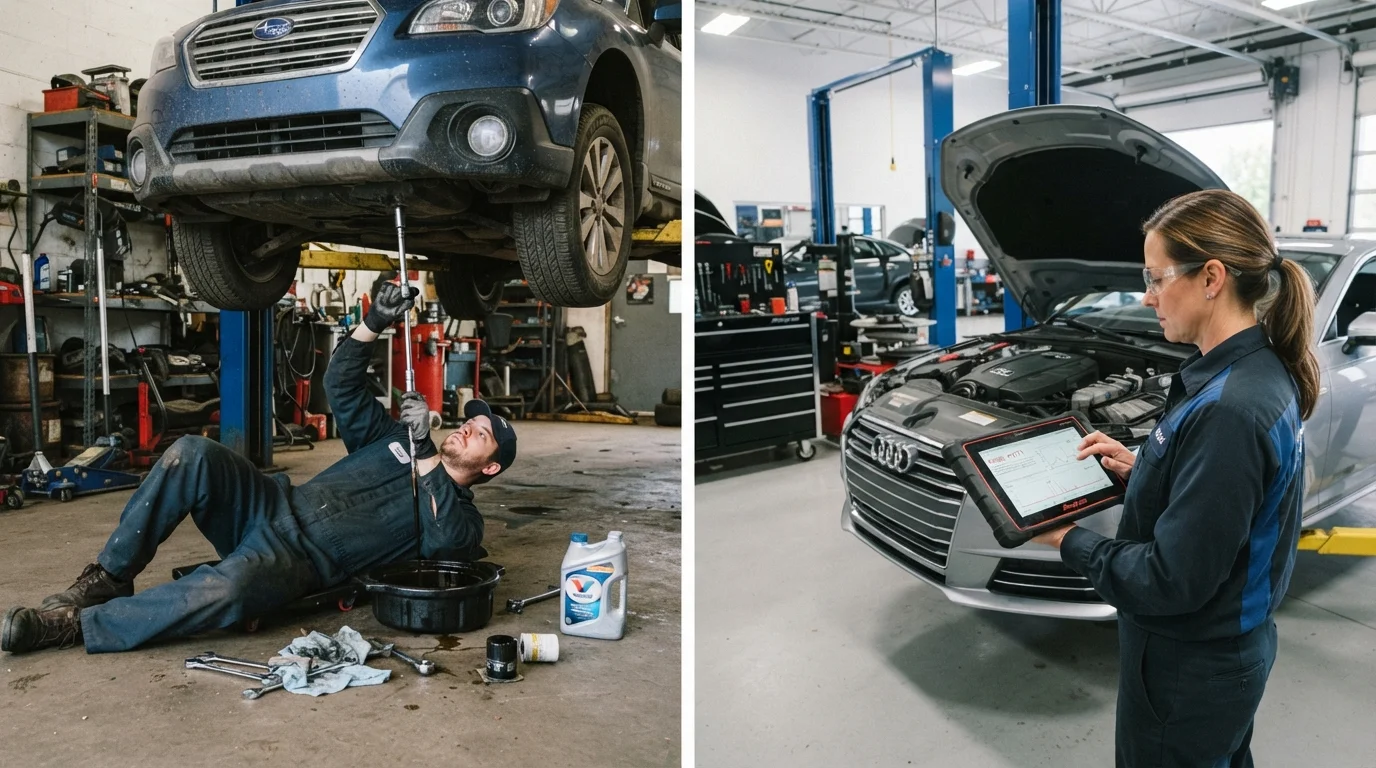
Photo: CoralScripts.com | Explore, Discover, Engage editorial
—— In This Article
Key Takeaways
- Many routine tasks - oil changes, air filters, wiper blades - are genuinely within reach of a capable home mechanic.
- Workshop servicing is necessary when specialist tools, calibration equipment, or safety lifts are required.
- Skill level, tool availability, and warranty considerations all affect which approach makes sense for any given job.
- Poorly executed DIY repairs can cost more to fix than the original professional service would have.
- Keeping accurate records matters equally whether you DIY or use a workshop.
The Case for DIY: Where It Makes Sense
For owners with a reasonable mechanical aptitude, a basic tool set, and access to the vehicle's service manual, a meaningful range of maintenance tasks are straightforward to perform at home. Oil and filter changes, engine air filter replacements, cabin air filter swaps, wiper blade replacements, battery swaps, and basic fluid top-ups sit well within the DIY tier for most modern vehicles.
The primary advantages are cost savings on labor and scheduling flexibility - you work on your timeline, not the shop's. There is also a knowledge dividend: owners who perform their own maintenance develop a hands-on familiarity with their vehicle's condition that no service report fully replicates. Spotting a cracked hose or a corroded ground strap while draining the oil is the kind of catch that can prevent a roadside failure.
The threshold for DIY success rises with preparation. Consulting the factory service manual (not just a generic aftermarket guide), sourcing the correct specification fluids and parts, and understanding torque specs before picking up a wrench are non-negotiable. Skipping these steps is where DIY efforts most often go wrong. See our guide to preventive maintenance logic to understand which routine tasks deliver the highest return on effort.
Start With Well-Documented, Low-Stakes Tasks
If you're new to DIY maintenance, begin with tasks that have clear procedures and limited consequences for minor errors - cabin air filters, wiper blades, and battery replacements are good starting points. Build confidence and tool inventory progressively before attempting brake work or anything involving sealed systems. A vehicle-specific forum or factory service manual is always a better reference than a generic video tutorial.
When the Workshop Is the Right Call
A number of service items genuinely require equipment, training, or data access that falls outside a typical home garage. Wheel alignment requires a precision alignment rack. Brake hydraulic work - including ABS module replacement - demands proper bleeding procedures and, on many late-model vehicles, scan tool activation sequences. Transmission fluid changes on sealed units often require dealer-level software to set the correct fill level. Advanced fault diagnosis on modern vehicles with complex sensor networks similarly depends on OEM or professional-grade scan tools that go well beyond a consumer-grade code reader.
Safety-critical systems - brakes, steering, suspension geometry, airbag components - carry a higher bar by definition. An error in these areas doesn't just risk the repair failing; it risks the vehicle becoming dangerous to operate. If there is any ambiguity about the scope of a repair or your competence to complete it safely, a qualified technician is the right choice. Workshop labor rates reflect not just time but also liability, calibrated equipment, and the ability to identify secondary issues that a single-task DIY inspection might miss.
Don't Underestimate Modern Vehicle Complexity
Contemporary vehicles integrate mechanical and electronic systems in ways that weren't true even a decade ago. A brake pad replacement that appears straightforward may require a scan tool to retract an electronic parking brake caliper piston. Attempting these steps without the correct procedure risks damaging the caliper, triggering fault codes, or disabling the parking brake function. Research the specific procedure for your make, model, and year before starting any job.
Warranty implications are also a practical consideration. Manufacturer warranties and extended service contracts frequently specify that maintenance be performed according to documented intervals by a qualified shop. Always review your warranty terms before substituting DIY work for scheduled dealer or workshop service. For a broader look at how maintenance needs evolve with age and mileage, see how maintenance priorities shift as mileage climbs.
Comparing the Two Approaches
The table below maps the key trade-offs across the dimensions that matter most to most owners.
| DIY Maintenance | Workshop Servicing | |
|---|---|---|
| Labor cost | None (your time only) | Charged at shop labor rate |
| Parts cost | Retail pricing | Shop pricing (varies) |
| Tool requirements | Basic to moderate for routine tasks | Specialist equipment available on-site |
| Diagnostic capability | Limited to consumer-grade tools | OEM-level scan tools and data access |
| Safety-critical repairs | High-risk without proper training | Appropriate with qualified technicians |
| Warranty compatibility | May void coverage if not documented | Typically maintains warranty standing |
| Scheduling flexibility | Full flexibility | Subject to shop availability |
| Error risk | Higher without experience | Lower with trained technicians |
Cost is rarely the whole story. A DIY oil change saves on labor, but that saving evaporates if an incorrectly torqued drain plug causes an oil leak that damages the engine. Conversely, paying workshop rates for a cabin air filter replacement - a ten-minute job on most vehicles - represents poor value for an owner with basic skills. Matching the approach to the task is the core discipline.
Documentation discipline matters equally on both paths. Whether you change your own oil or pay a shop to do it, maintaining a complete, dated service record affects resale value, warranty claims, and any future mechanic's ability to diagnose problems accurately. Our article on keeping maintenance records covers this in detail.
Making the Decision: A Practical Framework
Before committing to either path on any given task, work through four questions:
- Do I have the right tools? Not just common hand tools, but any task-specific equipment - torque wrenches, oil filter cap sockets, scan tools - that the job requires.
- Do I have a reliable, vehicle-specific procedure? Generic instructions can omit critical details. Factory service manuals or reputable model-specific resources are the standard.
- Is this a safety-critical system? Brakes, steering, suspension, fuel, and restraint systems warrant a higher threshold of certainty.
- What are the consequences of getting it wrong? A DIY error on a cabin air filter costs you a part and some frustration. An error on a brake caliper bolt can be catastrophic.
Owners who defer maintenance entirely - neither performing it themselves nor taking the vehicle in - face the steepest long-term costs. Deferred maintenance compounds quickly into failures that cost multiples of the original service. The DIY-versus-workshop question is secondary to simply keeping the vehicle maintained on schedule.
A hybrid approach is how most experienced enthusiasts operate: handle the accessible, well-understood tasks at home; hand off anything requiring specialist equipment, calibration, or a safety lift to a qualified shop. Understanding the boundary between those two categories is the most useful skill a car owner can develop.

Cars & Driving Editorial Team
Cars & Driving Editorial Team is the collective byline for our editorial team and contributor network. Articles published under this byline or an editorial pen name are researched, written, and reviewed according to our editorial standards for clarity, consistency, and independence before publication.
View author profile