
Managing Money Across Borders: Currency, Cards, and Cash Explained
Understand how foreign exchange, travel-friendly bank cards, and local cash needs interact so you can plan your spending with fewer surprises.
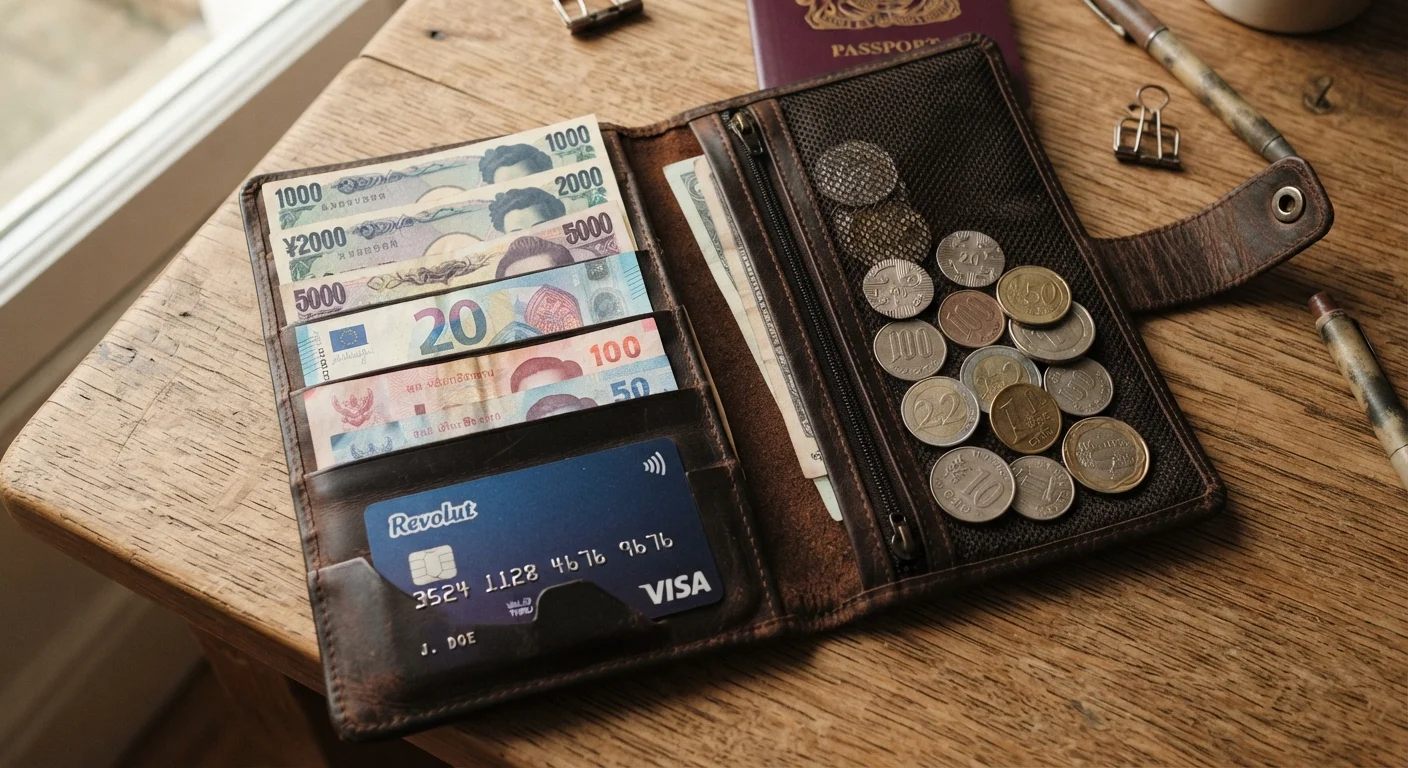
Photo: CoralScripts.com | Explore, Discover, Engage editorial
—— In This Article
How Foreign Exchange Actually Works
Every time you spend in a foreign currency, a conversion happens — and who executes that conversion, and at what rate, determines how much you actually pay. The foundational concept is the interbank exchange rate, the mid-market rate at which large financial institutions trade currencies. Travelers rarely access this rate directly; instead, they pay a marked-up version, with the spread representing revenue for whoever facilitates the exchange.
Exchange rates fluctuate continuously based on economic conditions, interest rate decisions, and market sentiment. A rate you see quoted online is a live benchmark — not necessarily what you'll receive at a bureau de change or ATM. The gap between the benchmark and the rate you receive is sometimes called the exchange rate margin, and it varies widely by provider and method.
| Average Foreign Transaction Fee | 1%–3% per purchase (Typical range among US card issuers; varies by product) |
| DCC Rate Disadvantage | Often 3%–7% worse than card rate (Varies by DCC provider; declining DCC is generally advisable) |
| ATM Fee Sources | Up to two separate fees (home bank + foreign ATM operator) (Some accounts reimburse foreign ATM fees; verify before travel) |
| Payment Networks Accepted Internationally | Visa and Mastercard are most broadly accepted worldwide (Acceptance of Amex and Discover varies significantly by region) |
| Recommended Cash Reserve | Enough for 1–2 days of essential expenses (General travel planning guidance; actual need depends on destination) |
For travelers who want to go deeper on general financial concepts before a trip, the foundational guide to saving and investing is a useful primer on how money mechanics work broadly.
Cards Abroad: What Fees to Watch For
Bank and credit cards are the most convenient way to pay internationally, but not all cards treat foreign transactions equally. Three fee types are most consequential:
- Foreign transaction fees: Typically 1–3% of each purchase, charged by the card issuer for processing a non-US transaction. Many travel-oriented cards waive this fee entirely.
- Dynamic Currency Conversion (DCC): A practice where a merchant or ATM offers to charge you in US dollars rather than local currency. While convenient-sounding, DCC rates are almost always significantly worse than your card's conversion rate. Declining DCC and paying in local currency is generally the better choice.
- ATM withdrawal fees: These may come from your own bank, the foreign ATM operator, or both. Some accounts reimburse these fees; others do not.
Chip-and-PIN technology is standard across much of Europe and Asia. US-issued cards increasingly carry chips, but some still default to chip-and-signature rather than PIN. Knowing which you have matters at unattended kiosks — transit gates, parking machines, fuel pumps — where a PIN is often required.
Always Pay in Local Currency at Merchants
When a card terminal or ATM asks whether you want to pay in US dollars or the local currency, choose the local currency. Opting for dollars activates Dynamic Currency Conversion (DCC), which applies the merchant's exchange rate — typically much less favorable than your card issuer's rate. This applies whether you're at a restaurant, hotel, or ATM abroad.
For a fuller look at where your spending actually lands during international travel, see The Anatomy of a Travel Budget.
When and How Much Cash to Carry
Despite the dominance of card payments in urban centers, cash remains essential in many destinations — rural areas, local markets, small restaurants, and regions with limited card infrastructure. Estimating how much local currency to carry requires thinking through your specific itinerary rather than applying a universal rule.
A practical approach: identify the cash-dependent transactions in your plans (street food, taxis without card readers, entrance fees at smaller sites, tips) and budget those specifically. For everything else, a card likely suffices. Carrying a moderate emergency cash reserve — enough for a day or two of essentials — is a sensible precaution regardless of destination.
Where you obtain cash matters as much as how much you carry. Airport kiosks, ATMs, and local banks each involve different trade-offs in terms of rates, fees, and convenience. Airport kiosks prioritize ease over value; in-network ATMs drawing from a low-fee account often offer competitive rates.
Tipping norms also affect how much small-denomination cash you need. Tipping conventions differ dramatically by country, and some destinations where gratuity is customary prefer it in cash.
Building a Practical Money Strategy Before You Depart
A coherent pre-departure plan reduces friction and unexpected costs. Consider the following framework:
- Notify your bank and card issuers of your travel dates and destinations. Fraud detection systems may block foreign transactions without advance notice.
- Audit your cards' fee structures. If your primary card charges foreign transaction fees, investigate whether a no-fee alternative is worth activating before your trip.
- Set a PIN on any cards you plan to use internationally if you haven't already — and make sure you know it; some machines reject over-the-phone workarounds.
- Source a small amount of local currency before departure if your destination's airport options are limited or you arrive late at night. Domestic options (some credit unions, certain bank branches) may offer better rates than airport kiosks, though availability varies.
- Plan for redundancy. Carrying at least two different payment methods — a card on one network and cash, or cards from two different issuers — protects against a single point of failure.
For first-time international travelers, this fits within a broader preparation checklist. Everything First-Time International Travellers Need to Know covers financial prep alongside visas, health, and logistics in one place.
Interbank Exchange Rate
The mid-market rate at which banks and large financial institutions exchange currencies with one another. Consumers rarely access this rate directly; retail providers add a margin on top of it.
Foreign Transaction Fee
A charge, typically 1–3% of the transaction amount, applied by a card issuer when a purchase is processed in a non-US currency or through a foreign bank.
Dynamic Currency Conversion (DCC)
A service offered at foreign ATMs or merchant terminals that converts the transaction to US dollars on the spot. The exchange rate applied by the DCC provider is usually less favorable than your card issuer's rate.
Chip-and-PIN
A card authentication method requiring both an embedded chip and a four-digit personal identification number (PIN). Widely required in Europe and parts of Asia, particularly at unattended payment terminals.
Exchange Rate Margin
The difference between the interbank (mid-market) rate and the rate offered to a retail customer. This margin is how banks, ATMs, and bureaux de change build in their profit on currency conversion.
Bureau de Change
A dedicated currency exchange business, found in airports, tourist areas, and city centers, where travelers can convert cash. Rates and fees vary significantly between operators.

Travel & Places Editorial Team
Travel & Places Editorial Team is the collective byline for our editorial team and contributor network. Articles published under this byline or an editorial pen name are researched, written, and reviewed according to our editorial standards for clarity, consistency, and independence before publication.
View author profile