
Rainforest vs. Savanna: Two Ecosystems, Two Entirely Different Rules of Survival
Contrasting the dense, layered tropics with Africa's open grasslands reveals just how differently life adapts to its environment.
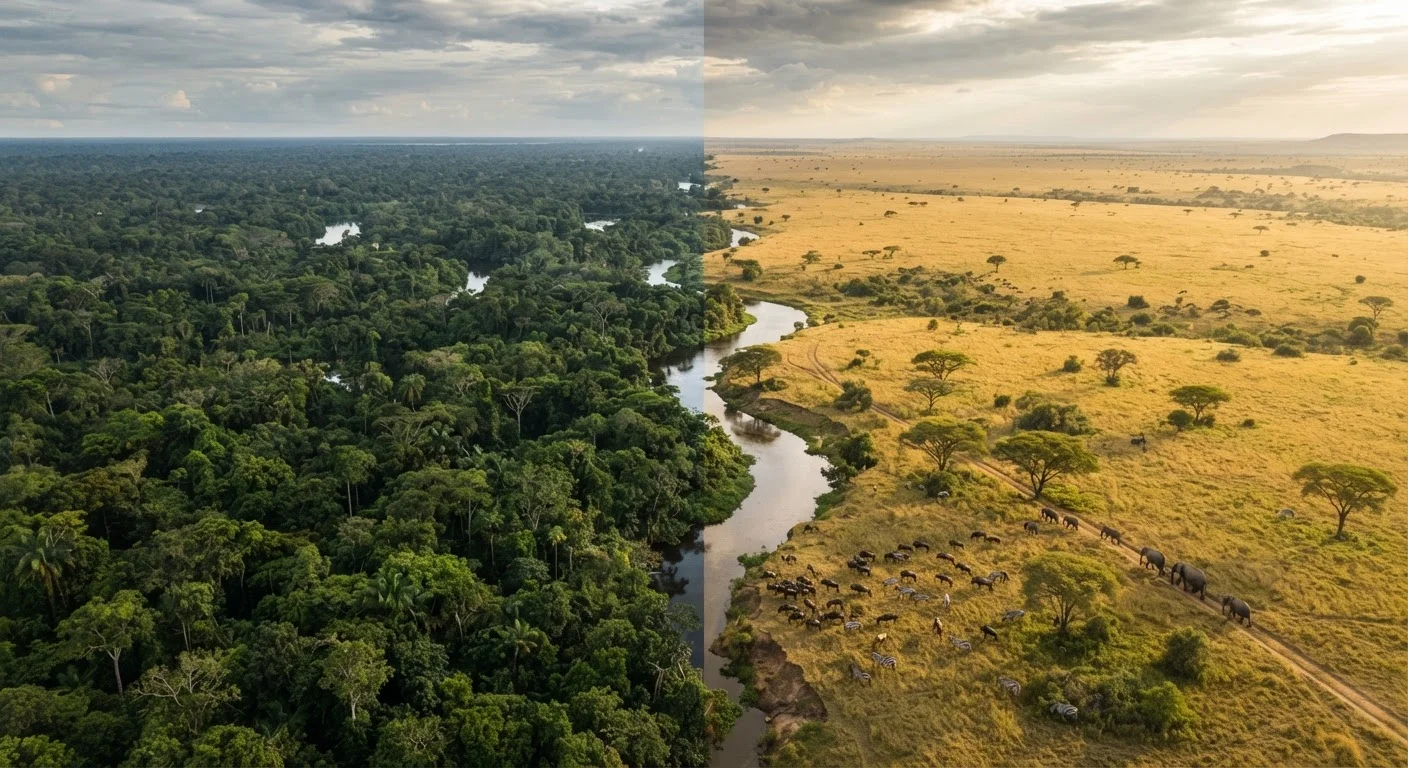
Photo: CoralScripts.com | Explore, Discover, Engage editorial
—— In This Article
Key Takeaways
- Tropical rainforests host roughly half of all terrestrial species despite covering less than 6% of Earth's land surface.
- Savannas rely on seasonal drought and periodic fire as ecological drivers, shaping animal behavior and plant physiology alike.
- Vertical layering in rainforests creates distinct microhabitats; savannas organize life horizontally across open landscape.
- Predator-prey dynamics in savannas are highly visible; in rainforests they are largely concealed within dense vegetation.
- Both ecosystems face accelerating pressure from habitat loss, with distinct but equally serious conservation consequences.
Climate and Physical Structure: The Foundation of Everything
The most fundamental difference between a tropical rainforest and a savanna is water — specifically, how reliably it arrives. Rainforests in the Amazon Basin, Congo, and Southeast Asia receive 80 to 400 inches of rainfall annually, distributed across most months. That constancy fuels continuous plant growth organized into distinct vertical zones: an emergent layer of towering trees reaching 200 feet, a closed canopy at roughly 100 feet, an understory of shade-tolerant shrubs, and a sparse forest floor. This layered architecture — sometimes called stratification — creates dozens of overlapping microhabitats within a single acre.
Savannas, by contrast, are defined by their seasonality. The African savanna experiences a pronounced wet season followed by months of drought, receiving 20 to 50 inches of rainfall per year. Vegetation is open: scattered acacia and baobab trees punctuate a continuous grass layer that can grow explosively during rains and desiccate almost entirely by dry season. That horizontal openness is not poverty — it is a different organizational principle entirely, one that favors large, mobile animals capable of tracking resources across vast distances.
Fire is an additional structural force in savannas that has no meaningful parallel in closed-canopy rainforests. Periodic burning clears accumulated biomass, releases nutrients into soil, and prevents woody shrubs from overtaking grassland — a process ecologists call the fire-grazing cycle. Many savanna grasses and trees have evolved fire-resistant bark or underground stem systems that regenerate rapidly after burns.
Biodiversity Patterns: Density vs. Visible Abundance
Tropical rainforests are the undisputed champions of species richness. A single hectare of Amazonian forest can contain more tree species than all of North America combined, and conditions that sustain this richness involve stable climate, high productivity, and millions of years of evolutionary time without glacial disruption. Insects, amphibians, birds, and small mammals fill thousands of specialized niches, many so narrow that a species may depend on a single plant genus.
Savannas are less species-rich in absolute terms but support populations of large vertebrates that rainforests simply cannot. The Serengeti hosts roughly 1.5 million wildebeest alongside hundreds of thousands of zebras, gazelles, and their predators. That biomass of large mammals is only possible because open grassland allows sunlight to reach ground level, driving grass production that can support grazing herds. Rainforest understories receive as little as 1–2% of sunlight reaching the canopy, making dense ground-level herbivory energetically impractical.
| Tropical Rainforest | Savanna | |
|---|---|---|
| Annual Rainfall | 80–400 inches, year-round | 20–50 inches, strongly seasonal |
| Vegetation Structure | Vertical layers, closed canopy | Horizontal, open grassland with scattered trees |
| Species Richness | Extremely high; millions of species | Moderate; high large-mammal diversity |
| Key Ecological Driver | Competition for light and nutrients | Seasonal drought and periodic fire |
| Dominant Animal Strategy | Camouflage, specialization, symbiosis | Mobility, herd behavior, speed |
| Primary Conservation Threat | Agricultural conversion, deforestation | Fragmentation, poaching, overgrazing |
The diversity strategies are also reflected in animal camouflage. Rainforest species trend toward disruptive coloration, mimicry, and transparency adapted for low-light concealment — think leaf-tailed geckos or glass frogs. Savanna prey animals more commonly rely on counter-shading and herd behavior, where individual recognition matters less than collective vigilance. For a deeper look at how activity timing intersects with these strategies, see how light shapes wildlife behaviour.
Predator-Prey Dynamics and Ecological Roles
In the savanna, predation is a public event. Lions, cheetahs, hyenas, and African wild dogs operate in open terrain where hunts can be observed across miles. This visibility has generated some of the most well-documented predator-prey arms races in ecology: cheetahs evolved explosive acceleration, gazelles evolved stotting (high, conspicuous leaps that signal fitness to predators), and wildebeest evolved synchronous calving that briefly floods the predator market with more prey than can be consumed. As explored in our article on apex predators and the ecosystems that depend on them, removing these top predators triggers cascading effects throughout the food web.
Rainforest predation, by contrast, is largely cryptic. Jaguars and leopards ambush prey in dense vegetation; harpy eagles drop silently through canopy layers; pit vipers remain motionless for days awaiting a single strike. Because encounters are individual and concealed rather than group and visible, cooperative hunting strategies are less common, and prey species invest more heavily in chemical defenses, toxicity, and camouflage than in group vigilance.
Specialist vs. Generalist: A Key Adaptive Divide
Rainforest conditions favor extreme specialization — species evolve to exploit very narrow niches because competition is intense and resources are stable enough to support specialists year-round. Savanna conditions, with their dramatic seasonal swings, more often favor generalist feeders and opportunistic behaviors. Understanding this distinction helps explain why rainforest species are often more vulnerable to habitat change: their survival depends on conditions that may no longer exist if even part of their narrow niche is disrupted.
Symbiotic relationships also take distinct forms across both biomes. Rainforest ecosystems are dense with mutualisms — fig trees and their obligate pollinating wasps, army ants and the birds that follow them to catch fleeing insects, mycorrhizal fungi networks that connect tree roots across hectares. Mutualism, commensalism, and parasitism all reach elaborate expression in the competitive, resource-saturated rainforest environment.
Conservation Pressures and What's at Stake
Both ecosystems are under serious anthropogenic pressure, though the mechanisms differ. Rainforest loss is dominated by agricultural conversion — particularly cattle ranching and soy production — as well as logging and infrastructure development. Because rainforest soils are often nutrient-poor (most nutrients are locked in living biomass), cleared land degrades rapidly, making recovery slow even when human pressure is removed.
Savanna faces a different threat profile: land fragmentation that interrupts migratory corridors, overgrazing by domestic livestock that shifts grass composition, suppression of natural fire cycles, and targeted poaching of large charismatic species. Wildlife corridors — strips of connected habitat — are recognized by conservationists as critical for maintaining the large-range movements that savanna megafauna require.
~50%
Terrestrial species housed in rainforests
Tropical rainforests cover less than 6% of Earth's land yet are estimated to harbor roughly half of all terrestrial plant and animal species.
1.5 million
Wildebeest in the Serengeti ecosystem
The Serengeti-Mara system supports approximately 1.5 million wildebeest in one of the largest remaining terrestrial migrations on Earth.
Understanding both ecosystems enriches our broader appreciation of how life adapts. Spending time in nature — even vicariously through education — carries its own documented value, as examined in the article on nature exposure and well-being. What savannas and rainforests share, ultimately, is their fragility in the face of rapid change — and the irreplaceable complexity they represent.

Pets & Animal Life Editorial Team
Pets & Animal Life Editorial Team is the collective byline for our editorial team and contributor network. Articles published under this byline or an editorial pen name are researched, written, and reviewed according to our editorial standards for clarity, consistency, and independence before publication.
View author profile