
Animal Intelligence: What Science Actually Knows About Cognition Beyond Humans
Tool use, problem-solving, and emotional bonds — a research-grounded look at how we measure and understand animal minds.
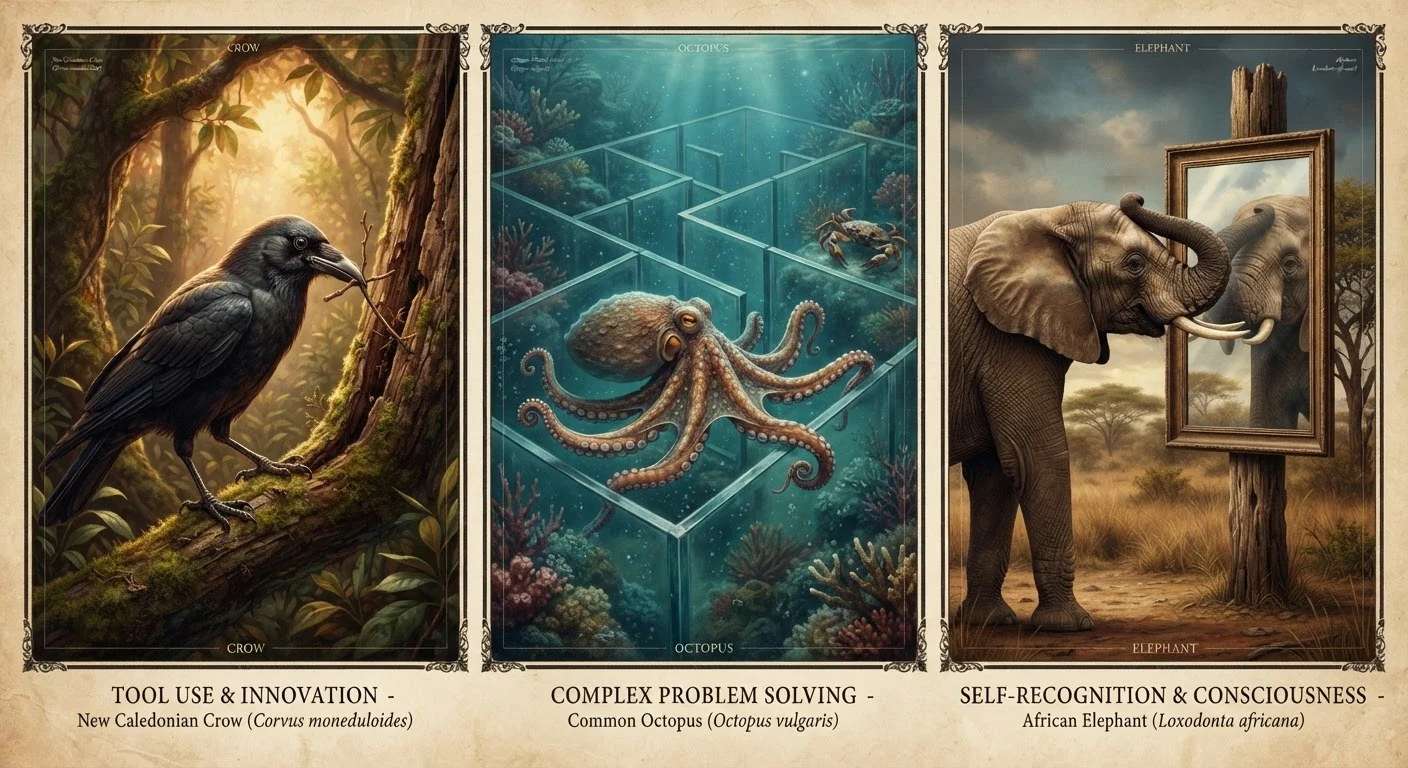
Photo: CoralScripts.com | Explore, Discover, Engage editorial
—— In This Article
Key Takeaways
- Animal intelligence is not a single trait but a collection of cognitive abilities shaped by evolutionary pressures.
- Tool use has been documented in crows, dolphins, sea otters, and several primate species.
- Self-recognition in mirrors - a marker of self-awareness - appears in great apes, elephants, dolphins, and some corvids.
- Emotional states in animals are inferred from behavioral and physiological evidence, not introspection.
- Measuring animal cognition is inherently difficult because tests are often designed around human or primate strengths.
Why the Question Is Harder Than It Looks
For most of Western scientific history, cognition was considered a uniquely human domain. That assumption has been systematically challenged over the past five decades as researchers developed more rigorous - and more species-appropriate - ways to probe animal minds. The difficulty is that intelligence has no single agreed definition even in humans, and every cognitive test carries assumptions about what abilities matter and how they should be demonstrated.
This challenge connects to a broader problem of interpretation. As explored in our guide to misreading animal behaviour, human observers routinely project familiar frameworks onto species with fundamentally different sensory and social worlds. A crow that solves a multi-step puzzle isn't being "almost human" - it's being a crow, deploying cognitive tools shaped by millions of years of scavenging and social competition.
Cognition and Behavior Overlap, But Are Distinct
Not all impressive animal behaviors reflect high cognition. Some elaborate displays - like a spider's courtship dance or a bird's nest construction - are largely innate and stereotyped rather than flexibly learned. Distinguishing these requires careful experimental design and familiarity with a species' natural history. Cognitive claims require behavioral evidence ruling out simpler explanations.
Understanding animal cognition also benefits from distinguishing what animals are born knowing from what they acquire through experience - a distinction covered in depth in our article on instinct vs. learned behavior.
Landmark Evidence: Tool Use, Planning, and Social Learning
Tool use was once considered a definitive marker of human uniqueness. That boundary collapsed when Jane Goodall documented wild chimpanzees stripping leaves from twigs to fish termites from mounds. Since then, tool use has been confirmed in New Caledonian crows (which craft hooked tools), sea otters (which use rocks to crack shellfish), and even some fish species that use stones as anvils.
Planning - the ability to act now for a future benefit - is equally compelling. Western scrub-jays (now called California scrub-jays) cache food and appear to account for what a watching competitor has or hasn't seen, adjusting caching behavior accordingly. This suggests both episodic-like memory and rudimentary theory of mind: modeling what another individual knows.
40+
Species documented using tools
Research compiled across field and laboratory studies identifies more than 40 non-human species observed using tools in naturalistic or experimental settings, spanning birds, mammals, fish, and invertebrates.
~500M
Neurons in an octopus nervous system
Octopuses have roughly 500 million neurons - comparable to some mammals - distributed across their arms and central brain, supporting complex problem-solving despite a radically non-vertebrate architecture.
6
Non-human species passing mirror self-recognition tests
As of peer-reviewed literature, species with robust MSR evidence include chimpanzees, bonobos, orangutans, gorillas (limited), bottlenose dolphins, Asian elephants, and Eurasian magpies.
Social learning, where individuals acquire behaviors by observing others, is widespread and consequential. Humpback whales have spread novel feeding techniques across ocean populations; Japanese macaques famously began washing sweet potatoes after one individual invented the behavior and others copied it. Such cultural transmission mirrors mechanisms studied in human development. For a deeper look at how communication underpins many of these social processes, see our tour of non-mammalian animal communication.
Emotional Cognition and Social Bonds
One of the most debated frontiers is whether animals experience emotions in a way that is cognitively meaningful - not just reflexive. Elephants display extended grieving behaviors over deceased conspecifics, returning to bones and engaging in what researchers describe as ritualistic attention. Ravens console distressed flock members through affiliative contact. Rats in laboratory settings have been shown to free trapped cage-mates even when food rewards are not involved - a behavior consistent with empathy-driven motivation.
“The question is not whether animals have minds, but how their minds work - and what problems those minds evolved to solve.”
— Frans de Waal, Primatologist and author known for research on animal empathy and social cognition
These social and emotional capacities are inseparable from cognitive architecture. How animals form attachments - from early imprinting to adult pair bonds - reveals that bonding is not incidental to cognition but deeply integrated with it. Animals that form selective long-term bonds tend to demonstrate stronger social learning, cooperation, and even deception capabilities.
What the Limits of Testing Tell Us
Cognitive science of animals is constrained by the tests themselves. The mirror self-recognition test, for instance, privileges visually dominant species; octopuses - which have remarkable problem-solving abilities and distributed nervous systems unlike any vertebrate - show little mirror-contingent behavior despite extraordinary cognitive flexibility in other domains. Similarly, language-analogue studies with great apes have been critiqued for rewarding imitation rather than demonstrating genuine symbolic reasoning.
A more ecologically valid approach assesses animals within their own perceptual and social contexts. When researchers do this, the cognitive gap between humans and other species narrows considerably - not because animals become more human-like, but because species-appropriate tasks reveal abilities that lab paradigms conceal. This aligns with principles from ethology's foundational concepts, which emphasize studying behavior in naturalistic conditions.
Look for Cognitive Cues in Everyday Pet Behavior
You don't need a laboratory to observe animal cognition in action. Watch whether your dog or cat adjusts strategies when a familiar approach fails - attempting a new route to a blocked toy, or vocalizing differently to different people. These small behavioral shifts can reflect genuine problem-solving and social modeling rather than mere habit.
For pet owners curious about applying these ideas, our framework for observing animal behavior at home offers practical, ethology-grounded methods for documenting and interpreting what your own animals are doing - and why.
Frequently Asked Questions

Pets & Animal Life Editorial Team
Pets & Animal Life Editorial Team is the collective byline for our editorial team and contributor network. Articles published under this byline or an editorial pen name are researched, written, and reviewed according to our editorial standards for clarity, consistency, and independence before publication.
View author profile