
Bird Song, Bee Waggle, Whale Call: A Tour of Non-Mammalian Animal Communication
Communication in the animal world extends far beyond mammals. Explore how birds, insects, fish, and cetaceans signal meaning across species.
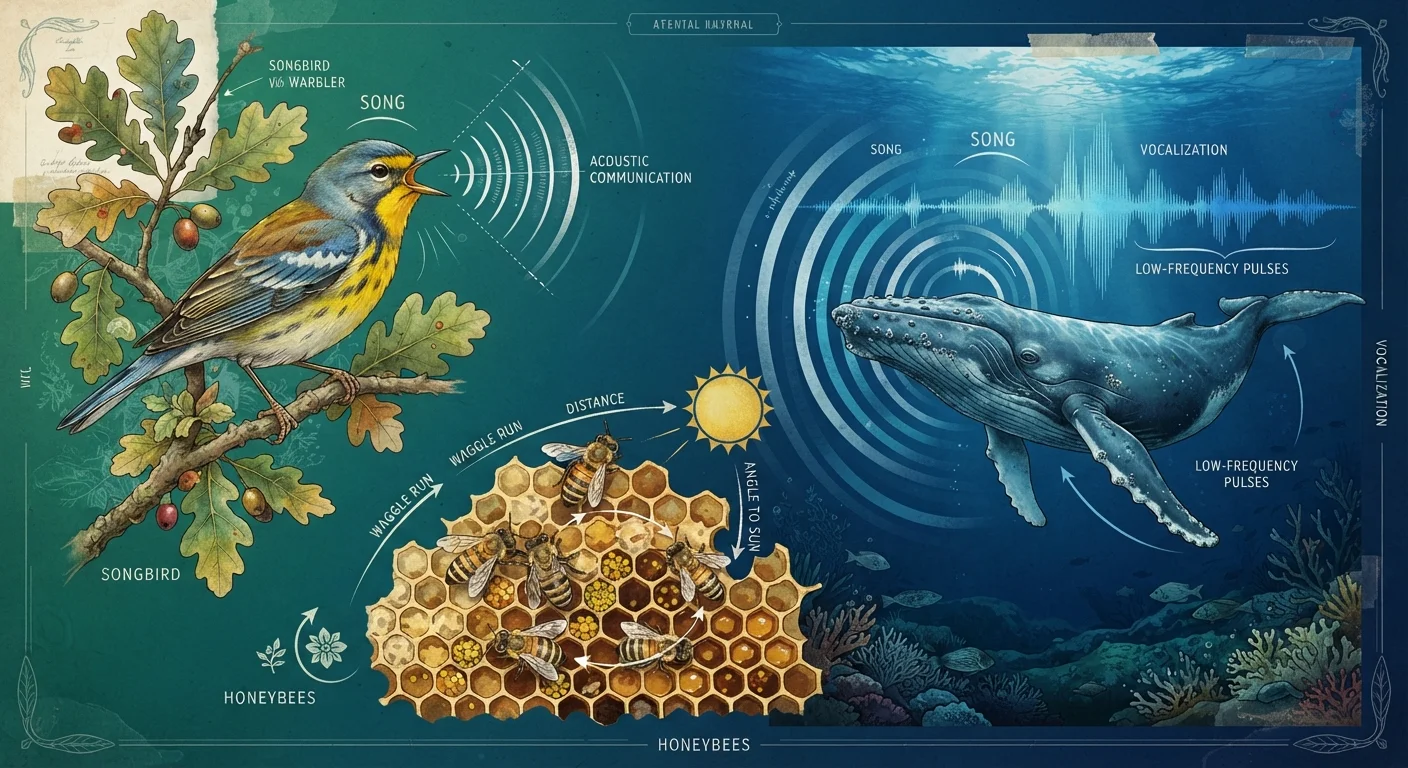
Photo: CoralScripts.com | Explore, Discover, Engage editorial
—— In This Article
Key Takeaways
- Birdsong involves learned dialects and syntax-like structures that vary regionally within species.
- Honeybee waggle dances encode precise directional and distance information about food sources.
- Humpback whales produce culturally transmitted songs that evolve across ocean populations over time.
- Fish and cephalopods use rapid color and pattern changes as dynamic visual communication signals.
- Electric fish generate and detect bioelectric fields to communicate identity, dominance, and readiness to mate.
Beyond Mammal Voices: The Breadth of Animal Communication
When most people think about animal communication, the familiar calls of dogs, primates, or dolphins come to mind. Yet some of the most sophisticated signaling systems on Earth belong to creatures far outside the mammalian lineage. Birds coordinate complex social relationships through vocal learning that rivals human language acquisition in its neural demands. Insects encode navigational data with choreographed movement. Fish sculpt electric fields into conversation. Understanding these systems doesn't just satisfy curiosity - it reshapes what we mean by the word language.
Communication, in biological terms, refers to any signal produced by one organism that alters the behavior of another. Those signals can be acoustic, visual, chemical, or electrical. What distinguishes the examples explored here is the evidence of structure, learning, and information content - hallmarks that push these exchanges well beyond simple reflexes. For a deeper look at how researchers measure and interpret these cognitive capacities, see what science knows about animal intelligence.
Birdsong: Learned Dialects and Syntactic Structure
Songbirds (oscines) are among the few non-human animals confirmed to learn their vocalizations rather than produce them innately. Young birds pass through a sensory phase, memorizing a tutor's song, followed by a sensorimotor phase in which they practice until output matches memory. This mirrors the babbling-to-speech trajectory in human infants at the neural level - both depend on cortico-basal ganglia loops dedicated to vocal learning.
Geographic variation produces dialects: white-crowned sparrows (Zonotrichia leucophrys) sing measurably different versions of their species song across distances as short as a few kilometers. Males use dialect matching to assess whether a rival is a local resident or a foreign interloper, influencing territorial aggression accordingly.
Beyond content, some species demonstrate rudimentary syntax. Research on Japanese great tits (Parus minor) published in Nature Communications found that individuals combine calls in specific orders to convey different meanings, and that other birds respond differently to the same elements rearranged - a functional analog to compositional structure.
Songbirds learn vocalizations through a neural process that closely mirrors human infant speech acquisition.
The Honeybee Waggle Dance: A Symbolic Navigation Code
Described in detail by Karl von Frisch in the mid-20th century, the honeybee (Apis mellifera) waggle dance is one of biology's most celebrated discoveries. A returning forager performs a figure-eight movement on the vertical face of a comb inside the hive. The duration of the straight waggle run encodes distance to the food source (roughly 75 milliseconds per 100 meters), while the angle of the run relative to vertical encodes direction relative to the sun's azimuth.
Subsequent research confirmed that bees can also communicate the quality of the source through the vigor and duration of dancing, and that followers integrate this information before departing. Remarkably, experimental playback of recorded waggle sounds alone can trigger recruitment flights, confirming the dance is a true symbolic signal rather than a byproduct of movement.
The system is not without limits. Bees cannot communicate vertical elevation, and hive architecture must be relatively vertical for the gravitational encoding to work. Still, the dance represents a genuine symbolic, arbitrary mapping between behavior and external referent - a property once considered unique to human language.
The waggle run's angle and duration map directly onto the sun's direction and distance to food.
Humpback Whale Song: Cultural Transmission Across Ocean Basins
Male humpback whales (Megaptera novaeangliae) produce long, structured vocalizations - known as songs - primarily during breeding season. Songs consist of hierarchical units: sounds → phrases → themes → songs, with individual males in a population singing nearly identical versions at any given time. Yet those versions change progressively over months and years.
A striking finding from researchers studying South Pacific populations is that new song types appear to spread directionally - from Australia eastward across the Pacific to French Polynesia - in a pattern consistent with cultural copying rather than genetic inheritance. This makes humpback song one of the clearest documented cases of non-human cultural transmission in a non-primate species.
The precise function of song remains debated. Hypotheses include mate attraction, male-male competition, and echolocation for long-distance orientation. Evidence for mate attraction is strong, but the songs' complexity - far exceeding what simple attraction signaling would require - suggests the communicative function may be richer than current models capture.
New song types spread directionally across humpback whale populations like cultural trends, not genetic shifts.
Electric Fish: Bioelectric Signaling in Freshwater Environments
Weakly electric fish - including South American gymnotiformes like the black ghost knifefish and African mormyrids - generate low-voltage electric organ discharges (EODs) using specialized cells derived from muscle tissue. Unlike the high-voltage discharges of electric eels, these fields are primarily communicative and sensory rather than predatory.
Each species produces species-typical EOD waveforms, and individuals modulate frequency, waveform shape, and timing to convey social information. During encounters between two fish generating similar frequencies, one or both will shift frequency - a behavior called the Jamming Avoidance Response (JAR) - to prevent signal interference. The JAR has been studied extensively as a model for neural computation because it requires the fish to compare its own signal to an incoming one and calculate the appropriate correction in real time.
Courtship involves elaborate frequency modulations called chirps and gradual frequency rises (GFRs), with females and males producing distinct patterns. Dominant males maintain higher resting frequencies, making EOD a reliable honest signal of competitive status.
Electric fish shift their discharge frequencies in real time to avoid jamming rivals' signals - a live neural computation.
Cephalopod Chromatic Signaling: Skin as a Dynamic Display Screen
Octopuses, cuttlefish, and squids communicate partly through rapid, high-resolution changes in skin color, pattern, and texture - changes driven by chromatophores (pigment-containing cells under direct neural control), iridophores (structural color cells), and papillae (texture-producing projections). Because these cells respond in milliseconds, a cuttlefish can run multiple pattern programs across different body regions simultaneously.
Cuttlefish (Sepia spp.) use polarized light signals - invisible to most vertebrates but detectable by cephalopod photoreceptors - to communicate covertly with conspecifics even while displaying camouflage to predators on the same body surface. This dual-channel display is a remarkable evolutionary solution to the competing pressures of predator avoidance and mate signaling.
Research has identified specific display states associated with threat, submission, courtship, and hunting. Male cuttlefish confronted with a rival while beside a female will sometimes display a male pattern on the side facing the rival while displaying a female pattern on the side facing the female - a deceptive strategy that reduces male-male aggression while preserving mating access. This context-sensitive deception implies a degree of social modeling rarely attributed to invertebrates.
Cuttlefish can simultaneously display male patterns to rivals and female patterns to mates on opposite body sides.
Frog Choruses and Acoustic Niche Partitioning
Anurans (frogs and toads) rely almost entirely on acoustic communication for reproduction, with males producing advertisement calls that females use to assess species identity, body size, and condition. Because many species breed simultaneously at shared water bodies, acoustic interference is a genuine problem - a challenge evolution has addressed through acoustic niche partitioning.
Communities of co-occurring frogs tend to segregate by call frequency, timing, and temporal patterning, reducing spectral and temporal overlap in ways that improve signal detection for both senders and receivers. Some species fine-tune call frequency in real time when exposed to background noise, a phenomenon analogous to the Lombard effect in humans (raising voice level in noisy environments).
Female frogs exhibit selective phonotaxis - oriented movement toward male calls - that depends on species-specific spectral and temporal filtering in the auditory system. This means the receiver's neural architecture coevolves with the sender's signal, a closed-loop process that can drive rapid signal divergence between populations and contribute to speciation. The intersection of communication and population-level behavior is also visible in contexts like seasonal animal migration, where acoustic and chemical cues often coordinate group movement.
Frog communities partition the acoustic spectrum so competing calls interfere as little as possible - an evolved sound-sharing agreement.
What Animal Communication Reveals About the Natural World
Each of the communication systems described above evolved under distinct ecological pressures - predation risk, mate competition, colonial food-sharing, or long-distance navigation across featureless ocean. That convergence on complexity suggests strong selective forces favor sophisticated signaling wherever organisms live in dense social environments or must coordinate over distance.
Observing Animal Communication in the Field
Many of these communication systems are observable without specialist equipment. Dawn chorus recordings can reveal local bird dialect variation; slow-motion video of honeybee combs makes waggle run angles legible. If you want to deepen your understanding of animal signals closer to home, our guide to reading your pet's body language applies many of the same behavioral observation principles to domestic animals. Keeping a consistent observation log across seasons amplifies what a single session can reveal.
It's also worth noting what these systems share with the rest of an animal's behavioral repertoire. Migration, for example, often depends on acoustic and chemical signals between conspecifics - a reminder that communication and movement ecology are deeply intertwined. Explore how signaling fits into the broader picture in our article on why millions of animals migrate each year.
Visual signals - color changes, pattern flashes, postural displays - complement acoustic and chemical channels in many species. Our guide to nature's visual survival toolkit covers how pigmentation and pattern serve both communication and concealment simultaneously. Meanwhile, chemical communication deserves its own spotlight: pheromones and scent marks operate across virtually every animal phylum, as detailed in how animals use scent to communicate.
Recognizing this diversity recalibrates our intuitions about intelligence and expression. The waggle dance of a single honeybee worker encodes a vector map derived from solar position and landmark memory. A juvenile white-crowned sparrow memorizes regional dialect during a critical developmental window. These are not metaphors - they are measurable biological processes that expand our understanding of what minds, even very small ones, can do.

Pets & Animal Life Editorial Team
Pets & Animal Life Editorial Team is the collective byline for our editorial team and contributor network. Articles published under this byline or an editorial pen name are researched, written, and reviewed according to our editorial standards for clarity, consistency, and independence before publication.
View author profile