
Pet Nutrition Labels Decoded
Ingredient lists, guaranteed analyses, and AAFCO statements can be confusing. This reference breaks down exactly what each section on a pet food label means.
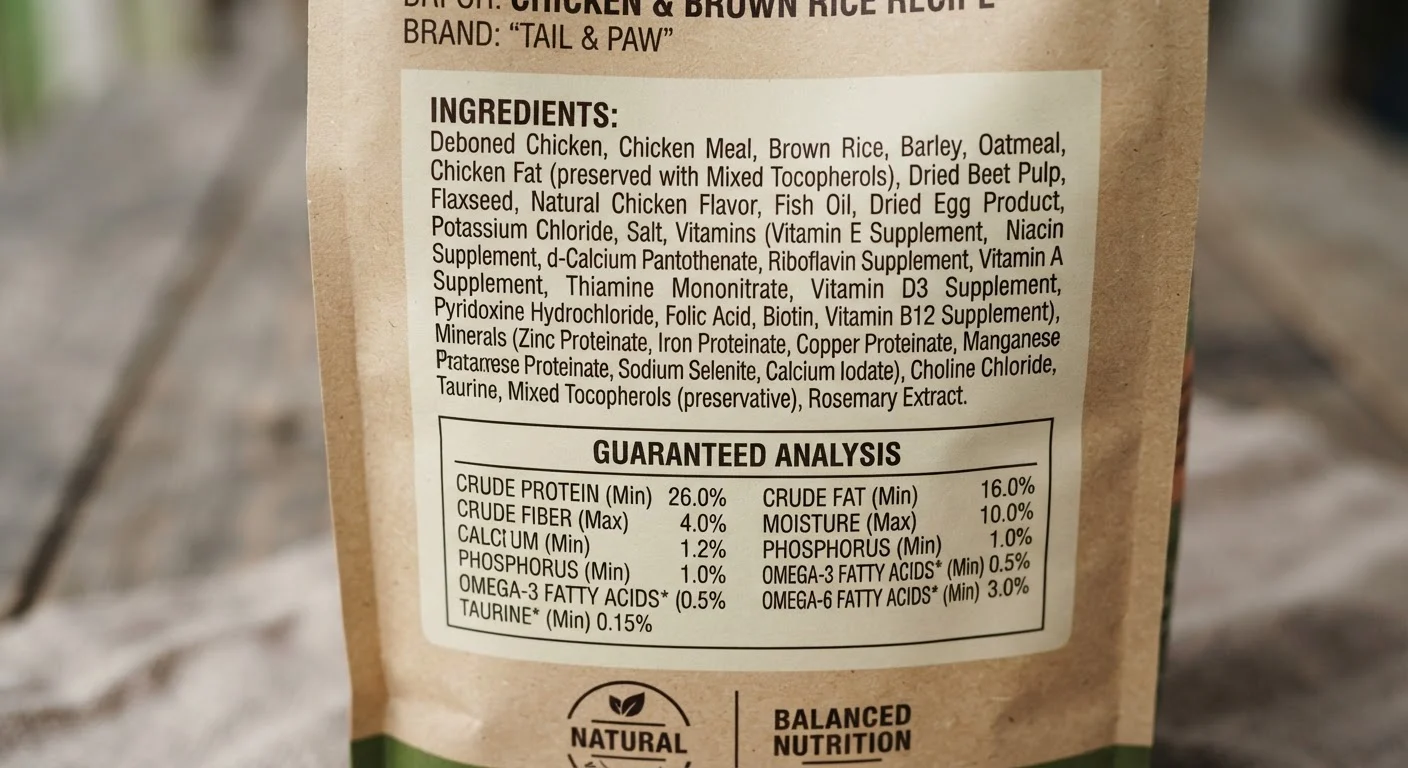
Photo: CoralScripts.com | Explore, Discover, Engage editorial
—— In This Article
The Seven Required Label Elements
Every pet food sold in the United States must display seven mandatory pieces of information. Understanding what each one means - and where to find it - is the foundation of label literacy.
| Regulatory Body | AAFCO sets model nutrient profiles; state agencies enforce labeling law (Association of American Feed Control Officials) |
| Required Label Sections | Product name, net weight, ingredient list, guaranteed analysis, nutritional adequacy statement, feeding directions, manufacturer info (AAFCO model regulations) |
| Ingredient List Order | Listed by pre-cooking weight, heaviest ingredient first (AAFCO and FDA guidelines) |
| Minimum Protein (Dry Matter) | Adult dogs: 18% DM; Adult cats: 26% DM (AAFCO nutrient profiles) |
| "Complete and Balanced" Validation | Via AAFCO feeding trials or nutrient profile comparison (AAFCO model regulations) |
| Moisture Cap (dry food) | Maximum 12% moisture for kibble (AAFCO model regulations) |
- Product name: Heavily regulated. Words like "beef," "chicken dinner," and "with salmon" each trigger specific ingredient percentage thresholds.
- Net quantity of contents: Weight or volume in standard U.S. units.
- Ingredient list: All ingredients listed by pre-cooking weight, heaviest first.
- Guaranteed analysis: Minimum or maximum nutrient percentages for crude protein, crude fat, crude fiber, and moisture.
- Nutritional adequacy statement: Indicates whether the food is "complete and balanced" and for which life stage.
- Feeding directions: A general guide - not a prescription - for how much to feed by body weight.
- Manufacturer name and address: Required for traceability and consumer inquiries.
For a parallel look at how human food labels are structured, see Reading a Nutrition Facts Label With Confidence.
Decoding the Ingredient List
The ingredient list is ordered by pre-processing weight - meaning a fresh meat listed first may weigh less than a dry grain after cooking drives off moisture. This is not a flaw; it is simply how the regulation works, and understanding it prevents misreading ingredient rank as a guarantee of nutritional dominance.
The product naming rules govern what the front panel can say:
- If a named ingredient appears alone (e.g., "Chicken for Cats"), it must constitute at least 95% of the total product weight, excluding added water.
- If descriptors like "dinner," "entrée," or "formula" appear, the named ingredient must make up at least 25%.
- "With " (e.g., "with real salmon") requires only 3% of that ingredient.
- "Flavor" designations require no minimum amount - only a detectable, characterizing level.
Watch for ingredient splitting. A food might list "chicken meal" first, followed by "rice flour," "brown rice," and "rice bran" as separate entries - even though their combined weight may exceed that of the meat. For a broader look at food marketing language, see Misleading Nutrition Claims and the Language Behind Them.
Guaranteed Analysis
A required panel on pet food labels listing minimum or maximum percentages of key nutrients - typically crude protein, crude fat, crude fiber, and moisture. It shows nutrient floors and ceilings, not exact amounts.
AAFCO
The Association of American Feed Control Officials, a nonprofit organization that sets model regulations and nutrient profiles for pet food. AAFCO does not directly regulate or approve products, but its standards are adopted by most U.S. states.
Ingredient Splitting
A labeling practice where a single ingredient (such as grain) is divided into multiple sub-forms - e.g., 'ground corn' and 'corn gluten meal' - so that each appears lower on the ingredient list individually, even if their combined weight is significant.
As-Fed vs. Dry Matter Basis
Two ways to express nutrient percentages. 'As-fed' includes moisture content; 'dry matter basis' removes moisture to allow fair comparisons between wet and dry foods.
Life Stage Claim
A label statement indicating which animal life stages a product is formulated for - such as growth, maintenance, reproduction, or all life stages. This is validated either through feeding trials or nutrient profile calculations.
Crude Protein
A measurement of total nitrogen-containing compounds in pet food, calculated by a standardized lab method. It reflects protein quantity, not quality or digestibility.
Understanding the Guaranteed Analysis
The guaranteed analysis panel lists minimum crude protein, minimum crude fat, maximum crude fiber, and maximum moisture. Some manufacturers voluntarily add taurine, omega fatty acids, or other nutrients, but only those four are universally required.
Wet vs. Dry: Compare on Dry Matter Basis
Because canned food can contain 70-80% moisture and kibble typically contains less than 12%, comparing guaranteed analysis percentages directly is misleading. To compare the two accurately, convert both to a dry matter basis: divide the nutrient percentage by (100 minus the moisture percentage), then multiply by 100. This levels the playing field and reveals true nutrient density across formats.
A critical point: "crude" measurements reflect a lab calculation method, not biological value. Crude protein estimates protein by measuring total nitrogen - but not all nitrogen comes from digestible amino acids. Two foods with identical crude protein percentages may differ substantially in how much protein a pet actually absorbs and uses.
7
Mandatory label elements on every U.S. pet food package
AAFCO model regulations require these elements regardless of product type or species.
~90%
Of U.S. states that adopt AAFCO model feed regulations
Most state feed control officials use AAFCO standards as the basis for pet food labeling enforcement.
4
Core nutrients in every guaranteed analysis panel
Crude protein, crude fat, crude fiber, and moisture are the four universally required guaranteed analysis entries.
When evaluating foods for pets with specific health conditions, always consult a veterinarian or board-certified veterinary nutritionist. The guaranteed analysis is a useful screening tool, but it does not replace professional guidance tailored to your individual animal. This article provides general educational information and is not a substitute for veterinary advice.
Nutritional Adequacy Statements and Life Stage Claims
The nutritional adequacy statement tells you whether a food is designed to serve as a complete diet. It will either confirm the food is "complete and balanced" for a named life stage, or indicate it is intended as a supplement or treat - not a sole diet source.
There are two ways a manufacturer can substantiate a "complete and balanced" claim:
- Nutrient profile method: Lab analysis confirms the food meets AAFCO's published minimum and maximum nutrient levels for the stated life stage.
- Feeding trial method: The food was fed to live animals under AAFCO protocol, and those animals maintained acceptable health markers. Labels validated this way typically read: "Animal feeding tests using AAFCO procedures substantiate that provides complete and balanced nutrition."
Life stage designations matter because nutrient requirements differ meaningfully across growth, reproduction, and adult maintenance. A food labeled only for "adult maintenance" is not formulated to meet the higher protein and mineral demands of puppies or kittens. For more on how population-level nutrient standards are built and applied, see The Science Behind Dietary Reference Intakes.
If you're also sorting through claims about human food safety for pets, Common Myths About Feeding Pets Human Food addresses the most persistent misconceptions with fact-based clarity.

Pets & Animal Life Editorial Team
Pets & Animal Life Editorial Team is the collective byline for our editorial team and contributor network. Articles published under this byline or an editorial pen name are researched, written, and reviewed according to our editorial standards for clarity, consistency, and independence before publication.
View author profile