
Understanding Your Car's Suspension System
Suspension is what keeps your wheels on the road and your ride comfortable. Explore how springs, dampers, and linkages work together.
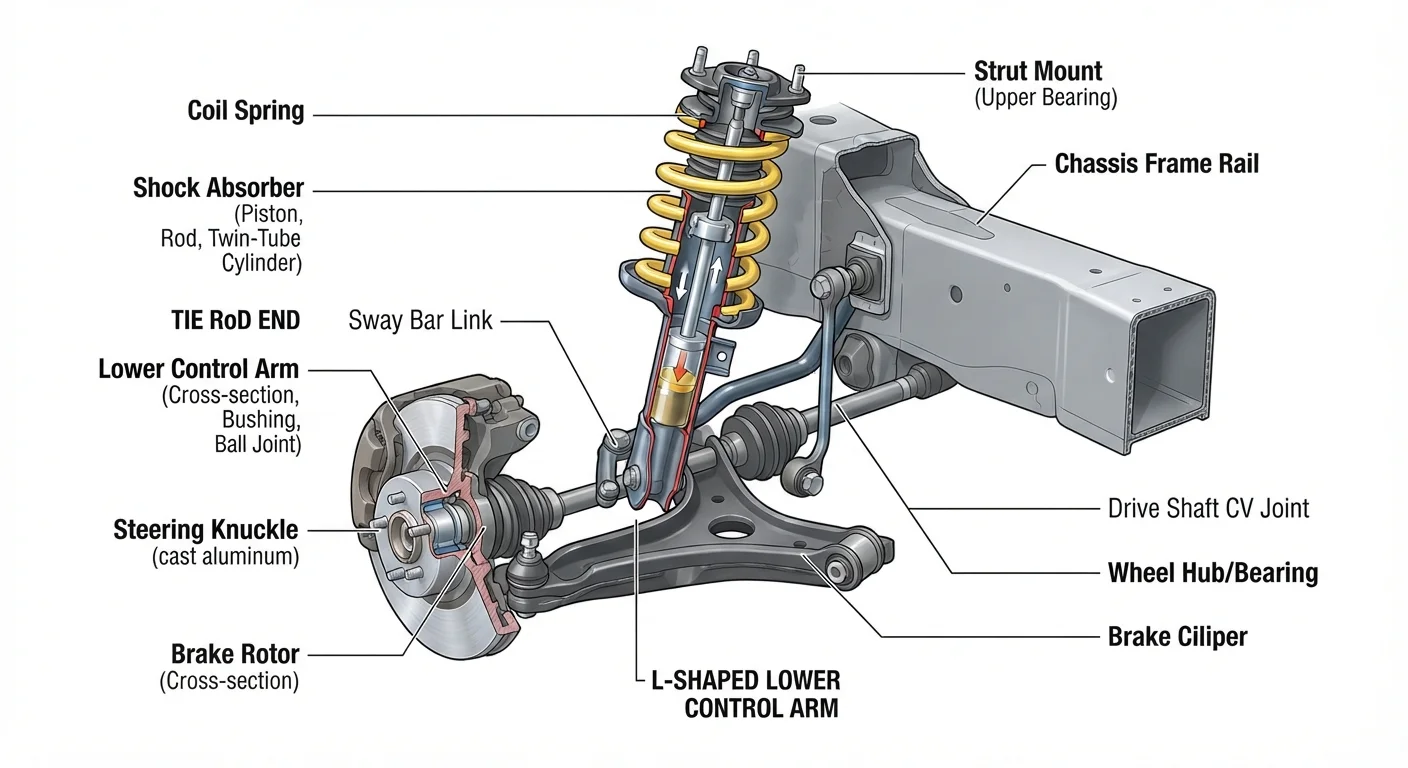
Photo: CoralScripts.com | Explore, Discover, Engage editorial
—— In This Article
Key Takeaways
- The suspension system keeps your tires in contact with the road surface while absorbing road impacts.
- Springs manage load and absorb bumps; dampers (shock absorbers) control how quickly the spring compresses and rebounds.
- Control arms, ball joints, and bushings form the linkage network that guides wheel movement.
- MacPherson strut and double-wishbone are the two most common suspension architectures on modern cars.
- Worn suspension components affect braking distance, tire wear, and steering precision - not just ride comfort.
- Many suspension inspections can be performed visually, but repairs typically require a qualified technician.
What a Suspension System Actually Does
Your car's suspension serves two simultaneous, sometimes competing goals: keeping the tires planted firmly on the road surface and isolating the passenger cabin from road irregularities. Without it, every crack, pothole, and undulation in the pavement would transmit directly to the chassis - and more critically, your tires would repeatedly lose contact with the road, degrading traction, steering, and braking.
Think of suspension as a controlled energy management system. When a wheel strikes a bump, kinetic energy enters the system. Springs store that energy momentarily; dampers dissipate it. The result is a wheel that follows the road profile while the body of the car remains comparatively stable. That stability is what makes safe steering inputs and effective braking possible.
For a broader grounding in how automotive systems interact, see our automotive terminology guide - it covers many of the geometry and handling terms you'll encounter when researching suspension topics.
Damper
A hydraulic device (also called a shock absorber) that controls how quickly the suspension compresses and rebounds, preventing ongoing oscillation after a bump.
Control Arm
A hinged link connecting the wheel hub assembly to the vehicle's frame or subframe, guiding the wheel's vertical travel while keeping it correctly positioned side-to-side.
Ball Joint
A pivot point connecting the control arm to the steering knuckle. It allows the wheel to steer left and right while also moving up and down with suspension travel.
Bushing
A cylindrical rubber or polyurethane sleeve pressed into suspension mounting points to absorb small vibrations and allow controlled, limited flex between components.
Wheel Alignment
The adjustment of the angles at which tires meet the road - including camber, caster, and toe - to ensure even tire wear, straight tracking, and predictable handling.
Unsprung Weight
The mass of components not supported by the springs - wheels, tires, hubs, and parts of the braking system. Lower unsprung weight generally improves the suspension's ability to follow road contours.
The Core Components: Springs, Dampers, and Linkages
Springs are the primary load-bearing element. Most modern passenger vehicles use coil springs - helical steel coils that compress under load and rebound when that load lifts. Leaf springs, traditional in trucks and rear axles, stack multiple steel strips that flex as a unit. Air springs, found on luxury and air-ride systems, use compressed air for adjustable stiffness.
Dampers (commonly called shock absorbers, or shocks) work in parallel with springs. A damper is essentially a hydraulic cylinder: as the suspension moves, a piston forces fluid through calibrated valves, converting kinetic energy into heat. Without dampers, a car would continue bouncing long after a bump - an effect known as underdamping.
Linkages guide how and where the wheel moves. The control arm (also called an A-arm or wishbone) connects the wheel hub to the vehicle's frame or subframe and allows the wheel to travel vertically while keeping it correctly positioned laterally. Ball joints at each end of the control arm provide the pivot points. Rubber or polyurethane bushings isolate small vibrations and allow controlled flex throughout the linkage.
Inspect Bushings During Tire Rotation
Each time your tires are rotated - typically every 5,000-7,500 miles - ask the technician to visually inspect control arm bushings and ball joints for cracking, tearing, or play. These checks take only a few minutes on a lift and can catch wear before it escalates. Catching a cracked bushing early is far less costly than replacing a bent control arm or correcting months of abnormal tire wear.
Common Suspension Designs
The MacPherson strut is the dominant front-suspension design on modern passenger cars. It combines the damper and upper structural support into a single strut assembly, reducing part count and packaging space. The strut's top mounts to the body via a bearing plate; the bottom attaches to the steering knuckle. It's cost-effective and compact, though it offers somewhat limited tuning flexibility compared to multi-link designs.
Double-wishbone (or dual A-arm) suspension uses two control arms - upper and lower - to locate the wheel. This geometry gives engineers greater control over camber change during suspension travel, which is why it's favored on performance cars and many trucks. It occupies more space and involves more components, but typically delivers superior handling precision.
Multi-link suspension uses three or more lateral and longitudinal links to control each wheel independently. Common at the rear of mid-range and premium vehicles, multi-link setups allow engineers to tune ride and handling characteristics with greater granularity than simpler designs permit.
Solid axle (beam axle) designs, still found on many trucks and heavy-duty vehicles, connect both wheels on an axle rigidly. One wheel's movement affects the other, which limits independent wheel travel but offers high load capacity and durability. Drive-layout also intersects with suspension behavior - our article on FWD, RWD, and AWD handling differences explains how torque delivery interacts with chassis dynamics.
Signs Your Suspension Needs Attention
Because suspension wear is gradual, many drivers adapt to degraded performance without realizing it. Watch for these concrete warning signs:
- Excessive bounce after hitting a bump - the car continues to oscillate rather than settling quickly.
- Nose-dive under braking or rearward squat during hard acceleration, indicating worn dampers.
- Uneven or cupped tire wear, which often results from suspension components that allow inconsistent tire contact.
- Steering wheel vibration or a drifting sensation on straight roads.
- Clunking or knocking sounds over bumps or during turns, commonly linked to worn ball joints or loose bushing play.
- Visible fluid leaks on or around the shock absorber or strut body.
If you observe multiple symptoms simultaneously, have a qualified technician inspect the system. Suspension problems compound: a worn bushing changes alignment geometry, which accelerates tire wear and places additional stress on adjacent components. See the Car Maintenance hub for a broader overview of what routine upkeep should cover.
Don't Delay Suspension Repairs
Worn suspension components directly affect your ability to steer and stop - not just ride comfort. A failed ball joint, for example, can cause sudden loss of wheel control. If a technician identifies a safety-critical component as worn beyond serviceable limits, treat the repair as urgent rather than discretionary. Operating a vehicle with known structural suspension damage is unsafe and may have legal implications depending on your state.
Suspension and Your Car's Overall System
Suspension does not operate in isolation. It is tightly coupled to steering geometry, tire performance, and braking effectiveness. Correct wheel alignment - the precise angular relationship between the wheels and the vehicle's centerline - depends entirely on suspension components being in good condition and properly adjusted. Worn bushings or bent control arms take the geometry out of specification even when the alignment was recently set.
The connection to braking is equally direct. As our related guide on how the braking system works explains, effective braking depends on consistent tire contact force. Degraded dampers undermine that contact, extending stopping distances.
Seasonal conditions add further demands - temperature extremes can harden rubber bushings and affect damper fluid viscosity. The seasonal vehicle maintenance checklist includes suspension-adjacent inspection points worth reviewing as conditions change.
Understanding your suspension system doesn't require mechanical expertise - but it does make you a more informed vehicle owner who can recognize problems early, communicate clearly with a technician, and make better decisions about maintenance timing.
Frequently Asked Questions

Cars & Driving Editorial Team
Cars & Driving Editorial Team is the collective byline for our editorial team and contributor network. Articles published under this byline or an editorial pen name are researched, written, and reviewed according to our editorial standards for clarity, consistency, and independence before publication.
View author profile