
The Origins of Mass Production: How Ford Reshaped the Automobile Industry
Explore how Ford's assembly line transformed car manufacturing and set the template for modern automotive production worldwide.
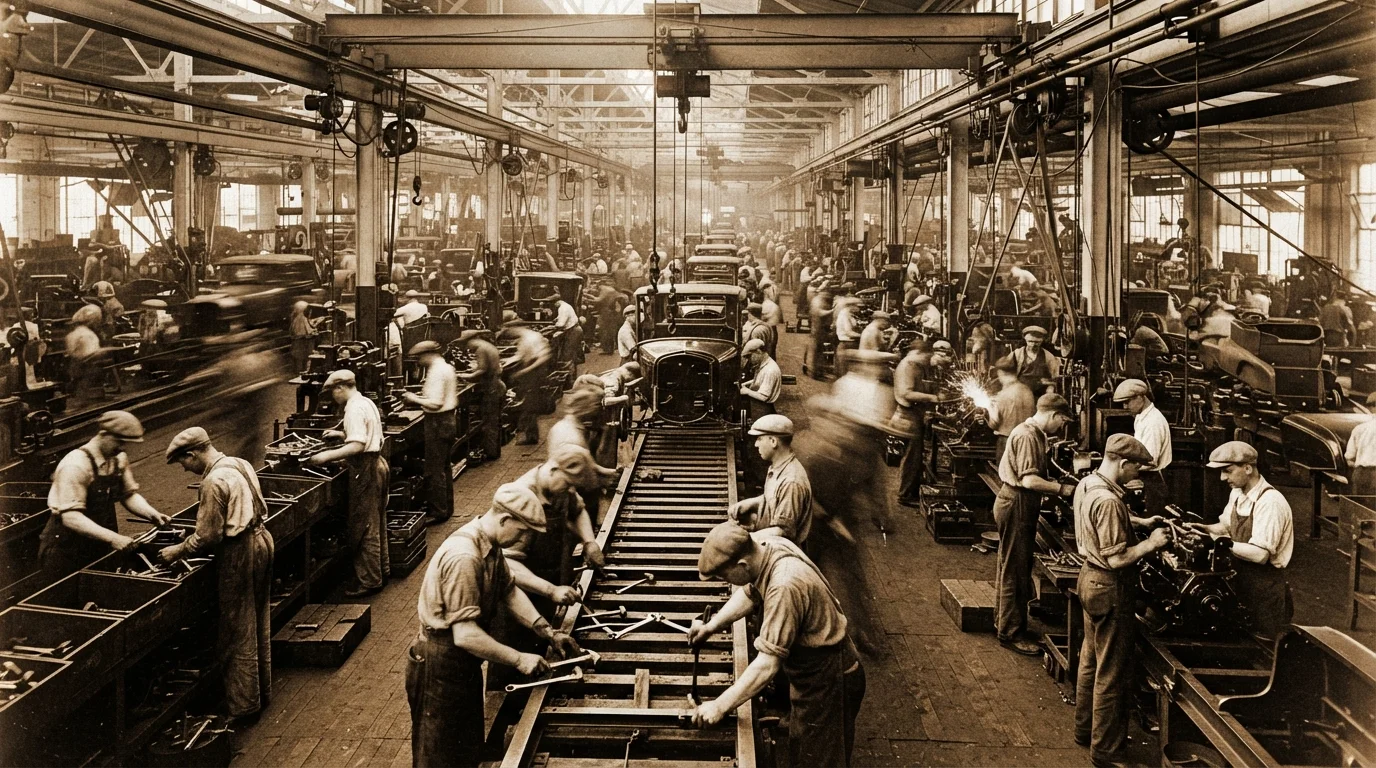
Photo: CoralScripts.com | Explore, Discover, Engage editorial
—— In This Article
Key Takeaways
- Ford's Highland Park plant introduced the moving assembly line in 1913, cutting Model T build time from over 12 hours to under 2 hours.
- Standardized, interchangeable parts were the engineering foundation that made continuous-flow assembly viable.
- Reduced production costs allowed Ford to lower the Model T's price repeatedly, expanding the car-buying market.
- The $5 workday Ford introduced in 1914 acknowledged that assembly-line workers needed wages sufficient to purchase what they built.
- Ford's production model influenced manufacturing well beyond the automobile industry, shaping 20th-century industrial economics globally.
Before the Assembly Line: Craft-Built Cars for the Few
In the early 1900s, building an automobile was essentially a craft trade. Small teams of skilled workers assembled each vehicle individually, fitting custom-machined parts and troubleshooting inconsistencies by hand. Production volumes were low, costs were high, and the resulting cars were priced well beyond the means of most American families. The automobile was a luxury of the prosperous, not a practical tool for the working class.
This constraint shaped the entire industry's character. Automakers competed on craftsmanship and novelty rather than accessibility. Manufacturers like Ransom Olds had experimented with stationary assembly stations and rudimentary division of labor as early as 1901, achieving modest efficiency gains with the curved-dash Oldsmobile, but no one had yet solved the central problem: how to build a reliable, affordable car at scale.
Ford recognized that unlocking mass ownership required solving the manufacturing problem first. The product had to be simple, durable, and consistently reproducible - and the process had to eliminate the bottlenecks inherent in craft production. That thinking led directly to the Model T and, more significantly, to the production system built around it.
The Highland Park Revolution: How the Moving Line Changed Everything
Ford's Highland Park plant in Michigan became the site of one of the most consequential manufacturing experiments in industrial history. Drawing on principles observed in grain elevators, flour mills, and Chicago meatpacking operations - where materials moved continuously past stationary workers - Ford's engineers designed a system where the car moved to the worker, not the other way around.
The moving assembly line was introduced in stages beginning in 1913. The first application was chassis assembly, where a continuous chain conveyor pulled the frame at a controlled pace past workers each performing a single, defined task. The result was transformative: chassis assembly time fell from over 12 hours to roughly 93 minutes by the end of that year. Total vehicle production costs dropped sharply, and Ford passed much of that saving to consumers through repeated price reductions.
~93 min
Model T chassis assembly time after moving line
Down from over 12 hours before the moving assembly line was introduced at Highland Park in 1913.
$5/day
Ford's landmark base wage introduced in 1914
Roughly double the prevailing industrial wage at the time, introduced partly to reduce severe worker turnover on the assembly line.
15 million+
Model T units produced over its production run
Produced from 1908 to 1927, the Model T's volume was made possible entirely by continuous-flow mass production methods.
The engineering prerequisites were equally important. Interchangeable parts - components machined to such consistent tolerances that any unit would fit any assembly without hand-fitting - made the moving line viable. Without that precision, line workers could not maintain pace; a misfit part would halt the entire sequence. Ford invested heavily in specialized machine tools that produced parts to specifications the craft era could not match.
The system's logic spread rapidly across Ford's operations. Subassemblies - engines, transmissions, axles - each got their own dedicated lines feeding into the main chassis line. Coordination between these parallel streams required disciplined scheduling and standardized timing, prefiguring modern just-in-time concepts by decades. For more on how that industrial legacy shaped automotive brand identities over time, see the world's major automotive brands reference guide.
The Human Equation: Labor, Wages, and the Social Contract of Mass Production
The assembly line's efficiency came with a significant human cost. The work was relentless, repetitive, and physically demanding. Early turnover rates at Highland Park were severe - Ford reportedly needed to hire roughly 963 workers for every 100 permanent positions it maintained, as workers quit or were dismissed at extraordinary rates. The monotony of performing one motion hundreds of times per shift was a genuine industrial problem, not merely an abstract concern.
Ford's response in January 1914 - doubling the base wage to $5 per day for qualified workers - is often framed as straightforward generosity, but the economics were more calculated. Higher wages reduced turnover, cutting the constant cost of hiring and training replacements. They also put purchasing power into the hands of the very workers building the cars, supporting the consumer market Ford needed to sustain production volume. It was an early, pragmatic recognition that wages and consumer demand were structurally linked.
“The way to make automobiles is to make one automobile like another automobile, to make them all alike, to make them come through the factory just alike - just as one pin is like another pin when it comes from a pin factory.”
— Henry Ford, Founder, Ford Motor Company - as quoted in his 1922 autobiography 'My Life and Work'
The labor arrangement also illustrates why mass production carries social implications beyond factory walls. As Ford's model was adopted globally through the 20th century, it reshaped not just manufacturing but the organization of urban life, commuting patterns, and national infrastructure policy. The ripple effects extended far beyond Detroit - a dynamic explored in how country of origin shapes a car brand's global reputation.
Legacy and Evolution: From Fordism to Modern Manufacturing
Ford's mass-production template, often called Fordism in economic and sociological literature, became the dominant manufacturing paradigm for much of the 20th century. Competitors adopted and modified it. General Motors added annual styling changes and a tiered model lineup under Alfred Sloan, addressing one of Fordism's weaknesses - its resistance to variety and consumer preference. The Model T's single-configuration rigidity was eventually the limitation that ended its production run in 1927.
Later, Japanese manufacturers - most notably Toyota - developed what became known as lean manufacturing, or the Toyota Production System. Rather than simply maximizing throughput on a moving line, lean methods focused on eliminating waste, empowering workers to halt the line when defects appeared, and building quality in at each stage rather than inspecting it out at the end. This represented a significant philosophical evolution from Ford's original model while retaining its core logic of continuous flow and standardization.
Today's automotive plants combine robotics, real-time sensor data, and sophisticated logistics software with assembly-line principles that remain recognizably Fordist in structure. The car still moves past stations; workers - human and robotic - still perform defined tasks in sequence. What has changed is the precision, the flexibility, and the quality assurance embedded in every step. Understanding these interconnected corporate structures helps explain why automaker alliances and platform-sharing arrangements are so economically logical: shared platforms and components are a direct descendant of standardization thinking Ford pioneered.
The contrast with artisanal traditions is equally instructive. Italian coachbuilding traditions represent the alternative path - low-volume, design-led production where craft and individual expression remained central. Both traditions coexist today, occupying different ends of a market that Ford's revolution made possible by defining what mainstream automotive manufacturing could be.
Connecting Manufacturing History to Modern Car Buying
Understanding mass production's origins helps explain why modern vehicles from mainstream manufacturers share so many components across model lines and even across brands within the same corporate group. Platform sharing is the direct descendant of Ford's standardization philosophy - and it's a key reason why today's vehicles offer better value per feature than previous generations. When evaluating any vehicle, knowing which platform it shares with other models can give useful context about parts availability and long-term support.
Frequently Asked Questions

Cars & Driving Editorial Team
Cars & Driving Editorial Team is the collective byline for our editorial team and contributor network. Articles published under this byline or an editorial pen name are researched, written, and reviewed according to our editorial standards for clarity, consistency, and independence before publication.
View author profile