
A Century of Italian Coachbuilding: The Carrozzerie That Shaped Car Design
Italy's design houses gave the world some of its most celebrated car bodies. Here's how the coachbuilding tradition evolved over 100 years.
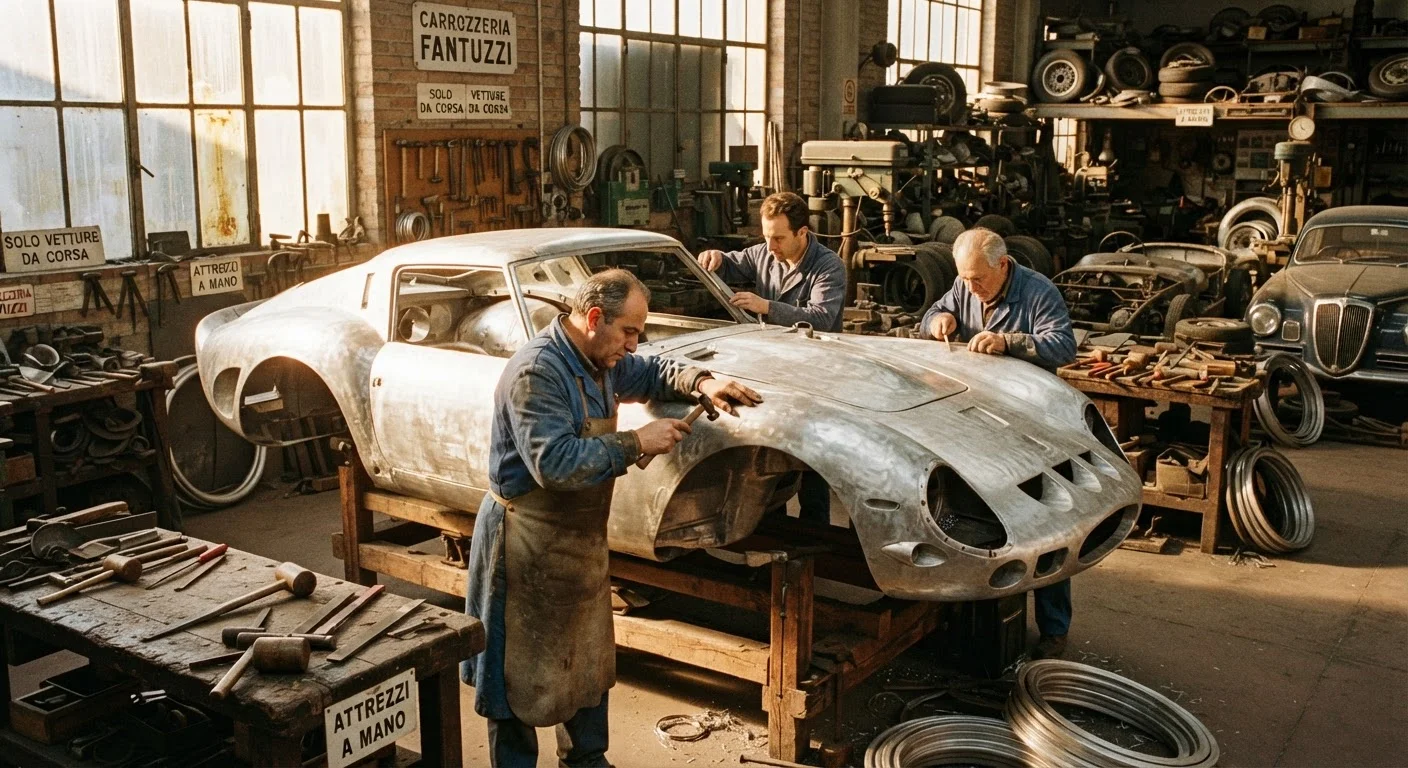
Photo: CoralScripts.com | Explore, Discover, Engage editorial
—— In This Article
What Is a Carrozzeria?
The Italian word carrozzeria (plural: carrozzerie) translates literally as "coachworks" - a body-building workshop that designs and constructs automobile bodywork, typically over a rolling chassis supplied by a separate manufacturer. The tradition traces directly to horse-drawn carriage making, where skilled craftsmen shaped wood and metal into bespoke vehicles for wealthy clients.
When the automobile arrived in Italy in the early 1900s, northern workshops - concentrated around Turin and Milan - adapted their skills to the new technology. Chassis from Fiat, Alfa Romeo, and later Ferrari would arrive bare, and a carrozzeria would clothe them in hand-formed aluminum or steel bodies according to a client's specification or its own show-stopping concept.
Carrozzeria
An Italian coachbuilding workshop that designs and constructs automobile bodies, typically mounted on a chassis supplied by a separate manufacturer. The plural form is carrozzerie.
Superleggera
Italian for "superlight," a construction technique pioneered by Touring that uses a network of small steel tubes as an internal skeleton over which thin aluminum panels are hand-formed and attached.
Rolling chassis
A completed mechanical platform - frame, engine, drivetrain, and suspension - delivered to a coachbuilder without any body or interior, ready to be clothed to specification.
Bespoke coachwork
A custom-built vehicle body produced to an individual client's requirements, as opposed to a standardized production body applied uniformly across a model run.
Double-bubble roof
A roofline design associated with Zagato, featuring two shallow parallel domes divided by a longitudinal ridge. The form reduces overall roof mass while maintaining interior headroom.
Concept car
A non-production vehicle built to demonstrate design direction, technical innovation, or brand identity, typically shown at international motor shows rather than sold commercially.
This division of labor - engine and mechanicals from one source, body from another - distinguished European, and especially Italian, car-making culture from the volume-production approach that was simultaneously transforming American manufacturing. For context on that contrasting trajectory, see how Ford's assembly line reshaped the automobile industry.
The Founding Era: 1910s-1940s
The foundational carrozzerie emerged between the two world wars. Stabilimenti Farina, established in Turin in 1906 by Giovanni Farina, is among the earliest documented Italian coachbuilders. His younger brother Battista "Pinin" Farina branched off in 1930 to create what would become Pininfarina - a name that would eventually define Italian automotive elegance globally.
Touring Superleggera, founded in Milan in 1926, pioneered the Superleggera (superlight) construction method: a framework of small-diameter steel tubes over which thin aluminum panels were beaten by hand. The result was a body structure that was both lighter and more aerodynamically refined than conventional practice allowed. Touring used this technique on bodies for Alfa Romeo, Lancia, and visiting British and German chassis.
| Oldest surviving major carrozzeria | Zagato (founded 1919, Milan) |
| Primary hub city | Turin (Torino), Piedmont - home to Pininfarina, Bertone, Italdesign, and Stabilimenti Farina |
| Superleggera technique origin | Touring Superleggera, Milan, 1930s |
| Pininfarina founding year | 1930, by Battista "Pinin" Farina |
| Italdesign founding year | 1968, by Giorgetto Giugiaro |
| Key design shift | 1980s-1990s transition from volume coachbuilding to design consultancy and limited-series production |
Zagato, also Milan-based and founded in 1919 by Ugo Zagato, developed a reputation for aerodynamic efficiency rooted in its founder's experience with aircraft construction during World War I. The double-bubble roofline - two shallow domes separated by a central ridge - became a Zagato signature, reducing weight while creating headroom.
Postwar Golden Age: 1950s-1970s
Italy's postwar economic recovery, the miracolo economico, coincided with the golden age of coachbuilding. Carrozzerie were producing some of the most photographed automobile bodies in history - often for Ferrari, Maserati, and Lancia chassis that served as competitive platforms for their design ambitions.
Pininfarina's work on the Ferrari 250 series through the late 1950s and into the 1960s established proportional language - long hood, short rear deck, minimal ornamentation - that influenced sports car design worldwide. Sergio Pininfarina, who took over from his father Battista in 1961, oversaw a studio that also shaped production Fiats and Alfa Romeos, bringing coachbuilding aesthetics to mainstream volumes.
Bertone, founded by Giovanni Bertone in 1912 and reshaped by his son Nuccio, produced landmark concept cars that redefined what an automobile could look like. The Alfa Romeo Giulia Sprint GT (1963) and the Lamborghini Miura (1966) body - both Bertone designs - introduced the mid-engine supercar silhouette. Italdesign, established by Giorgetto Giugiaro in 1968, extended coachbuilding logic into industrial design consultancy, producing the Volkswagen Golf Mk1, the original Fiat Panda, and the De Tomaso Mangusta body among hundreds of projects.
Racing heritage shaped many of these road car designs, with aerodynamic lessons from competition filtering directly into how carrozzerie approached fastback rooflines, fender flares, and underbody profiles.
Consolidation and the Modern Studio Model
By the 1980s and 1990s, the economics of bespoke coachbuilding had become difficult to sustain. Safety regulations required crash testing of every new body variant - an expense that made small-run, one-off construction far more costly. Simultaneously, major automakers had built substantial in-house design departments, reducing their dependence on outside studios for production vehicle styling.
Several historic names were absorbed by larger groups. Pininfarina became a publicly listed company, eventually moving away from large-scale manufacturing toward design consultancy and engineering services. Bertone filed for bankruptcy in 2014, and its Turin facility was later sold. Zagato survived by focusing on ultra-limited "bespoke" collaborations with marques including Aston Martin and Alfa Romeo, typically building fewer than a hundred units per project.
The surviving studios pivoted from sheet-metal fabrication to digital design, clay modeling for major clients, and concept car production for motor shows - a role that keeps their design language visible even as volume production moved elsewhere. This evolution reflects a broader dynamic explored in how car brands reinvent themselves without losing their identity.
Design Studios vs. Manufacturers: An Important Distinction
Italian carrozzerie were independent commercial entities, not subsidiaries of the chassis manufacturers they worked with. A single studio - such as Pininfarina - could simultaneously hold design contracts with Fiat, Alfa Romeo, Ferrari, and foreign marques like Peugeot or Honda. This independence gave studios creative latitude but also commercial vulnerability when automakers built in-house design capacity.
Italy's coachbuilding legacy continues to shape how the country's automotive reputation is perceived internationally. The cultural weight of design provenance is examined further in how country of origin shapes a car brand's global reputation. For a broader reference on the manufacturers these studios clothed, see the world's major automotive brands reference guide.

Cars & Driving Editorial Team
Cars & Driving Editorial Team is the collective byline for our editorial team and contributor network. Articles published under this byline or an editorial pen name are researched, written, and reviewed according to our editorial standards for clarity, consistency, and independence before publication.
View author profile