
Making Sense of International Phone Plans, SIM Cards, and eSIMs
Roaming charges, local SIM cards, and eSIM profiles each work differently. Here's what American travelers need to know about staying connected abroad.
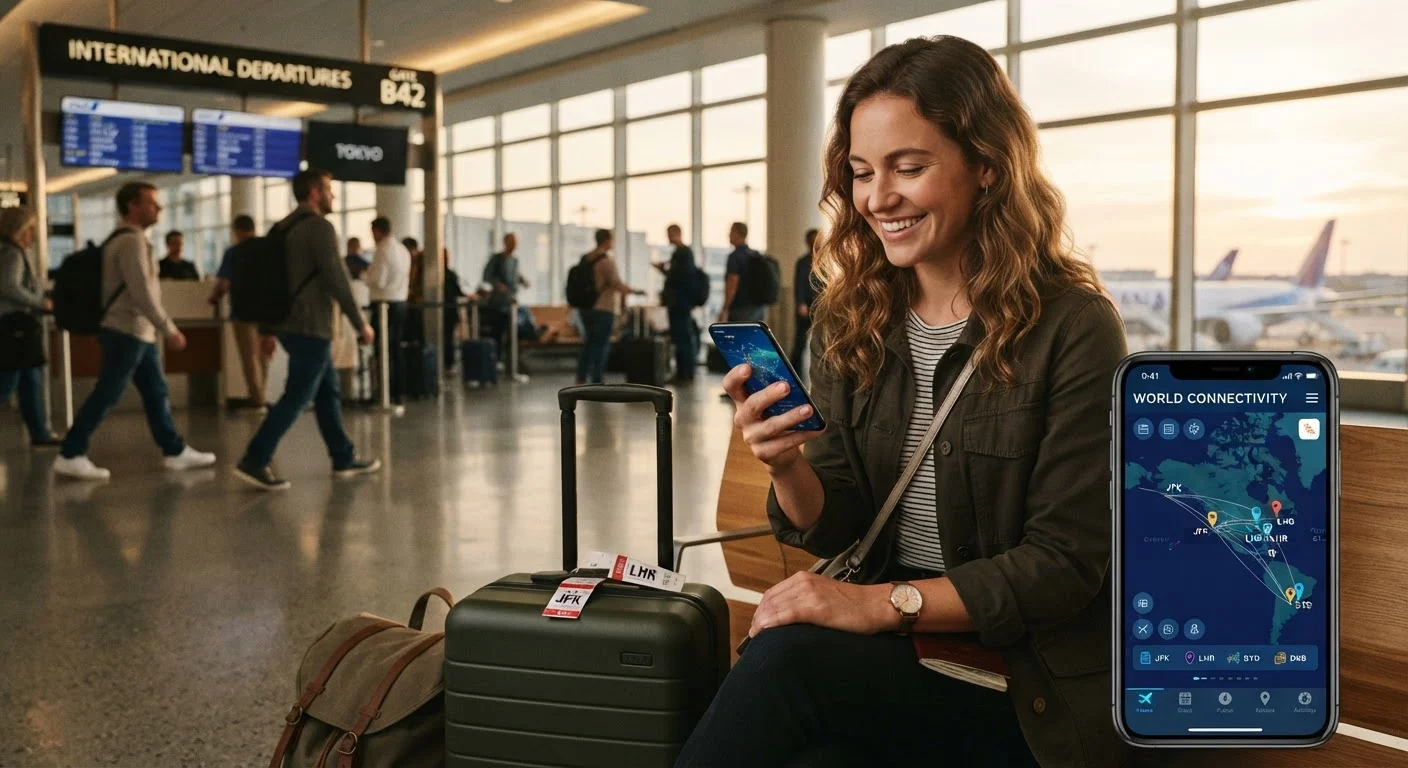
Photo: CoralScripts.com | Explore, Discover, Engage editorial
—— In This Article
Key Takeaways
- International roaming through your US carrier is the most convenient but typically the most expensive option.
- Local SIM cards offer the best per-day value but require an unlocked phone and some logistical effort on arrival.
- eSIMs allow travelers to pre-load a foreign data plan before departure without swapping physical cards.
- Not all phones support eSIM, and not all carriers support international eSIM profiles — check both before relying on this option.
- Each connectivity method has distinct trade-offs across cost, convenience, and reliability worth comparing before you pack.
The Three Options Every Traveler Should Understand
When Americans travel internationally, staying connected typically comes down to three approaches: activating an international roaming add-on through their existing US carrier, purchasing a local SIM card after arriving in-country, or loading an eSIM profile from a data provider before departure. Each approach works differently at a technical and logistical level, and each has a distinct cost and convenience profile worth understanding before you leave home.
This isn't a purely academic question. Connectivity abroad affects navigation, translation apps, ride-hailing services, banking two-factor authentication, and communication with family — all practical needs that compound quickly. For context on how phone connectivity fits alongside other financial logistics, see our guide on managing money across borders.
| Roaming Add-On | Local SIM Card | eSIM Profile | |
|---|---|---|---|
| Typical cost | $10–$15/day or monthly add-on | Varies; often $10–$30 for multi-day | $10–$40 depending on region and data |
| Setup effort | Minimal — activate via app or SMS | Requires finding a store and ID | Pre-purchase and install before travel |
| US number retained | Yes | No (new local number) | Data only; US number needs separate plan |
| Phone requirement | Any unlocked or carrier-locked phone | Phone must be unlocked | eSIM-compatible device required |
| Works across multiple countries | Often yes, at extra per-country cost | Typically limited to one country | Depends on provider; regional plans exist |
| Data speeds | Variable; depends on partner networks | Full local network speeds | Full local network speeds |
| Best trip length | 1–5 days | 5+ days in one region | Any length on supported devices |
International Roaming Add-Ons: Convenience at a Price
Major US carriers — including the three national network operators — offer international day passes or monthly add-ons that extend your existing number and plan to partner networks overseas. The appeal is frictionless: no new SIM, no new number, and your contacts can still reach you normally.
The drawback is cost. Day-pass pricing typically runs $10–$15 per day, which adds up fast on a two-week trip. Monthly international add-ons exist and offer better value for frequent travelers, but data speeds on partner networks may be throttled after a usage threshold. Always read the specific terms for the countries you're visiting — coverage quality varies considerably by destination.
Roaming Without a Plan Can Be Costly
Using your US phone abroad without activating an international add-on can result in per-megabyte data charges that accumulate quickly. Even background app activity — software updates, email syncing, cloud backups — can trigger significant charges. Enable airplane mode and connect only via Wi-Fi until you have a plan in place, or disable data roaming in your phone's settings as a precaution.
Local SIM Cards: Best Value, Most Setup
Purchasing a prepaid SIM card from a local carrier after landing often delivers the most data per dollar. In many markets — Western Europe, Southeast Asia, Japan, Mexico — robust prepaid options are available at airports, convenience stores, or carrier shops. Plans commonly include generous data allotments, local calling minutes, and sometimes international call credits for $10–$30.
The requirements: your phone must be unlocked (not carrier-locked to a US network), and you'll need to physically swap your SIM card, storing the original safely. In some countries, SIM registration requires a passport, so have it accessible. Local SIMs are purpose-built for stays in one country; if your itinerary spans multiple nations, you'll either need a separate SIM per country or a regional SIM designed for multi-country use, which exist but vary in quality.
Check Your Phone's Lock Status First
Before committing to a local SIM or eSIM strategy, confirm your phone is unlocked. Most US carriers unlock devices after contract obligations are met, but the process varies. Contact your carrier directly or check your device settings — an unlocked phone opens up the full range of international connectivity options.
eSIMs: The Increasingly Practical Middle Ground
An eSIM (embedded SIM) is a software-based SIM profile that can be downloaded onto compatible devices without a physical card swap. Travelers can purchase an international eSIM plan from a data provider before departure, scan a QR code, and have coverage ready when the plane lands. Many modern iPhones (XS and newer), Google Pixel phones, and Samsung Galaxy models support eSIM — though availability varies by carrier and region.
eSIMs are particularly well-suited for multi-country itineraries when a regional plan is available. The main limitations: not all devices support eSIM, and purely data-only eSIM plans don't provide a local phone number, meaning calls and SMS to your US number won't come through unless your US carrier's plan remains active in parallel. A common workaround is using a dual-SIM device — keeping the US eSIM or physical SIM active for calls and number retention while running a separate international data eSIM.
If you're in the early stages of planning your international trip, the trip planning approaches guide offers a useful framework for thinking through logistics like this alongside your broader itinerary.
3–5x
Cost premium for standard international roaming
Industry analyses consistently show per-MB roaming costs run several times higher than equivalent local data, making plan selection a meaningful financial decision.
~50%
Global smartphone eSIM adoption share
GSMA research indicates roughly half of new smartphones shipped globally include eSIM capability, though rollout varies by market and carrier.
How to Choose Before You Depart
The right method depends on several practical factors. Trip length is the most immediate filter: a three-day business trip favors the simplicity of a roaming add-on, while a three-week backpacking journey justifies the setup investment of a local SIM or eSIM. Destination count matters next — single-country trips simplify the SIM equation considerably. Device compatibility determines whether eSIM is even on the table.
Before departure, take these concrete steps: confirm whether your phone is unlocked; check your carrier's international add-on pricing for your specific destinations; verify eSIM compatibility in your device settings; and research local SIM availability for your arrival city. For first-time international travelers, the first international trip guide covers this and other practical groundwork in detail.
Whichever method you choose, the key principle is the same: make the decision before departure, not after you land with a roaming clock already running.

Travel & Places Editorial Team
Travel & Places Editorial Team is the collective byline for our editorial team and contributor network. Articles published under this byline or an editorial pen name are researched, written, and reviewed according to our editorial standards for clarity, consistency, and independence before publication.
View author profile