
Animal Play: What It Teaches Young Animals and Why It Matters
Play isn't just fun — it's how young animals develop motor skills, social bonds, and problem-solving abilities. A look at play behavior across species.
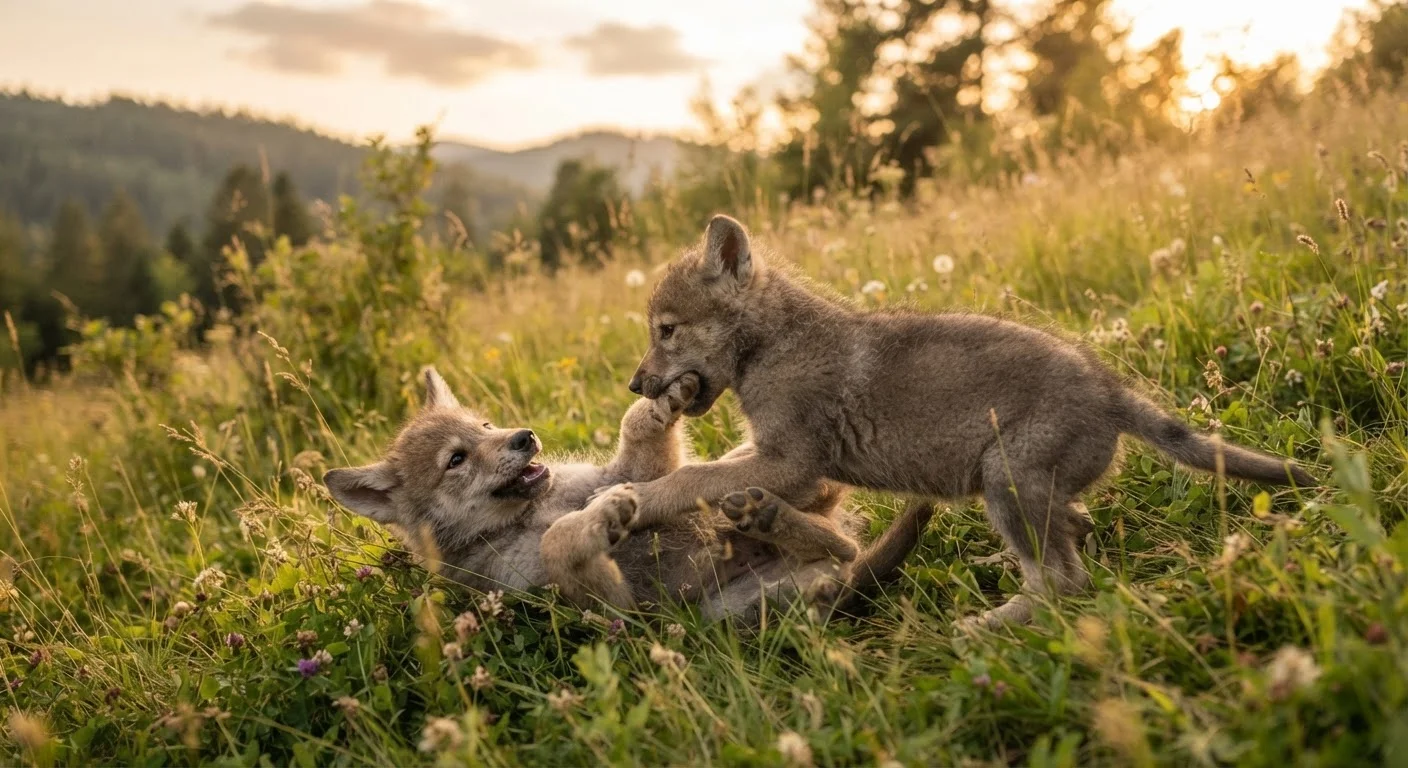
Photo: CoralScripts.com | Explore, Discover, Engage editorial
—— In This Article
Key Takeaways
- Play behavior is a recognized scientific category with specific criteria, not simply random activity.
- Young animals use play to develop motor coordination, predator-prey skills, and social rules.
- Play deprivation in juveniles has measurable negative effects on adult social competence.
- Multiple species - including ravens, dolphins, and meerkats - show complex, structured play.
- Play intensity typically peaks during juvenile development and declines as animals mature.
- Understanding play informs how we enrich domestic pet environments and support captive animal welfare.
Why Scientists Take Play Seriously
For much of the 20th century, animal play was treated as a developmental footnote - charming, perhaps, but not scientifically urgent. That view has shifted substantially. Behavioral biologists now regard play as one of the most revealing windows into an animal's developmental biology, cognitive capacity, and social architecture.
The foundational challenge was definitional. Play looks superficially like other behaviors - running, biting, stalking - but operates by different rules. Ethologist Gordon Burghardt's widely cited framework identifies five criteria that distinguish genuine play: it is voluntary, intrinsically rewarding, structurally incomplete or exaggerated compared to serious behavior, repeated, and initiated when the animal is relaxed and unstressed. Applying these criteria has allowed researchers to document play systematically across dozens of species, from brown bears to komodo dragons.
This matters because play isn't cheap. It consumes energy, carries injury risk, and distracts from foraging. Natural selection would not preserve costly behavior without payoff. The question researchers ask is: what does play buy the animal? The answers, accumulated across decades of field and laboratory work, are substantial. See the ethology field guide for foundational concepts underpinning this research.
5
Criteria defining genuine play behavior
Ethologist Gordon Burghardt's widely referenced framework requires behavior to meet five distinct criteria before it qualifies as true play.
~15%
Daily time juvenile meerkats spend in social play
Field research on meerkat groups has documented juveniles dedicating roughly 15% of their active time to social play during peak developmental periods.
Lasting
Social deficits from juvenile play deprivation in rats
Laboratory studies have shown that rats denied play during sensitive developmental windows exhibit persistent social behavior deficits that are difficult to reverse in adulthood.
What Young Animals Are Actually Learning
Play functions as a rehearsal stage for adult competencies across three domains: motor skills, social negotiation, and problem-solving.
Motor and Predatory Skills
In carnivores, juvenile play closely mirrors adult hunting sequences - stalking, pouncing, biting, and shaking - but performed with reduced force and against non-threatening partners. Domestic kittens, for example, progress through recognizable predatory play sequences that refine the timing and coordination they'll rely on for hunting. Research on meerkats has shown that pups introduced to live prey during play sessions achieve hunting proficiency earlier than those who aren't, suggesting that play accelerates motor calibration.
Social Rules and Conflict Management
Perhaps the most critical function of play is teaching animals how to navigate social relationships without catastrophic conflict. Play fighting requires constant negotiation: signaling intent, reading responses, self-handicapping to keep the interaction going, and repairing ruptures when play turns too rough. Animals that skip this training often struggle as adults. Studies on rats show that juveniles denied play experience during sensitive developmental windows display inappropriate aggression and difficulty reading social cues as adults - a deficit not easily corrected later. This connects directly to what we know about socialisation windows in domestic species.
Cognitive Flexibility and Problem-Solving
Object play - manipulating items with no immediate functional purpose - appears linked to cognitive flexibility. Corvids, including ravens and crows, engage in elaborate object play, and the same species consistently top avian problem-solving tasks. Whether play causes cognitive capacity or simply co-occurs with it remains an active research question, though the correlation is consistent enough to take seriously. For a broader look at how researchers measure animal minds, see our coverage of animal intelligence.
Recognizing Play vs. Stress in Pets
Play and stress-driven behavior can look superficially similar - both involve high energy and rapid movement. Key distinctions: play typically involves role reversals, self-handicapping, and repeated return to the interaction. Stressed or fear-driven behavior tends to be directional (toward escape) and lacks the relaxed facial and body posture common in genuine play. When in doubt, observe whether the animal voluntarily re-engages after a pause.
Play Across Species: Patterns and Variations
Play is not uniformly distributed across the animal kingdom. Its prevalence and complexity follow predictable patterns tied to ecology, social structure, and developmental pace.
Social species with long juvenile periods - wolves, dolphins, elephants, primates - show the most elaborate play repertoires. Wolf pups engage in role-reversal play fighting where dominant individuals deliberately allow subordinates to "win," a behavior thought to build social cohesion. Bottlenose dolphins have been observed using objects as play props and engaging in cooperative play sequences with no survival function. Young elephants engage in extended social play that appears to rehearse dominance negotiation and alliance-building skills they'll need in adult herds.
By contrast, many solitary species - certain felids, most reptiles - show minimal juvenile play, consistent with the theory that play's social learning function is less relevant when adult life is largely solitary. Understanding these patterns requires appreciating how social living arrangements shape behavioral development across species.
What This Means for Domestic Animals and Captive Wildlife
The science of play has practical implications for anyone responsible for animal welfare - whether caring for pets or managing animals in professional settings.
For domestic pets, play isn't optional enrichment; it's developmentally necessary. Puppies and kittens deprived of adequate play with conspecifics during juvenile windows often display anxiety, poor bite inhibition, and difficulty reading social signals from other animals. This is why animal behaviorists consistently emphasize structured, supervised play with other animals - not just with humans or toys - during early development.
Adult pets also benefit, though for different reasons. Play in adult animals is associated with stress reduction and maintenance of cognitive engagement. The distinction between physical exercise and mental enrichment is important here: enrichment, not just exercise, is what keeps animals mentally well. Play that involves novelty, choice, and problem-solving components delivers both.
In zoo and conservation settings, play opportunities are now considered a welfare indicator. Captive animals that play are generally assessed as less stressed and more behaviorally flexible - qualities that matter significantly if individuals are candidates for reintroduction programs. Pet owners interested in observing and interpreting their own animals' play can find a useful starting framework in our guide to observing animal behavior at home.
Play Deprivation Is a Welfare Concern
Animal welfare assessments increasingly include play opportunity as a measurable indicator of psychological wellbeing, not just physical health. For domestic animals, especially those kept in isolation or highly restricted environments, the absence of regular play opportunity should be treated as a welfare gap worth addressing - not a minor inconvenience. Consult a veterinary behaviorist if you observe persistent play deficits in your pet alongside other behavioral changes.
Frequently Asked Questions

Pets & Animal Life Editorial Team
Pets & Animal Life Editorial Team is the collective byline for our editorial team and contributor network. Articles published under this byline or an editorial pen name are researched, written, and reviewed according to our editorial standards for clarity, consistency, and independence before publication.
View author profile