
Index Funds Explained: Passive Investing and the Case for Broad Market Exposure
Learn what index funds are, how they differ from actively managed funds, and why broad market exposure is central to many long-term strategies.
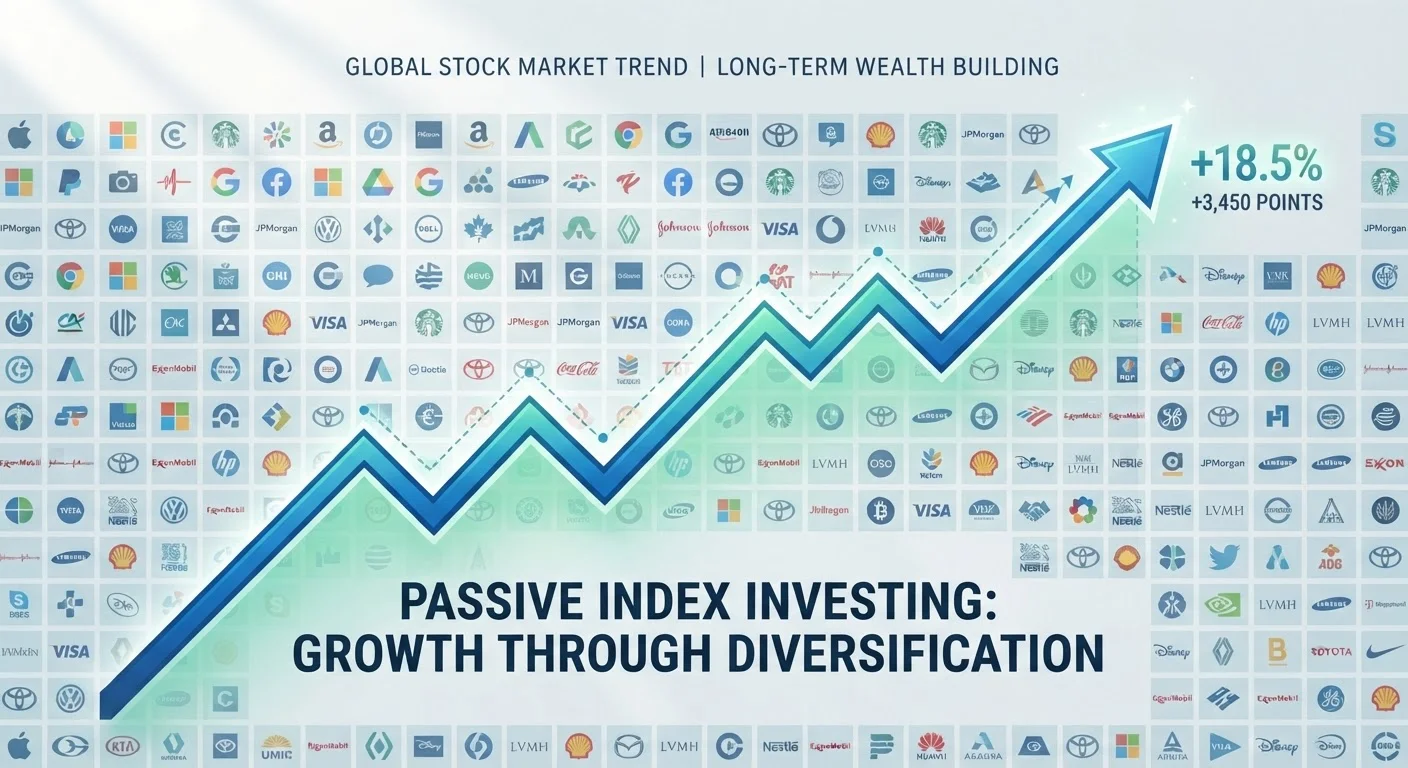
Photo: CoralScripts.com | Explore, Discover, Engage editorial
—— In This Article
Key Takeaways
- Index funds track a market benchmark rather than relying on active stock selection.
- Their passive structure typically results in lower expense ratios than actively managed funds.
- Broad market exposure helps spread risk across hundreds or thousands of holdings.
- Over long time horizons, most actively managed funds underperform their benchmark index after fees.
- Index funds are not risk-free - they fall when the market falls, and returns are never guaranteed.
What Index Funds Are and How They Work
At their core, index funds eliminate the human element of stock selection. When a fund manager attempts to identify undervalued companies or time the market, that is active management. An index fund, by contrast, simply holds every security in its target index - weighted by market capitalization in most cases - and adjusts only when the index itself changes.
This mechanical approach has two immediate consequences. First, operating costs stay low because there is no team of analysts conducting deep research or executing frequent trades. Second, the investor's return closely mirrors the index's return, for better or worse. If the S&P 500 rises 10% in a year, a fund tracking it should return close to that figure, minus a small expense ratio.
Before exploring the strategic case for index funds, it helps to understand the foundational building blocks they hold. Stocks, bonds, and cash each play distinct roles in a portfolio, and index funds can be constructed around any of these asset classes.
~90%
Active large-cap funds underperforming the S&P 500 over 20 years
According to S&P Dow Jones Indices' SPIVA U.S. Scorecard, approximately 90% of active large-cap funds have underperformed the S&P 500 over rolling 20-year periods.
0.05%
Typical expense ratio for a broad market index fund
Many broad U.S. total market or S&P 500 index funds are available with expense ratios at or below 0.05%, compared to industry averages above 0.5% for actively managed equity funds.
$7T+
Assets in U.S. index mutual funds and ETFs
The Investment Company Institute has reported that U.S. index funds - including both mutual funds and ETFs - collectively hold trillions of dollars in assets, reflecting a multi-decade shift toward passive strategies.
The Cost Advantage: Why Fees Matter More Than They Appear
One of the most durable arguments for index funds is straightforward arithmetic. Every dollar paid in management fees is a dollar that does not compound. Actively managed funds in the U.S. have historically carried average expense ratios well above 0.5% annually, while broad market index funds are frequently available at 0.03% to 0.10%.
That gap compounds dramatically. On a $100,000 portfolio growing at 7% annually, a 1% annual fee versus a 0.05% fee represents a difference of roughly $100,000 or more over 30 years - before taxes. Hidden investment costs like expense ratios and tax drag deserve careful attention from any long-term investor.
Check the Expense Ratio Before Investing
When evaluating any index fund, the expense ratio is one of the first figures to examine. Even small differences compound significantly over time. For funds tracking the same index, a lower expense ratio is generally preferable, all else being equal. Fund prospectuses and financial data providers typically list this figure prominently.
Index funds also tend to be more tax-efficient. Because they trade infrequently, they generate fewer taxable capital gains distributions compared to actively managed counterparts - an advantage particularly relevant in taxable brokerage accounts.
Broad Market Exposure: The Diversification Logic
Owning a total stock market index fund means owning a small slice of thousands of companies across every sector of the economy. No single earnings miss, product failure, or executive scandal can meaningfully damage the overall portfolio. This is the practical meaning of diversification - not just holding multiple stocks, but holding enough that individual outcomes become statistically insignificant.
The counterargument is that this same breadth prevents investors from concentrating in high-conviction bets that might outperform. That trade-off is real. Active and passive investing represent genuinely different philosophies, and some investors combine both approaches. However, research consistently shows that most actively managed funds - particularly after fees - fail to outperform their benchmark index over periods of 10 years or longer.
Broad exposure is not a guarantee of positive returns. When a broad index declines, so does the fund. The argument is not that index funds cannot lose money; it is that they offer a disciplined, cost-efficient way to participate in long-run economic growth.
Fitting Index Funds Into a Broader Financial Plan
Index funds are a tool, not a complete financial plan. Before directing significant capital toward any investment vehicle, it is worth confirming that foundational priorities are in order. Deciding whether your next dollar belongs in an emergency fund or an investment account is a question worth answering deliberately.
Financial priorities also shift over time. A strategy appropriate early in a career - heavy equity exposure through broad stock index funds - may need rebalancing toward bonds and cash as retirement approaches. How saving and investing strategies evolve across a career lifecycle is a question worth revisiting periodically.
Index Funds Still Carry Market Risk
A common misconception is that index funds are low-risk in an absolute sense. They are diversified, but they are not insulated from broad market declines - they will fall when the market falls. Investors with short time horizons or low risk tolerance should consider how much market volatility they can sustain before selecting an allocation.
This article is for general informational and educational purposes only and does not constitute personalized financial, investment, tax, or legal advice. Individual circumstances vary. Consult a qualified, licensed financial adviser before making investment decisions.
Frequently Asked Questions

Money Matters Editorial Team
Money Matters Editorial Team is the collective byline for our editorial team and contributor network. Articles published under this byline or an editorial pen name are researched, written, and reviewed according to our editorial standards for clarity, consistency, and independence before publication.
View author profile