
Active vs. Passive Investing: Two Philosophies, One Portfolio
A side-by-side look at active and passive investment strategies—what each involves, the trade-offs in cost and control, and how investors typically combine them.
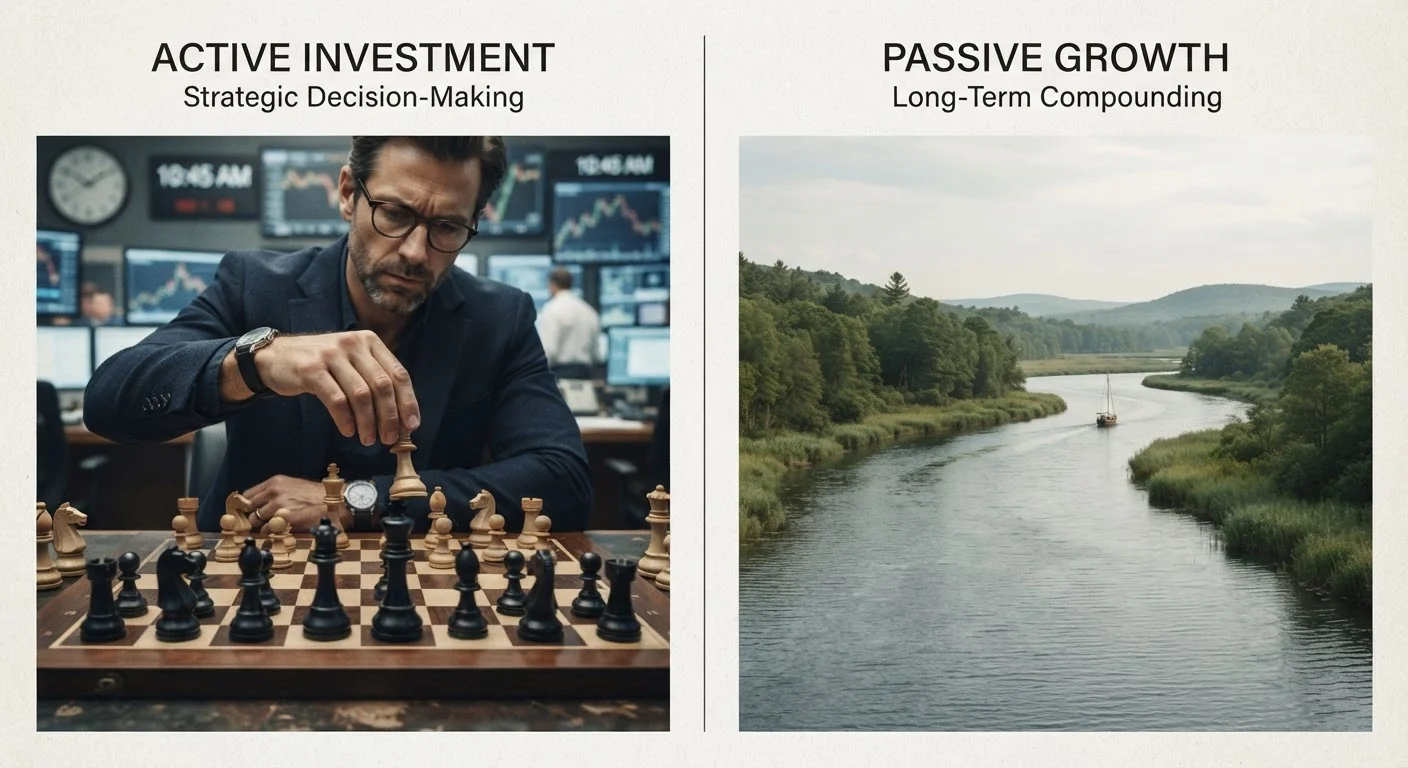
Photo: CoralScripts.com | Explore, Discover, Engage editorial
—— In This Article
Key Takeaways
- Active investing aims to outperform market benchmarks; passive investing aims to match them at lower cost.
- Higher fees in active strategies can significantly reduce net returns over time.
- Research consistently shows most actively managed funds underperform their benchmarks over long periods.
- Many investors combine both approaches to balance control with cost efficiency.
- Neither strategy eliminates investment risk - all investing involves the possibility of loss.
What Each Strategy Actually Means
Active investing involves making deliberate decisions about which securities to buy, hold, or sell - with the explicit goal of outperforming a market benchmark, such as the S&P 500. This can take the form of a professional fund manager running a mutual fund, or an individual investor selecting stocks based on their own analysis.
Passive investing, by contrast, seeks to replicate the performance of a market index rather than beat it. Rather than trying to identify winning stocks, passive investors hold a broad, diversified basket of securities that mirrors an index. Index funds and ETFs are the primary vehicles for this approach, offering exposure to entire markets or sectors in a single instrument.
The philosophical divide is significant: active investing assumes that skilled analysis can identify mispriced assets; passive investing assumes markets are efficient enough that consistent outperformance is unlikely to justify the added cost.
| Criterion | Active Investing | Passive Investing |
|---|---|---|
| Primary goal | Outperform market benchmark | Match market benchmark |
| Typical expense ratio | Higher (often 0.5%-1%+) | Lower (often under 0.2%) |
| Portfolio turnover | Frequently higher | Generally low |
| Tax efficiency | Can be lower due to trading | Generally higher |
| Management involvement | High - ongoing decisions required | Low - systematic rebalancing |
| Long-term benchmark performance | Majority underperform after fees | Tracks benchmark by design |
| Flexibility | Can respond to market conditions | Holds index regardless of conditions |
The Cost and Performance Trade-Off
Cost is where the two approaches diverge most concretely. Actively managed funds typically carry higher expense ratios - annual fees charged as a percentage of assets - to cover research teams, portfolio management, and higher portfolio turnover. Passive funds, with little need for active decision-making, tend to have significantly lower expense ratios.
This fee gap matters more than it might appear. Because fees are deducted regardless of performance, even a seemingly small annual difference compounds into a substantial drag on returns over decades. Management fees and expense ratios deserve careful scrutiny before committing to any fund.
~85%
Active large-cap funds underperforming S&P 500
S&P Dow Jones Indices' SPIVA reports have consistently found that roughly 80-90% of actively managed US large-cap funds trail the S&P 500 over 15-year periods, after fees.
~1%
Typical annual fee gap between active and passive funds
Industry data from Morningstar indicates the asset-weighted average expense ratio for active funds can exceed passive equivalents by approximately 0.5-1 percentage point annually.
$10,000+
Potential 20-year cost of a 1% fee difference
On a $50,000 portfolio earning 7% annually, a 1% higher annual fee can reduce ending value by more than $25,000 over 20 years due to compounding, based on standard compound growth modelling.
Performance data adds nuance. Academic and industry research - including long-running studies from S&P Dow Jones Indices - consistently finds that the majority of actively managed funds underperform their benchmark index over periods of ten years or more, after fees. However, a minority of active managers do outperform persistently, and active strategies may offer advantages in less efficient market segments, such as small-cap or emerging market equities.
Combining Both in a Single Portfolio
The active-versus-passive debate is often framed as binary, but most real-world portfolios blend elements of both. A common approach is the core-satellite model: a low-cost passive foundation provides broad market exposure, while a smaller allocation to active strategies targets specific sectors or opportunities where the investor believes active management adds value.
This structure balances cost discipline with tactical flexibility. It also recognises that different market environments can favour different approaches - though predicting which will outperform in any given period is itself an uncertain exercise.
Before deciding on any allocation, it is worth establishing foundational priorities. For instance, where your next dollar should go is a prior question that affects how aggressively you invest at all. As financial goals evolve, so too does the appropriate mix of strategies - a theme explored in depth in structuring a saving and investing lifecycle.
Neither Strategy Eliminates Market Risk
Both active and passive investors are exposed to market risk - the possibility that the value of investments will decline. Passive funds fall in tandem with the market they track; active funds may fall further or less depending on how they are positioned. Diversification across asset classes can reduce, but not eliminate, portfolio volatility. Past performance of any strategy does not guarantee future results.
This article is for general informational and educational purposes only and does not constitute personalised financial or investment advice. Investing involves risk, including the possible loss of principal. Consult a qualified financial adviser before making decisions based on your individual circumstances.

Money Matters Editorial Team
Money Matters Editorial Team is the collective byline for our editorial team and contributor network. Articles published under this byline or an editorial pen name are researched, written, and reviewed according to our editorial standards for clarity, consistency, and independence before publication.
View author profile