
Stocks, Bonds, and Cash: Understanding the Three Building Blocks of a Portfolio
Explore what stocks, bonds, and cash equivalents actually are, how each behaves over time, and the role each plays in a balanced portfolio.
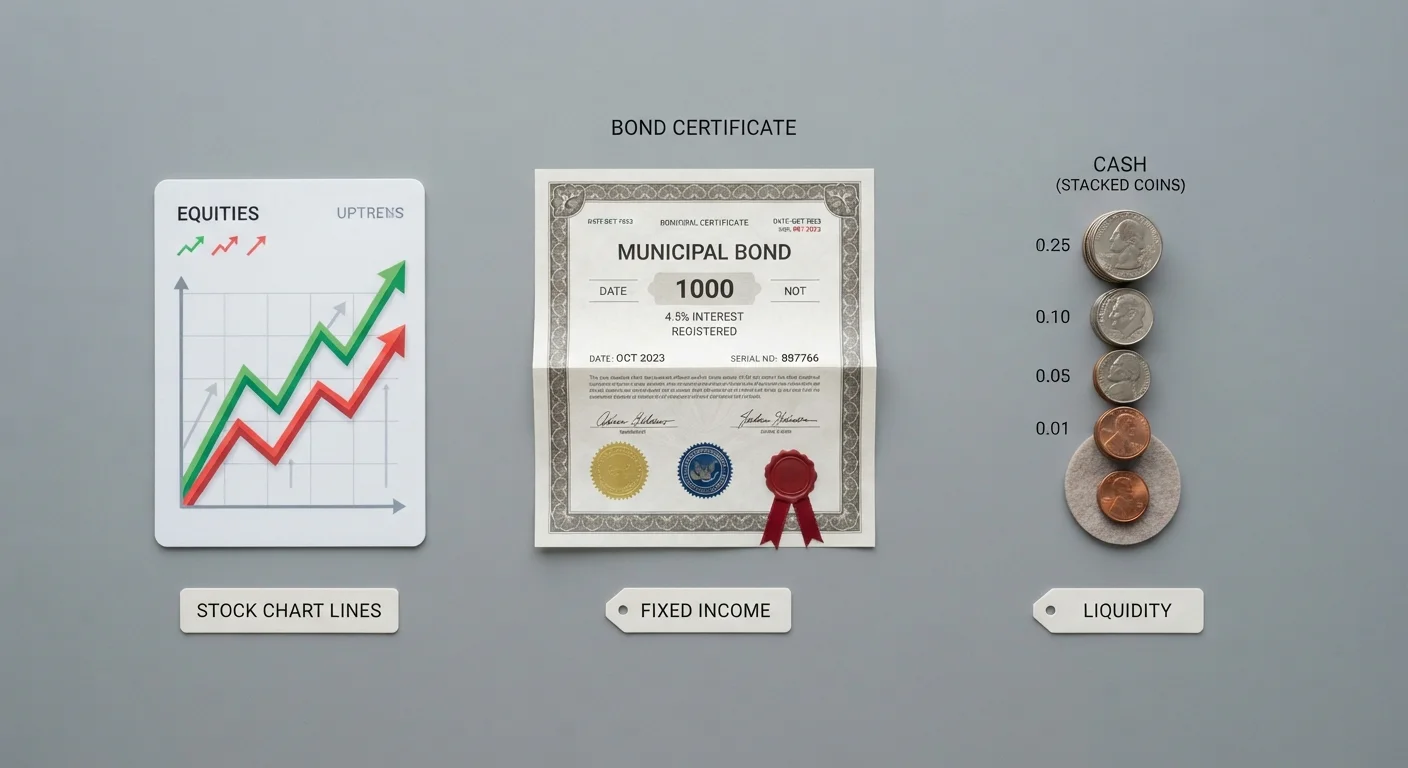
Photo: CoralScripts.com | Explore, Discover, Engage editorial
—— In This Article
Key Takeaways
- Stocks offer the highest long-term growth potential but carry the most volatility and risk.
- Bonds provide relatively stable income and act as a cushion when stock markets decline.
- Cash and cash equivalents preserve capital and provide liquidity for short-term needs.
- A portfolio's mix of these three classes - its asset allocation - is the primary driver of its risk and return profile.
- No single asset class is universally superior; the right balance depends on your goals, time horizon, and risk tolerance.
Stocks: Ownership, Growth, and Volatility
When you buy a stock - also called an equity - you are purchasing a fractional ownership stake in a company. If that company grows and becomes more profitable, your shares typically increase in value. Some companies also pay dividends, distributing a portion of earnings directly to shareholders.
Stocks have historically produced the highest long-term returns among the three asset classes. However, that growth potential comes with meaningful risk. Stock prices can fall sharply in response to company-specific news, economic downturns, or shifts in investor sentiment - sometimes losing a significant portion of their value in a short period.
This volatility is why stocks are generally best suited for money you won't need for at least five to ten years. The longer the holding period, the more time a portfolio has to recover from downturns. For a deeper look at how broad stock market exposure works in practice, see our guide to index funds and passive investing.
10.5%
Average annual U.S. stock market return (long-term)
According to historical data compiled by financial researchers, the U.S. stock market has delivered approximately 10-10.5% annualized returns over the past century before adjusting for inflation.
~4-5%
Long-term average annual bond return
U.S. investment-grade bonds have historically returned roughly 4-5% annually over long periods, significantly less than equities but with considerably lower volatility.
90%+
Portfolio variance explained by asset allocation
Research published in the Financial Analysts Journal, including the influential Brinson, Hood, and Beebower studies, found that asset allocation policy explains the large majority of the variability in long-term portfolio returns.
Bonds: Income, Stability, and Trade-Offs
A bond is essentially a loan. When you buy a bond, you are lending money to an issuer - a corporation, a municipality, or the federal government - in exchange for regular interest payments (called coupon payments) and the return of your principal when the bond matures.
Bonds tend to be less volatile than stocks, which makes them valuable for smoothing out a portfolio's ride. When stock markets decline sharply, bonds - particularly high-quality government bonds - often hold their value or even increase as investors seek safety. This inverse relationship, while not perfectly reliable, is one reason a mix of stocks and bonds can reduce overall portfolio risk.
The trade-offs are real, though. Bond returns are generally lower than stocks over long periods. And bonds are not without their own risks: when interest rates rise, existing bond prices fall. A bond paying 3% becomes less attractive when newer bonds pay 5%, so its market price drops to compensate. Inflation can also erode the purchasing power of fixed coupon payments over time.
“Diversification is the only free lunch in investing. Spreading risk across asset classes is one of the few strategies that can reduce risk without necessarily reducing expected return.”
— Harry Markowitz, Nobel Laureate in Economic Sciences, pioneer of Modern Portfolio Theory
Cash and Cash Equivalents: Liquidity and Preservation
Cash in a portfolio context means more than dollar bills. It includes cash equivalents - short-term, highly liquid instruments such as money market funds, Treasury bills, and short-term certificates of deposit. These instruments preserve capital and can be accessed quickly without meaningful loss of value.
Cash serves two distinct roles in a portfolio. First, it is the asset class you draw on for short-term needs, providing stability when markets are turbulent. Second, it gives investors flexibility - the ability to deploy capital into stocks or bonds when opportunities arise, without being forced to sell at a loss.
The drawback is opportunity cost. Over time, cash typically earns less than inflation, meaning its purchasing power gradually erodes. Holding too much cash is itself a financial risk for long-term investors. This is an important distinction from an emergency fund, which is cash held outside an investment portfolio entirely. Our article on emergency funds versus investment accounts explains how to think about this separation.
Don't Confuse Your Emergency Fund With Cash Allocation
Cash held inside an investment portfolio serves a different purpose from your emergency fund, which should sit in a separate, accessible account outside your investment accounts. Mixing the two can lead to either under-investing or being caught without liquidity when you need it most. Keep them conceptually and practically separate.
How the Three Classes Work Together: Asset Allocation
Asset allocation - the deliberate division of a portfolio among stocks, bonds, and cash - is widely regarded as the single most important determinant of long-term investment outcomes, greater in impact than which individual securities are chosen.
A simple illustration: a portfolio allocated 80% to stocks and 20% to bonds will behave very differently from one split 40/50/10 across stocks, bonds, and cash. The former carries more risk and more growth potential; the latter is more conservative and likely to experience smaller swings in either direction.
The right allocation is personal. It depends on your time horizon, financial goals, and genuine tolerance for seeing your portfolio value fluctuate. Younger investors with decades before retirement can often absorb more stock risk. Those nearing a withdrawal date - whether for retirement, a home purchase, or another goal - typically benefit from shifting toward bonds and cash to protect accumulated gains.
If you are new to thinking about these trade-offs, the foundational guide to saving and investing covers the core concepts clearly. Before making allocation decisions, it also helps to confirm your financial foundation is solid - our financial readiness checklist is a useful starting point.
Asset Allocation Is Not a One-Time Decision
Markets move, and over time the actual allocation of your portfolio will drift from your intended target - stocks may grow to represent a larger share after a bull market, for example. Periodic rebalancing - selling over-weighted assets and buying under-weighted ones - brings the portfolio back in line with your goals. The frequency and method of rebalancing depends on your personal situation and any tax implications involved.
This article is for general informational and educational purposes only and does not constitute personalised investment, tax, or financial advice. All investing involves risk, including the possible loss of principal. Consult a qualified, licensed financial adviser before making decisions based on your individual circumstances.
Frequently Asked Questions

Money Matters Editorial Team
Money Matters Editorial Team is the collective byline for our editorial team and contributor network. Articles published under this byline or an editorial pen name are researched, written, and reviewed according to our editorial standards for clarity, consistency, and independence before publication.
View author profile