
Revolving Credit vs. Instalment Loans: How Lenders View Each Differently
Credit cards and personal loans aren't the same in a lender's eyes. Understand the structural differences and their scoring impact.
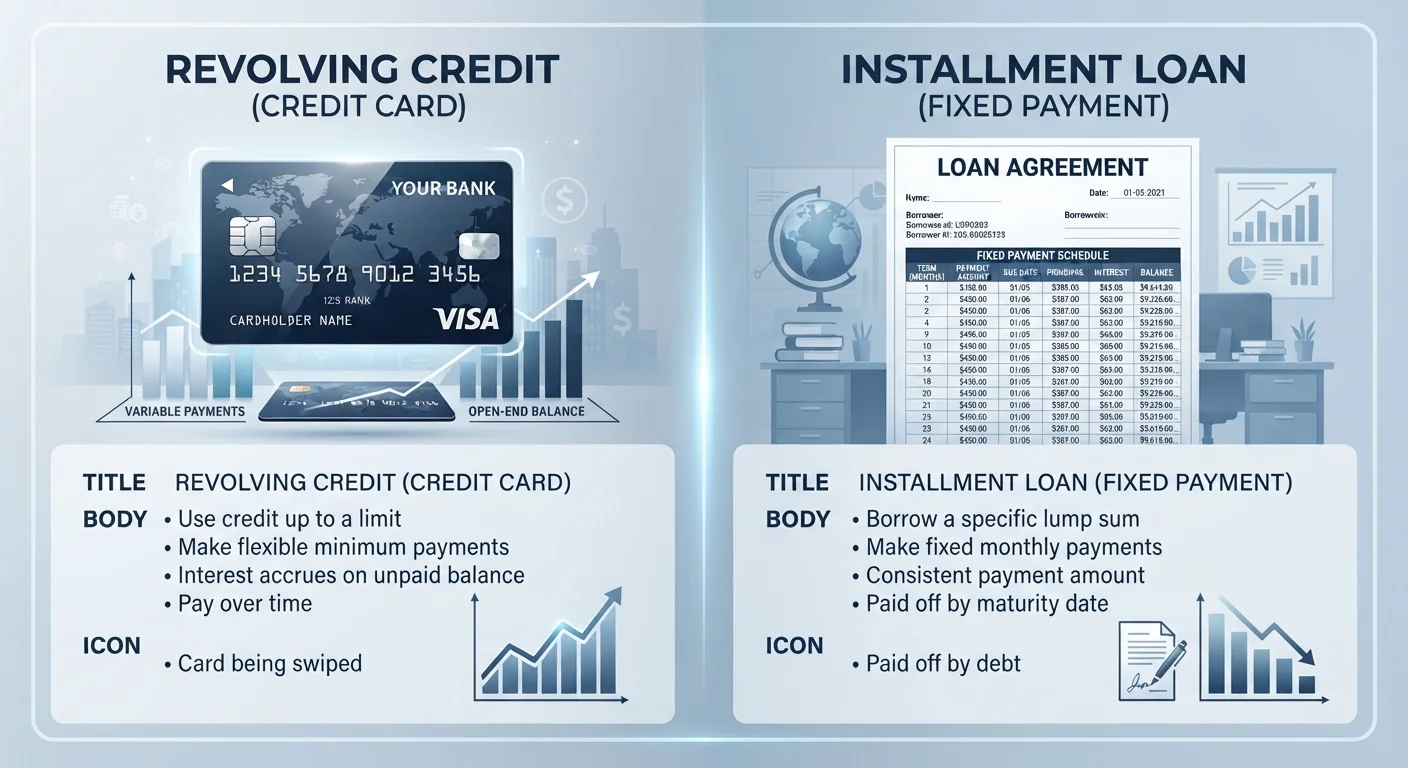
Photo: CoralScripts.com | Explore, Discover, Engage editorial
—— In This Article
Key Takeaways
- Revolving credit has a reusable limit; instalment loans deliver a fixed lump sum repaid over a set term.
- Credit utilisation - a major scoring factor - applies only to revolving accounts, not instalment loans.
- Both account types contribute to credit mix, which influences scoring models like FICO and VantageScore.
- High revolving balances can significantly suppress your credit score even with on-time payments.
- Instalment loan balances decline predictably, which lenders generally view as lower utilisation risk.
- A healthy credit profile typically includes both revolving and instalment accounts over time.
The Structural Difference That Changes Everything
At their core, revolving credit and instalment loans are built on opposite architectures. With revolving credit - think credit cards and home equity lines of credit - you're granted a maximum credit limit. You can borrow any amount up to that ceiling, repay it, and borrow again. The balance and minimum payment fluctuate each month depending on how much you've used.
An instalment loan, by contrast, delivers a fixed lump sum - a personal loan, auto loan, student loan, or mortgage - which you repay in equal, scheduled instalments over a defined term. Once the loan is paid off, the account closes. There's no revolving access.
This structural distinction isn't just semantic. It shapes how interest accrues, how lenders assess your risk, and how scoring models interpret your debt. For a plain-language breakdown of these and related terms, see our credit and debt glossary.
| Criterion | Revolving Credit | Instalment Loans |
|---|---|---|
| Structure | Reusable credit limit | Fixed lump sum, set term |
| Monthly payment | Variable (based on balance) | Fixed amount each period |
| Affects utilisation ratio | Yes - directly | No |
| Contributes to credit mix | Yes | Yes |
| Account lifecycle | Remains open; reusable | Closes upon payoff |
| Typical examples | Credit cards, HELOCs | Personal, auto, student, mortgage loans |
| Lender risk perception | Higher when balances are elevated | Predictable, amortising liability |
How Each Type Affects Your Credit Score
Scoring models treat revolving and instalment debt quite differently, and understanding that distinction can meaningfully inform your borrowing decisions.
Utilisation: The Revolving-Only Factor
Credit utilisation - the ratio of your revolving balances to your revolving credit limits - is one of the most influential factors in most scoring models, accounting for roughly 30% of a FICO Score. Crucially, this calculation applies only to revolving accounts. An instalment loan balance does not factor into your utilisation ratio. Carrying a $4,000 balance on a $5,000 credit card limit (80% utilisation) is far more damaging to your score than carrying a large instalment loan balance. For a deeper look at how this ratio works, see our article on credit utilisation and scoring.
~30%
Utilisation weight in FICO Score
FICO's published scoring breakdown shows amounts owed - dominated by revolving utilisation - carries approximately 30% of the total score calculation.
~35%
Payment history weight in FICO Score
Payment history is the single largest factor in the FICO scoring model, applying equally to revolving and instalment accounts.
~10%
Credit mix contribution to FICO Score
Having a variety of account types - including both revolving credit and instalment loans - positively influences this scoring category.
Credit Mix and Payment History
Both account types contribute to credit mix - the variety of debt types in your file - which typically accounts for around 10% of a FICO Score. Lenders and scoring models prefer to see that you can responsibly manage different structures. Payment history, the single largest scoring factor at roughly 35%, applies equally to both: missed payments on either type will damage your score.
Scoring Models Can Differ in Their Weighting
FICO and VantageScore are the two dominant scoring models in the US, and while they use similar categories, they weight factors differently. VantageScore, for instance, treats credit utilisation as 'extremely influential' and may assess it differently across its versions. Always consider which scoring model a lender uses when evaluating how changes in your credit behaviour might affect your approval odds.
To see exactly how scoring categories are weighted across different models, refer to our guide on factors affecting credit scores.
How Lenders Read Each Type During Underwriting
When a lender reviews your application, they're not just looking at your score - they're reading the composition of your credit file. Revolving debt signals ongoing, discretionary borrowing behaviour. A borrower consistently carrying high revolving balances may appear more financially stretched, even if payments are current. Instalment debt, by contrast, represents a contractual, amortising obligation - lenders often view a declining instalment balance as a predictable, manageable liability.
Lenders also look at your debt-to-income ratio (DTI) - the percentage of your gross monthly income consumed by debt payments. Both types of debt factor into DTI, but instalment loans with fixed payments are easier for lenders to model. A revolving minimum payment can fluctuate, which introduces more variability into DTI calculations during underwriting.
If you're new to borrowing and want to understand how your credit report is assembled from these different accounts, our primer for first-time borrowers provides a solid foundation. Before taking on any new credit product, it's also worth working through the questions in our pre-borrowing checklist to assess whether the timing and terms suit your situation.
This article is for general informational purposes only and does not constitute personalised financial or credit advice. Consult a qualified financial professional for guidance specific to your circumstances.

Money Matters Editorial Team
Money Matters Editorial Team is the collective byline for our editorial team and contributor network. Articles published under this byline or an editorial pen name are researched, written, and reviewed according to our editorial standards for clarity, consistency, and independence before publication.
View author profile