
How a Manual Gearbox Works (And Why the Technique Matters)
Manual transmissions are mechanical elegance in action. Understand the clutch, gear selection, and synchromesh — and why smooth shifts matter.
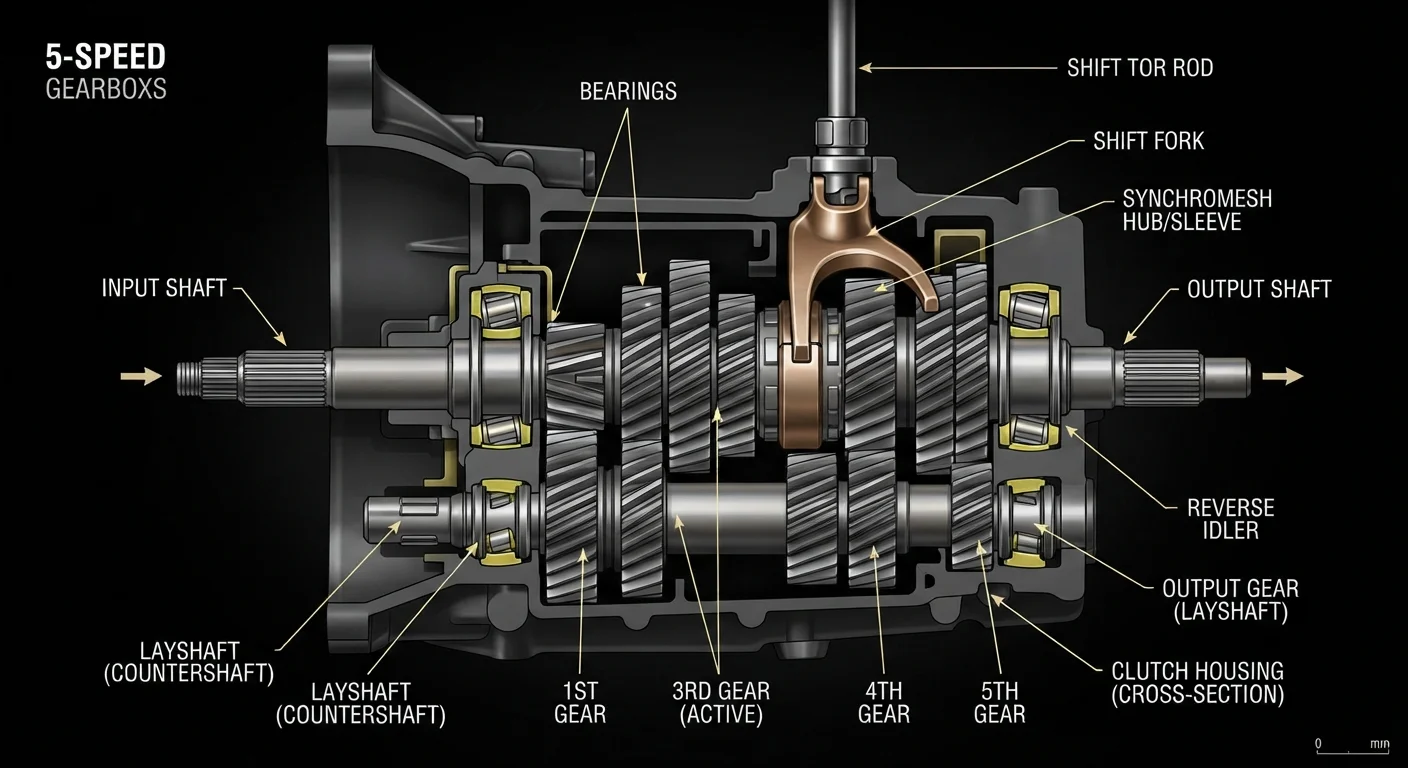
Photo: CoralScripts.com | Explore, Discover, Engage editorial
—— In This Article
Key Takeaways
- The clutch disconnects and reconnects the engine from the gearbox during gear changes.
- Different gear ratios allow the engine to operate efficiently across a wide range of vehicle speeds.
- Synchromesh rings are what make modern manual shifts smooth - they match shaft speeds before locking gears together.
- Poor shifting technique accelerates wear on synchros, clutch friction material, and gear teeth.
- Heel-and-toe downshifting and smooth clutch release are foundational skills for preserving drivetrain longevity.
The Three Core Elements: Clutch, Gearbox, and Synchromesh
A manual transmission system is best understood as three cooperating assemblies. First, the clutch - a friction disc sandwiched between the engine flywheel and the pressure plate. When you depress the clutch pedal, a hydraulic or cable-actuated release bearing pushes against the pressure plate, separating the friction disc from the flywheel and interrupting torque flow. This is the window in which gear selection happens.
Inside the gearbox housing, two parallel shafts - the input shaft (connected to the clutch) and the output shaft (connected to the drivetrain) - carry multiple gear pairs of different sizes. Each pair represents a specific ratio of input speed to output speed. First gear uses a large input gear and small output gear for high torque multiplication; sixth gear approaches a near 1:1 ratio for relaxed highway cruising.
What makes modern manual boxes shift without clash is the synchromesh mechanism. When you move the gear lever, a selector fork moves a synchronizer sleeve toward the target gear. Before the sleeve locks, a tapered brass synchro ring contacts the gear cone and uses friction to match rotational speeds. Only once speeds are equalized does the sleeve's internal splines lock onto the gear's dog teeth, completing engagement. This entire process takes a fraction of a second - but forcing it faster than the synchro can function is what causes that telling crunch.
For a broader look at how the engine generates the power that flows through this system, see The Anatomy of a Car Engine.
~2%
Share of new US car sales with manual transmissions
Industry sales data from the mid-2020s shows manual transmissions now account for roughly 2% of new vehicle sales in the United States, down from over 35% in the 1980s.
5-6
Forward gear ratios in most modern manual boxes
The majority of current manual-equipped passenger cars offer either a five- or six-speed gearbox, with six-speed units predominant in performance and sport-trim vehicles.
≈0.1 sec
Time for synchromesh to equalize gear speeds
Engineering references describe synchromesh synchronization completing within roughly one-tenth of a second under normal driving conditions and clutch release speeds.
Why Driving Technique Has a Direct Mechanical Consequence
Understanding the hardware makes it immediately clear why technique isn't just about smoothness - it's about preserving components with finite service lives. Every clutch engagement involves friction between the disc and flywheel; every gear change exercises the synchro rings. The way you do both determines how long those parts last.
The most damaging habits are slipping the clutch excessively on hill starts (generating heat that glazes friction material), holding the car on a hill with clutch slip rather than the brake, and downshifting without rev-matching. In that last case, when you drop to a lower gear, the lower ratio demands a higher engine RPM for the current road speed. If the engine is still at idle, re-engaging the clutch forces it to accelerate instantaneously via the drivetrain - a shock load that stresses synchros, mounts, and CV joints.
The corrective technique for downshifts is a throttle blip: a brief, deliberate stab of the accelerator while the clutch is depressed to raise engine RPM to approximately the speed the lower gear requires. This is the foundation of heel-and-toe downshifting - a technique used in performance driving where the right foot simultaneously brakes and blips the throttle using heel and toe, enabling smooth, composed downshifts under hard braking.
Practice Rev-Matching Before It Becomes Automatic
Learning to blip the throttle on downshifts is easiest to practice at low speeds in light traffic before attempting it under hard braking. Focus on listening to the engine note - a good blip brings the RPM up to a point where engaging the clutch produces no jerk. Over time, the action becomes intuitive and significantly reduces wear on synchromesh components.
Equally important is clutch release rate. On moving-off, releasing the clutch too quickly dumps drive abruptly onto a stationary or slow-moving drivetrain. The clutch disc must slip progressively through the engagement zone - fast enough to avoid unnecessary heat, slow enough to bring engine and drivetrain speeds into alignment without jerk.
Manual Transmissions in the Context of Modern Powertrains
Manual gearboxes were once universal; today they occupy a smaller but significant niche. Their mechanical directness gives drivers tactile feedback that automatic and dual-clutch transmissions cannot fully replicate - gear selection is a deliberate act rather than an algorithm's decision. This is why manual-equipped vehicles remain popular in performance and enthusiast segments.
From an efficiency standpoint, manuals have a slight mechanical advantage: no hydraulic torque converter and no parasitic pump losses mean friction losses are minimal. However, modern automatic and dual-clutch units shift faster and more precisely than most human drivers, which has largely erased the fuel-economy gap that once favored manuals.
In the context of the broader shift toward electrification, manual transmissions face a structural challenge: electric motors don't require multi-ratio gearboxes because their torque output is linear across a wide RPM range. Hybrid architectures similarly tend to prioritize seamless CVT or planetary gear arrangements. For a full comparison of how different powertrain architectures manage torque delivery, see Petrol, Diesel, Hybrid, and Electric: How Each Powertrain Works.
Despite this trend, the manual gearbox remains a masterclass in applied mechanical engineering. For drivers who understand how the system works, every shift is an informed, deliberate action - and that understanding, more than raw speed, is what separates confident drivers from merely capable ones.
Frequently Asked Questions

Cars & Driving Editorial Team
Cars & Driving Editorial Team is the collective byline for our editorial team and contributor network. Articles published under this byline or an editorial pen name are researched, written, and reviewed according to our editorial standards for clarity, consistency, and independence before publication.
View author profile