
New Orleans vs. Savannah: Comparing Two Cities Built on History and Atmosphere
Both cities ooze Southern character, but their architecture, food, culture, and pace of life diverge in revealing ways.
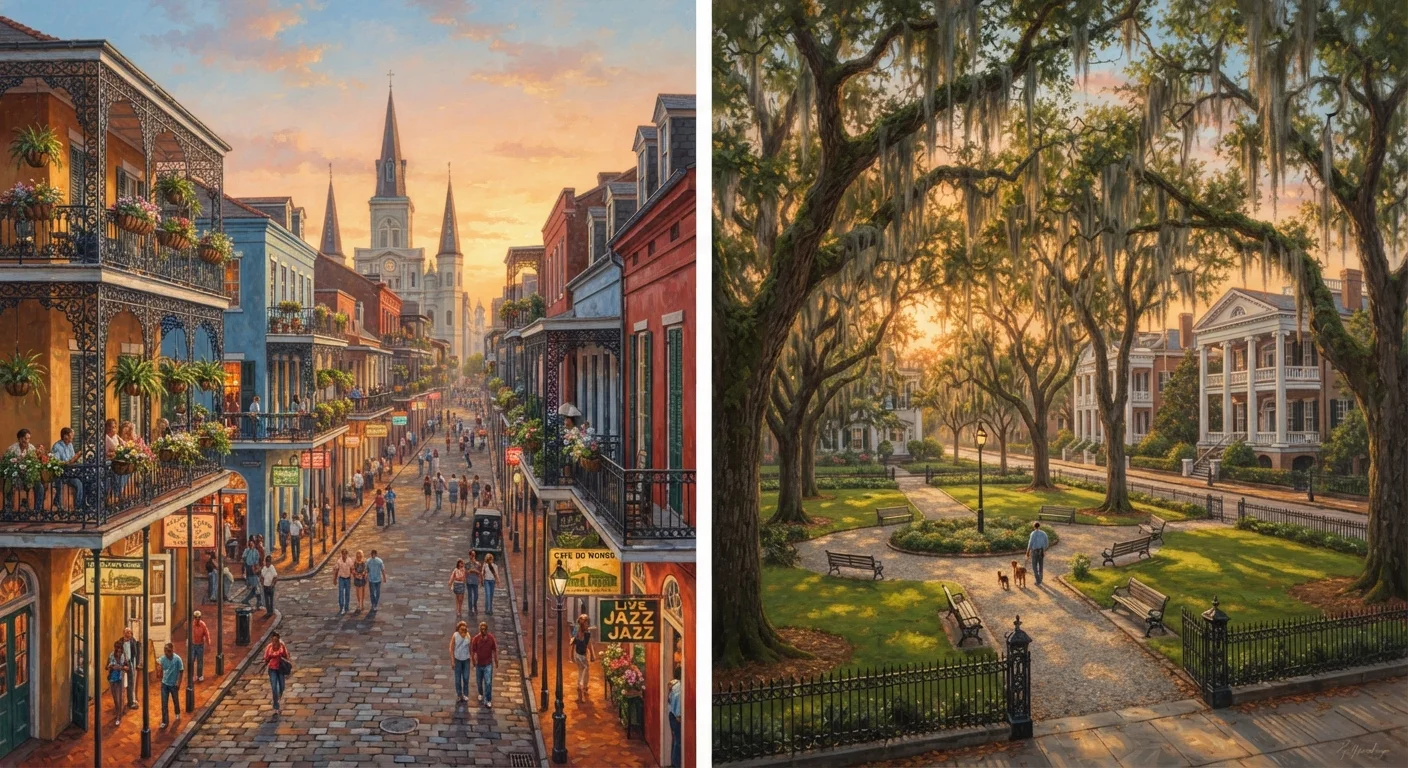
Photo: CoralScripts.com | Explore, Discover, Engage editorial
—— In This Article
Key Takeaways
- New Orleans is defined by its Creole and Caribbean cultural layering; Savannah reflects English colonial and antebellum Georgia heritage.
- Both cities are highly walkable in their historic cores, but New Orleans offers a broader nightlife and music scene.
- Savannah's 22 historic squares give it one of the most intact 18th-century urban grids in the United States.
- New Orleans cuisine — gumbo, beignets, po'boys — is distinct from Savannah's lowcountry-influenced cooking.
- Each city carries a complex history tied to slavery and should be engaged thoughtfully by visitors.
Architecture and Urban Layout
The bones of each city tell two very different stories. New Orleans grew under French and Spanish colonial rule before passing to the United States in 1803, and that succession left a layered architectural vocabulary: the iron-lace balconies and stucco-clad Creole cottages of the French Quarter sit alongside Greek Revival mansions in the Garden District. The city's street grid follows the curves of the Mississippi River, creating the distinctive crescent shape from which it draws one of its nicknames.
Savannah, by contrast, was founded in 1733 by James Oglethorpe under a methodical plan still visible today. The original ward system — each ward centered on a public square — produced a grid of 22 landscaped parks draped in Spanish moss. The result is one of the most coherent and beautiful planned urban environments in the country. Strolling from Forsyth Park to the riverfront, visitors move through intact blocks of Federal, Regency, and Italianate architecture with an ease that few American historic districts allow.
| Criterion | New Orleans | Savannah |
|---|---|---|
| Founding heritage | French, Spanish, Creole, Caribbean | English colonial, antebellum Georgia |
| Urban layout | River-curved grid, mixed neighborhoods | Planned ward-and-square system |
| Signature architecture | Iron-lace balconies, Creole cottages | Federal and Italianate townhouses |
| Music scene | Jazz, brass band, blues — daily | Niche live venues, quieter scene |
| Culinary tradition | Creole and Cajun — highly distinct | Lowcountry Southern cooking |
| Nightlife intensity | High — 24-hour culture | Moderate — relaxed evening pace |
| Walkability | Good in French Quarter/Garden District | Excellent across historic core |
| Ideal trip length | 3–5 days minimum | 2–4 days covers highlights |
Culture, Music, and Atmosphere
New Orleans is, by almost any measure, one of the culturally densest cities in North America. Jazz was born here, and the tradition is not a museum piece — it plays live in clubs, on street corners, and at second-line parades that can materialize on any given Sunday. Mardi Gras is the city's most famous export, but the cultural calendar includes Jazz Fest, Voodoo Fest, and dozens of neighborhood celebrations tied to the city's Creole, Haitian, and Caribbean roots. The city operates at a high emotional temperature: louder, more festive, and more unpredictable than almost any comparable destination.
Savannah's atmosphere is quieter and more internalized. The city nurtures a strong arts community anchored partly by the Savannah College of Art and Design, which has restored significant historic buildings and infused the downtown with creative energy. Ghost tours flourish here — Savannah has a well-established reputation as one of America's most haunted cities, grounded in its layered burial history. Evenings on the riverfront or in one of the residential squares have a contemplative, almost literary quality that draws a different traveler than Bourbon Street does. For readers curious about other Southern cities with this kind of understated appeal, our guide to small Southern cities worth slowing down for explores comparable destinations beyond the major names.
22
Historic squares in Savannah's original grid
Savannah's ward-based plan, laid out in 1733, originally called for 24 squares; 22 survive today and remain public parks.
1718
Year New Orleans was founded
Founded by French colonists in 1718, New Orleans has one of the longest continuous urban histories of any major American city.
~400,000
Population of greater New Orleans metro
The New Orleans metropolitan area is significantly larger than Savannah's, which has a city population of roughly 150,000.
Food Culture and Culinary Identity
New Orleans cuisine is among the most original in the United States — a genuine culinary tradition rather than a regional variation. Dishes like gumbo, jambalaya, red beans and rice, étouffée, and beignets reflect a convergence of French technique, West African ingredients and cooking methods, Spanish seasoning, and Native American plant knowledge. The city's restaurant culture spans from no-frills lunch counters serving po'boys to destination fine-dining institutions that have shaped American gastronomy for generations.
Savannah's food scene draws on the lowcountry tradition shared with coastal South Carolina: shrimp and grits, she-crab soup, boiled peanuts, and peach-inflected desserts anchor the local identity. The city has developed a more contemporary dining culture in recent years, with chefs interpreting these foundations through a modern lens. Neither city is a poor choice for food travelers, but New Orleans commands a singular reputation that is difficult to match in scale or historical depth.
On Engaging with Difficult History
Both New Orleans and Savannah were deeply shaped by the Atlantic slave trade and plantation economies. Landmark sites in each city — including the Whitney Plantation outside New Orleans and Savannah's First African Baptist Church — offer substantive historical interpretation. Visiting these sites adds essential context to the architecture and culture that define both destinations, and many historians and cultural organizations encourage travelers to make them a meaningful part of any itinerary.
Practical Considerations for Visitors
Both cities concentrate their visitor appeal in walkable historic cores, but each presents distinct logistical realities. New Orleans is larger and more spread out; neighborhoods like the Garden District, Tremé, and Bywater each reward separate exploration, and ride-sharing or the historic streetcar lines help connect them. Summer heat and humidity in New Orleans are intense, and the city sits below sea level — visitors should be aware of the ongoing infrastructure and resilience context when planning travel.
Savannah's historic district is more compact and manageable on foot over a long weekend. The climate is similarly humid in summer, but the canopy of live oaks over the squares offers meaningful shade. Both cities carry histories of enslavement that shaped their built environments, economies, and cultures, and both have museums, tours, and interpretive sites that engage seriously with that history — visitors are encouraged to seek those out as part of any substantive trip.
Whichever city you choose, travel conditions, entry logistics, and local regulations can change; verify current details with official tourism sources before your trip.

Travel & Places Editorial Team
Travel & Places Editorial Team is the collective byline for our editorial team and contributor network. Articles published under this byline or an editorial pen name are researched, written, and reviewed according to our editorial standards for clarity, consistency, and independence before publication.
View author profile