
Solo Travel vs Group Travel: Matching the Format to Your Goals
Compare the freedoms, costs, safety considerations, and social dynamics of travelling alone versus with others before you commit.
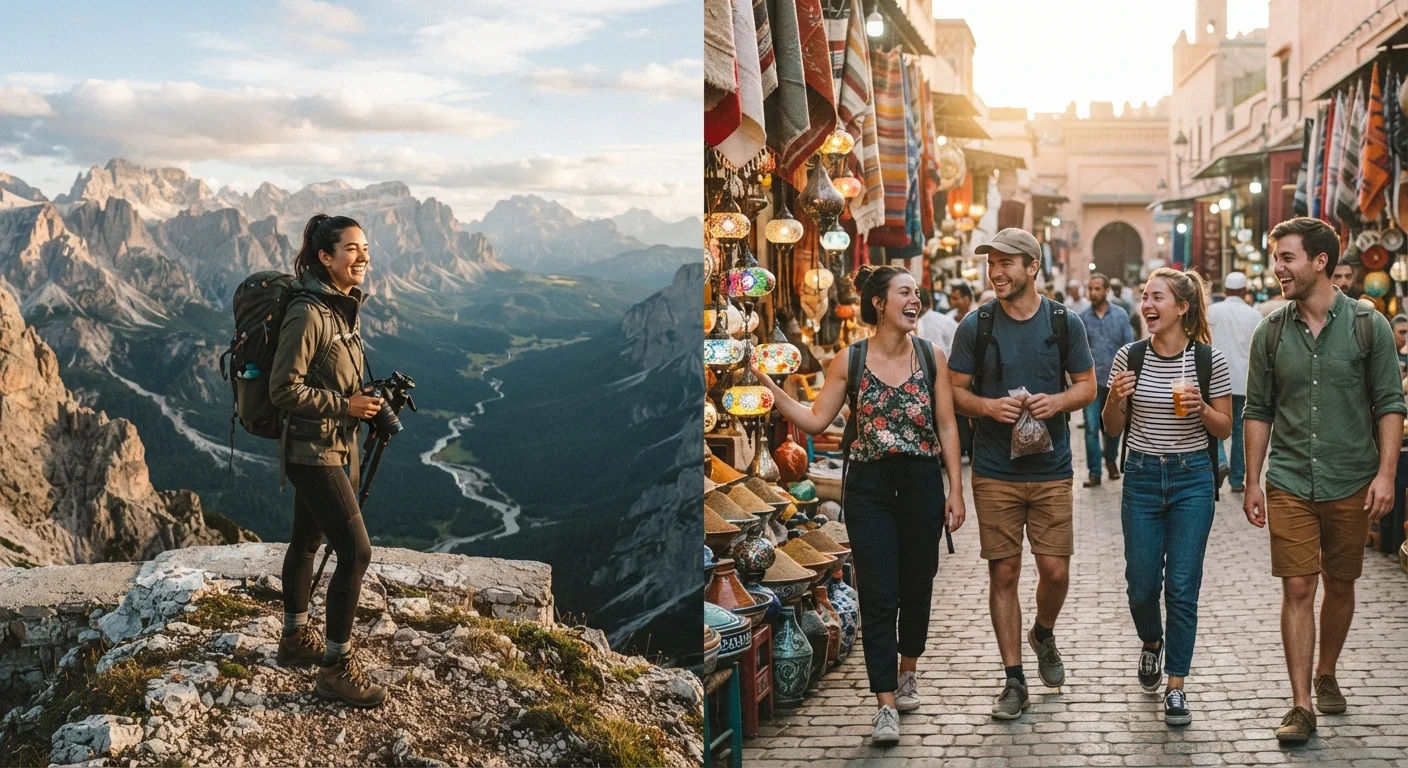
Photo: CoralScripts.com | Explore, Discover, Engage editorial
—— In This Article
Key Takeaways
- Solo travel offers maximum flexibility and deeper personal immersion, but typically costs more per person.
- Group travel reduces per-person costs and provides built-in safety and companionship, but demands compromise.
- Safety considerations differ significantly between the two formats, especially in unfamiliar destinations.
- Neither format is universally superior — the right choice depends on your goals, budget, and travel style.
- Hybrid models, like joining a structured group tour as a solo traveler, can blend the best of both approaches.
Freedom vs. Structure: The Core Trade-Off
The most fundamental difference between solo and group travel is control over time. Solo travelers design their own itinerary, adjust it on the fly, and answer to no one else's preferences. Spend three hours at a single museum, skip the popular landmark, or change cities on a whim — the format accommodates it. This flexibility is particularly valuable when combined with adaptable planning styles that leave room for spontaneity.
Group travel, whether with friends, family, or a packaged tour, operates on shared timelines. Decisions about when to leave, where to eat, and how long to linger require negotiation. For travelers who find that negotiation energizing rather than draining — or who genuinely prefer having decisions made for them — this structure is a feature, not a constraint. The key is self-awareness: underestimating how much you value autonomy is one of the most common sources of travel friction.
| Solo Travel | Group Travel | |
|---|---|---|
| Itinerary flexibility | Full — change plans anytime | Limited — requires group consensus |
| Per-person cost | Higher — single supplements apply | Lower — costs split among travelers |
| Safety redundancy | Lower — requires proactive preparation | Higher — companions provide backup |
| Local social interaction | Higher — solo travelers engage more readily | Lower — group provides internal social buffer |
| Logistics burden | Fully individual | Shared or handled by tour operator |
| Compromise required | None | Ongoing — pace, food, activities |
Cost Realities: Where Each Format Wins
Group travel generally reduces per-person costs across accommodation, transportation, and sometimes entry fees. Splitting a rental car, booking a multi-bed vacation apartment, or qualifying for group admission rates all create savings that solo travelers simply cannot replicate. Organized group tours also absorb logistical overhead — visas, guides, transfers — spreading that cost across participants.
Solo travelers pay single-occupancy premiums on hotel rooms, bear full vehicle rental costs, and handle every booking fee independently. On the other hand, they can make cost decisions purely on personal priority: budget accommodation one night, a splurge the next. Timing trips around shoulder season trade-offs can help solo travelers reduce expenses without sacrificing quality.
~25%
Solo travel share of leisure trips
Industry research from the Adventure Travel Trade Association has found roughly one in four leisure travelers takes at least one solo trip annually.
2–3x
Single-room premium over shared
Single-occupancy hotel rates commonly run two to three times the per-person rate of a shared double room at equivalent properties.
Safety Considerations and Risk Management
Safety dynamics differ meaningfully between formats. Solo travelers are statistically more visible targets for opportunistic crime in certain destinations, and a medical or logistical emergency without nearby companions requires more individual preparation. Mitigation strategies — sharing itineraries with contacts at home, registering with the U.S. State Department's STEP program, carrying travel insurance, and researching destination-specific risks before departure — are non-negotiable rather than optional for solo travelers.
Group travel provides inherent safety redundancy: companions can assist in emergencies, deter opportunistic crime, and share decision-making in unfamiliar situations. However, group dynamics can also create a false sense of security or suppress individual caution. Neither format eliminates risk; both require active preparation. Always verify current entry requirements and safety advisories through official government sources before any international trip, regardless of how you're traveling.
Don't Skip Pre-Trip Safety Research
Regardless of whether you travel solo or in a group, safety preparation should be destination-specific, not generic. Travel advisories, local laws, and entry requirements change — sometimes quickly. Verify current conditions through the U.S. State Department (travel.state.gov) and register your trip via the Smart Traveler Enrollment Program (STEP) before departure. Travel insurance covering medical evacuation is strongly advisable for both formats in international destinations.
Social Dynamics and the Quality of Experience
Solo travel creates conditions for a distinct type of social engagement. Without the ready-made social buffer of companions, solo travelers are far more likely to initiate conversations with locals, fellow guests, or other travelers — connections that rarely happen when you're already embedded in a group. For those interested in genuine cultural immersion, this openness is one of solo travel's most underappreciated advantages. It also connects naturally to travel styles explored in slow travel frameworks that prioritize depth over breadth.
Group travel, meanwhile, delivers consistent companionship and shared memory-making. The quality of that experience depends heavily on group composition — traveling with people whose pace, interests, and budget align with yours produces a fundamentally different outcome than traveling with mismatched companions. For those whose social needs extend beyond travel, itinerary pacing choices interact closely with how much downtime groups actually get together.
Consider a Hybrid Approach
Joining a structured group tour as a solo participant is a practical middle path — you gain logistical support, built-in companionship, and cost-sharing while still arriving independently and spending free time on your own terms. Many organized tours actively attract solo travelers and offer no single supplement on certain departures. It's worth researching before committing to either extreme.

Travel & Places Editorial Team
Travel & Places Editorial Team is the collective byline for our editorial team and contributor network. Articles published under this byline or an editorial pen name are researched, written, and reviewed according to our editorial standards for clarity, consistency, and independence before publication.
View author profile