
US Passport vs. Passport Card: Which Document Actually Gets You Where You're Going
A passport card costs less and fits in your wallet, but its use is limited. Understand exactly where each document is accepted before you apply.
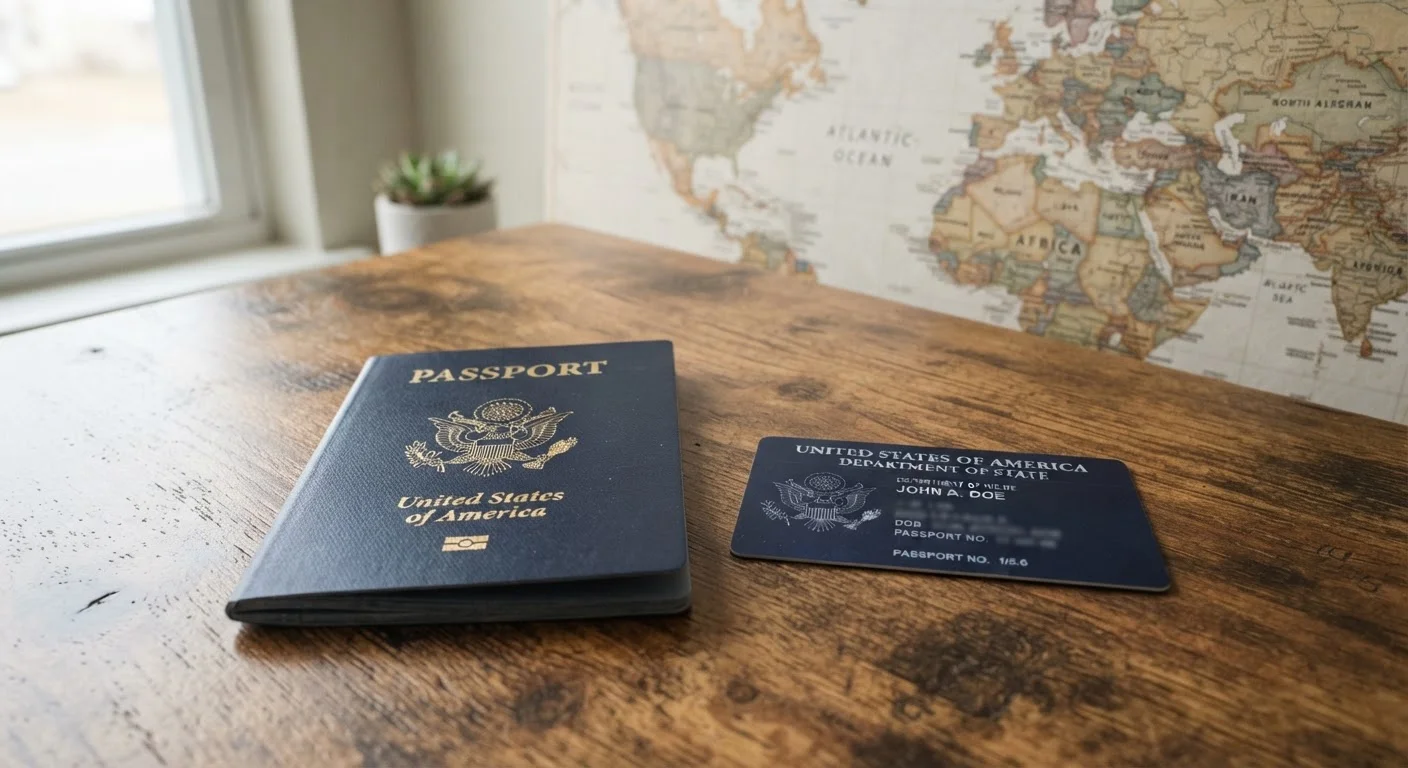
Photo: CoralScripts.com | Explore, Discover, Engage editorial
—— In This Article
Key Takeaways
- The passport book is accepted for all international travel, including air travel; the passport card is not valid for international air travel.
- The passport card is accepted only at land and sea ports of entry from Canada, Mexico, the Caribbean, and Bermuda.
- A passport card costs significantly less than a book, making it an affordable supplement for frequent land border crossers.
- Both documents are issued by the US Department of State and require the same application process.
- Holding both a book and a card provides flexibility without sacrificing convenience at familiar land crossings.
- Always verify entry requirements with official government sources before traveling, as policies can change.
What Each Document Actually Is
Both the US passport book and the passport card are official federal identity and citizenship documents issued by the US Department of State. They prove the same two things — that you are a US citizen and that the US government vouches for your identity — but they do so in very different physical formats designed for different use cases.
The passport book is the familiar navy booklet with pages for entry stamps and visas. It is recognized as a valid travel document in virtually every country in the world and is required for all international air travel. A standard adult book contains 28 pages; a larger 52-page version is available at no additional cost for frequent travelers who accumulate stamps quickly.
The passport card, introduced in 2008, is the size of a standard credit card and uses RFID technology to store identity data. It was specifically designed to ease congestion at busy land border crossings. Its acceptance is strictly limited by federal regulation to land and sea ports of entry from Canada, Mexico, the Caribbean, and Bermuda. It cannot be used to board an international commercial flight.
| Criterion | Passport Book | Passport Card |
|---|---|---|
| Valid for international air travel | Yes — all destinations | No |
| Valid at land borders (Canada/Mexico) | Yes | Yes |
| Valid for Caribbean/Bermuda sea entry | Yes | Yes (sea ports only) |
| Accepted as REAL ID domestically | Yes | Yes |
| Physical format | 48- or 52-page booklet | Credit-card size |
| Validity period (adults) | 10 years | 10 years |
| Relative cost | Higher government fee | Lower government fee |
| RFID technology | No (standard book) | Yes |
Where Each Document Is and Isn't Accepted
Understanding acceptance boundaries is the most critical factor in choosing — or combining — these documents.
The passport book faces almost no geographic restrictions. Foreign governments, airlines, cruise lines, and border agencies worldwide recognize it as definitive proof of US citizenship and identity. It is the document you need for any flight departing the United States to a foreign country, and it is the only US-issued document that satisfies most countries' entry requirements.
The passport card's acceptance is narrower by design. US Customs and Border Protection (CBP) formally accepts it at land border crossings and sea ports of entry when arriving from Canada, Mexico, the Caribbean, or Bermuda. It is also accepted as a REAL ID-compliant identification document for domestic purposes such as boarding domestic flights within the US. However, it does not meet the entry requirements of any foreign government for air travel, and carrying only a card when departing for an overseas flight will result in denied boarding.
A Word on Closed-Loop Cruises
US Customs and Border Protection formally accepts the passport card for closed-loop cruises — voyages that depart and return to the same US port. Despite this, the State Department recommends carrying a passport book on any cruise itinerary. If a medical emergency or an unexpected schedule change requires you to fly home from a foreign port, only the passport book will satisfy airline and foreign government requirements.
One practical note for cruisers: CBP accepts the passport card for closed-loop cruises — voyages that begin and end at the same US port. However, the State Department itself recommends carrying a passport book on any cruise, because if a medical emergency or itinerary change requires you to fly home from a foreign port, you will need the book.
Cost, Processing, and Practical Logistics
Cost is one area where the passport card has a clear advantage. For first-time adult applicants, the passport book carries a higher government fee than the card; applying for both at the same time reduces the marginal cost of adding the card considerably. Renewal fees follow a similar structure. Exact current fee schedules are published by the US Department of State at travel.state.gov and should be verified before applying, as fees are periodically revised.
Both documents are valid for 10 years for adults and 5 years for applicants under 16. Processing times — routine and expedited — are the same for both, and applicants can request both documents on a single DS-11 application form. Choosing to add a card while applying for a book is administratively straightforward.
The physical difference matters in day-to-day logistics. The card slides into a wallet alongside your driver's license, making it convenient for routine Canada or Mexico land crossings where you might otherwise risk losing or damaging a full booklet. Frequent border commuters in states like Texas, Arizona, California, and New York often find this combination — book stored safely, card carried daily — genuinely practical. Just as smart planning applies to your documents, it applies to your finances abroad; see our guide to managing money across borders for strategies that complement good document preparation.
146M+
Valid US passports in circulation
The US Department of State reported over 146 million valid passports in circulation as of recent fiscal year data, reflecting the large proportion of Americans who hold travel documents.
~50%
Lower fee for passport card vs. book
For adult first-time applicants, the government fee for a passport card is roughly half that of a passport book, per the US Department of State fee schedule at travel.state.gov.
10 years
Validity for adult holders of either document
Both the passport book and passport card issued to applicants aged 16 and older carry a 10-year validity period before renewal is required.

Travel & Places Editorial Team
Travel & Places Editorial Team is the collective byline for our editorial team and contributor network. Articles published under this byline or an editorial pen name are researched, written, and reviewed according to our editorial standards for clarity, consistency, and independence before publication.
View author profile