
Social Hierarchies in Pack Animals - and What They Mean for Pet Dogs
The idea of a strict alpha hierarchy has been revised by modern research. Discover what scientists now understand about social structure in wolves and dogs.
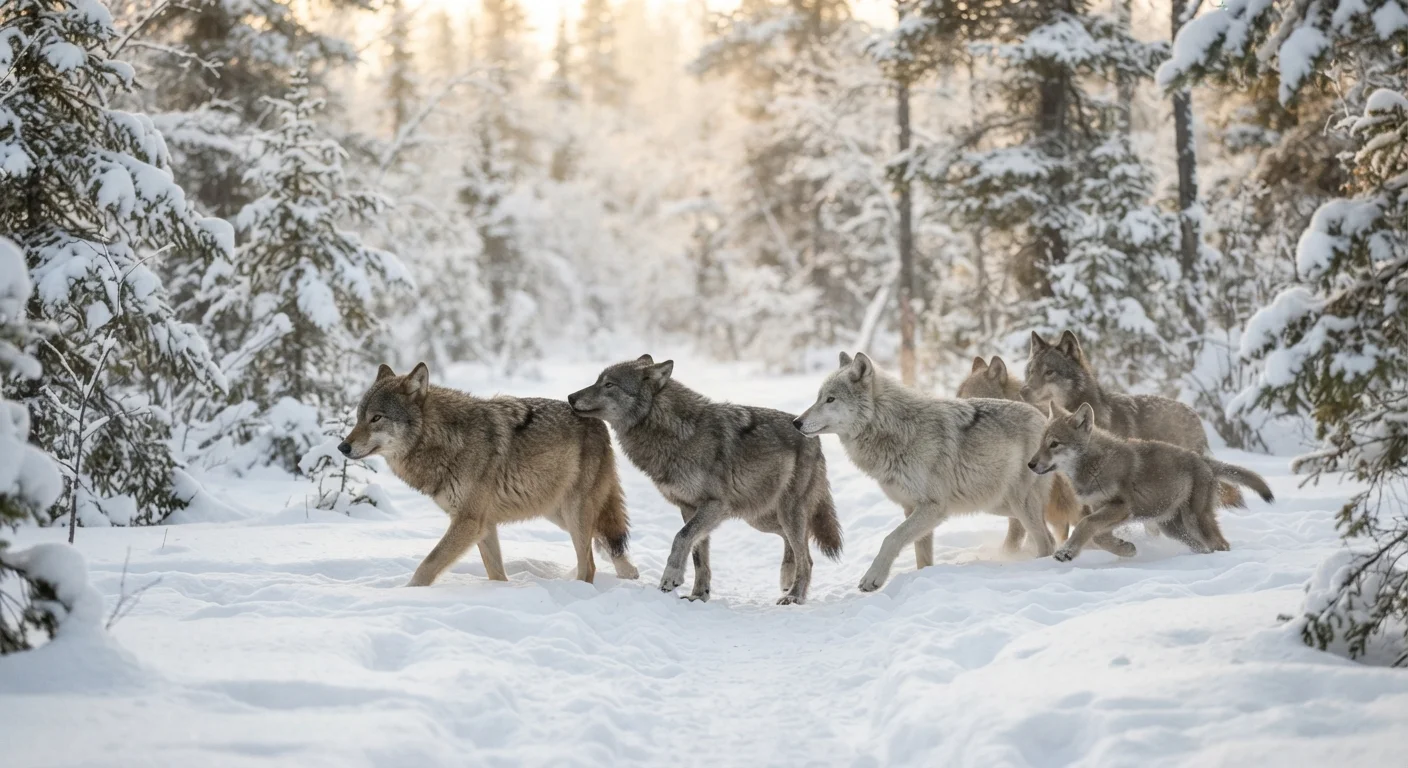
Photo: CoralScripts.com | Explore, Discover, Engage editorial
—— In This Article
Key Takeaways
- Wild wolf packs are primarily family groups, not rigid dominance hierarchies led by an 'alpha.'
- The alpha wolf concept originated from studies of unrelated captive wolves - not natural populations.
- Domestic dogs are not wolves and do not replicate wolf pack social structures in human homes.
- Dominance-based training methods are not supported by current behavioral science and can increase fear and aggression.
- Dogs form cooperative, context-dependent social relationships rather than fixed linear rank orders.
Where the Alpha Myth Came From - and Why It Persisted
Few ideas in popular animal science have proven as durable - or as difficult to correct - as the 'alpha dog' model. Its roots lie in mid-twentieth-century captive animal studies, particularly observations of wolves held together in zoo-like enclosures. When unrelated adult wolves are forced into close proximity with no option to disperse, competition over resources escalates in ways that simply don't occur in the wild. The aggressive dynamics observed in those settings were mistakenly generalized into a universal theory of wolf social structure.
That theory then migrated into dog training culture during the 1970s and 1980s, amplified by television and popular books. By the time field researchers were publishing corrections based on wild wolf data, the dominance framework had already embedded itself in mainstream pet ownership. The lesson here is not merely about wolves - it illustrates how scientific findings can be distorted when removed from their original context and applied to different species and settings.
Myth
Wolf packs are ruled by a dominant 'alpha' that achieves status through constant aggression and fights for power.
Fact
Wild wolf packs are family units led by breeding parents - the structure emerges from kinship, not combat.
The alpha wolf concept was popularized by researcher Rudolf Schenkel's 1947 study of unrelated captive wolves - a situation that produced high competition that simply doesn't reflect natural pack life. Biologist L. David Mech, who spent decades studying wild wolves in Yellowstone and Ellesmere Island, later argued strongly against using the term 'alpha' for wild populations. Wild packs are typically a mated pair and their offspring. Leadership is contextual: one parent may lead hunts, the other may guide pup rearing. Aggression is relatively rare and cooperation is the norm.
Myth
Because dogs descend from wolves, they instinctively try to establish dominance over their human family.
Fact
Dogs diverged from wolves thousands of years ago and have evolved a distinct social orientation toward humans rather than pack-hierarchy-seeking behavior.
Domestic dogs (Canis lupus familiaris) share a common ancestor with modern wolves but are not domesticated wolves - they are a separately adapted species shaped by roughly 15,000 or more years of coevolution with humans. Research by scientists including those at the Family Dog Project in Budapest has shown that dogs read human social cues in ways wolves raised by humans do not, indicating that dogs evolved specifically to operate within human social contexts. The idea that dogs are constantly attempting to 'take over' a household misapplies wolf captivity data to a fundamentally different animal. For a deeper look at how social living shapes behavior across species, see how living arrangements shape animal behavior.
Myth
Dominance-based training - such as 'alpha rolls' or physically asserting control - is the most effective way to manage a dog's behavior.
Fact
Dominance-based aversive methods are not supported by current behavioral science and are associated with increased fear, stress, and aggression in dogs.
The American Veterinary Society of Animal Behavior (AVSAB) has formally stated that dominance theory is an inadequate and potentially harmful framework for explaining or modifying dog behavior. Studies comparing training methodologies consistently show that reward-based (positive reinforcement) approaches produce more reliable learning outcomes with fewer adverse effects. Aversive techniques - physical corrections, flooding, or social pressure intended to 'establish rank' - can suppress warning signals that precede biting, making dogs less predictable, not more compliant. What science actually says about dominance and aggression in pets provides a fuller examination of how this theory has been misapplied.
Myth
Dogs establish a strict, stable linear hierarchy among themselves - one dog is always 'top dog' over all others.
Fact
Dog social relationships are fluid and context-dependent; rank, where it exists at all, often shifts by situation rather than holding rigidly across all interactions.
Observations of free-ranging and feral dog populations - which are the closest analog to dogs' natural social organization - show loose, flexible groupings rather than tightly structured hierarchies. One dog may control access to food while another leads movement decisions. These relationships shift with context, age, health, and familiarity. This contrasts sharply with the idea of a single, stable dominance order that governs every interaction. Understanding this fluidity helps owners interpret everyday dog interactions more accurately and avoid misreading normal social negotiation as problematic 'dominance' behavior.
Myth
A dog that pushes through a door first, pulls on leash, or jumps up is trying to dominate its owner.
Fact
These behaviors are almost always driven by excitement, reinforcement history, or insufficient training - not by a strategic attempt to assert rank.
Leash pulling gets a dog to the interesting smell faster; jumping up historically earned attention. Both are behaviors that have been inadvertently rewarded, not expressions of social ambition. Framing them as dominance can lead owners to apply punishment that addresses none of the underlying causes. Behavioral science points instead to identifying what reinforces the behavior and systematically training an incompatible alternative. For owners who want to build structured observational skills, a framework for observing pet behavior at home offers practical tools grounded in ethology.
What Current Research Actually Shows
Contemporary behavioral science paints a more nuanced picture of both wolf and dog social life. Wild wolf packs, studied through decades of field observation rather than captivity research, show that cooperation, not coercion, holds the group together. Parents guide pups, older siblings help provision younger ones, and group decisions about territory and hunting emerge from collective behavior rather than top-down command.
15,000+
Years dogs have been domesticated
Genetic and archaeological evidence places dog domestication at least 15,000 years ago, supporting the view that dogs are a species shaped by coevolution with humans, not simply tame wolves.
~2-15
Typical size of a wild wolf pack
Field studies, including long-term research in Yellowstone National Park, show most wild packs consist of a breeding pair and one to three generations of offspring.
Dogs, for their part, appear to have traded inter-species pack integration for something more useful to their ecological niche: a finely tuned sensitivity to human social signals. Research has shown that dogs spontaneously follow human pointing gestures - a skill even chimpanzees rarely demonstrate - and that they actively seek human eye contact when solving problems, unlike hand-raised wolves. These are not the traits of an animal scheming for pack dominance. They are traits shaped by thousands of years of living alongside people. To understand how those bonds form and what sustains them, the science of animal attachment is worth exploring.
Misreading Social Signals Has Real Consequences
When owners interpret normal dog communication - growling before a bite, stiffening near resources, or avoidance behavior - as 'dominance challenges,' they often respond with suppression rather than addressing what drives the behavior. Suppressing a growl without resolving its cause can remove the dog's early warning signal, making a bite more likely and less predictable. Behavioral concerns are best evaluated by qualified professionals, not managed through rank-assertion strategies.
Wolves remain ecologically significant in ways that extend far beyond their social lives. Their role as apex predators shapes entire ecosystems - a dynamic examined in depth in the article on apex predators and the ecosystems that depend on them.

Pets & Animal Life Editorial Team
Pets & Animal Life Editorial Team is the collective byline for our editorial team and contributor network. Articles published under this byline or an editorial pen name are researched, written, and reviewed according to our editorial standards for clarity, consistency, and independence before publication.
View author profile