
Risk Tolerance Unpacked: Matching Your Investments to Your Comfort with Uncertainty
Risk tolerance shapes every investing decision. This explainer breaks down how it's defined, what influences it, and why it changes across life stages.
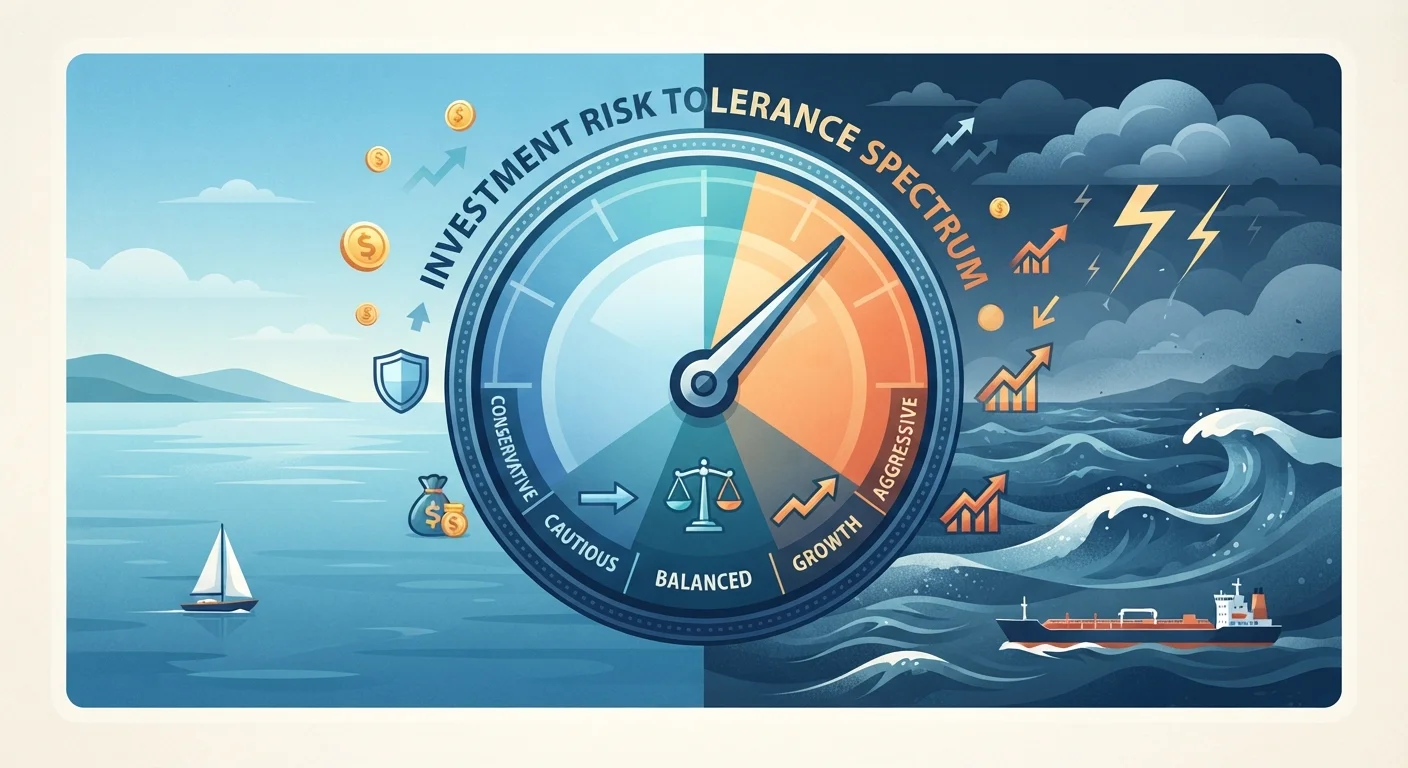
Photo: CoralScripts.com | Explore, Discover, Engage editorial
—— In This Article
Key Takeaways
- Risk tolerance reflects both financial capacity and emotional comfort with investment uncertainty.
- It is shaped by time horizon, income stability, financial obligations, and personal psychology.
- Risk tolerance typically changes across life stages and should be reassessed periodically.
- Misaligned risk tolerance leads to poor decisions like panic-selling during market downturns.
- A qualified financial adviser can help you assess and apply your risk tolerance objectively.
What Risk Tolerance Actually Means
Every investment decision involves a trade-off between potential reward and the possibility of loss. Risk tolerance defines where you personally fall on that spectrum - not just what you can withstand financially, but what you can handle emotionally without abandoning your strategy at the worst possible moment.
There are two distinct dimensions. Risk capacity is objective: it's determined by your income stability, debt obligations, liquid savings, time horizon, and financial goals. Risk attitude is subjective: it reflects how you feel when you see your portfolio drop 20% in a quarter. Both must be understood and reconciled. Someone with a high capacity but low tolerance may still make damaging decisions during market turmoil - and vice versa.
If you're newer to these concepts, our introduction to saving and investing covers foundational ideas including risk, returns, and time horizons without the jargon.
52%
Americans who say stock market risk worries them
According to Gallup polling, roughly half of U.S. adults express concern about the riskiness of stock market investing, reflecting widespread anxiety about volatility.
20+ years
Time horizon that generally supports higher equity allocation
Financial planning literature broadly holds that long time horizons - typically 20 years or more - allow investors to absorb short-term volatility and recover from downturns.
3-6 months
Recommended liquid emergency fund before investing
Most financial planning frameworks recommend holding three to six months of living expenses in accessible savings before committing capital to higher-risk investments.
Factors That Shape Your Risk Profile
Risk tolerance is not fixed - it emerges from the intersection of several personal and financial factors:
- Time horizon: The longer you have before you need the money, the more time you have to recover from downturns. A 30-year retirement timeline supports more volatility than a 3-year savings goal.
- Income stability: Reliable, predictable income gives you the cushion to ride out short-term losses. Irregular or uncertain income often requires a more conservative posture.
- Existing financial obligations: Mortgage payments, dependent care costs, and outstanding debt all reduce the capital you can afford to put at risk.
- Liquid reserves: Investors with a robust emergency fund are better positioned to leave invested assets alone during downturns. Before sizing up your investment risk, confirm your liquid cushion is in place. Our comparison of emergency funds versus investment accounts can help clarify the relationship.
- Psychological makeup: Some people are genuinely more comfortable with uncertainty. Others find market volatility deeply stressful regardless of financial position. Honest self-assessment here matters as much as any spreadsheet.
Stress-Test Your Tolerance Before Investing
Before committing to an asset allocation, imagine your portfolio dropping 30% in a single quarter. Ask yourself honestly: would you hold, buy more, or sell? Your gut answer - not your aspirational one - is the more reliable guide to your actual risk tolerance. Adjusting your allocation before a downturn is far less costly than reacting during one.
How Risk Tolerance Evolves Across Life Stages
Risk tolerance is not a number you calculate once and carry for life. It tends to shift - sometimes gradually, sometimes abruptly - in response to life events and the natural progression from accumulation to distribution.
Early-career investors often have a high capacity for risk. Time is on their side, income is likely to grow, and a market downturn represents a buying opportunity rather than a crisis. As responsibilities grow - a mortgage, a growing family, a business - the financial obligations that constrain risk capacity multiply.
Approaching retirement, the calculus shifts again. There is less time to recover from large drawdowns, and the sequence of returns becomes critically important: a significant loss in the years immediately before or after retirement can permanently impair a portfolio's longevity. For a broader picture of how strategies shift across a working life, see our guide on structuring a saving and investing lifecycle.
“The stock market is a device for transferring money from the impatient to the patient. Understanding your true tolerance for volatility is what determines which side of that transfer you end up on.”
— Warren Buffett, Chairman and CEO, Berkshire Hathaway
Applying Risk Tolerance to Portfolio Construction
Once you have a clear sense of your risk profile, the practical task is building a portfolio that reflects it. Broadly, investors are often described as conservative, moderate, or aggressive - though these labels mask meaningful variation within each category.
Conservative investors typically lean toward bonds, cash equivalents, and dividend-paying equities that offer lower volatility and more predictable income. Aggressive investors accept significant short-term swings in exchange for the potential of higher long-term growth, often through equity-heavy allocations. Moderate investors balance the two.
Asset allocation - how you distribute capital across asset classes - is the primary lever. Diversification within those classes then helps manage specific risks without abandoning return potential. Passive, low-cost strategies can serve many risk profiles well; our explainer on index funds and broad market exposure covers how these instruments work in practice.
Tax-advantaged account structures can also shape how you deploy your risk budget. Understanding how different wrappers affect your net returns is part of the picture - see how tax-advantaged accounts affect returns for a deeper look.
This article is for general informational and educational purposes only and does not constitute personalised financial or investment advice. Consult a qualified financial adviser before making investment decisions based on your individual circumstances.
Frequently Asked Questions

Money Matters Editorial Team
Money Matters Editorial Team is the collective byline for our editorial team and contributor network. Articles published under this byline or an editorial pen name are researched, written, and reviewed according to our editorial standards for clarity, consistency, and independence before publication.
View author profile