
Debt Consolidation: What It Changes, What It Doesn't
Debt consolidation can simplify repayments, but it comes with trade-offs. Here's a balanced look at how it works in practice.
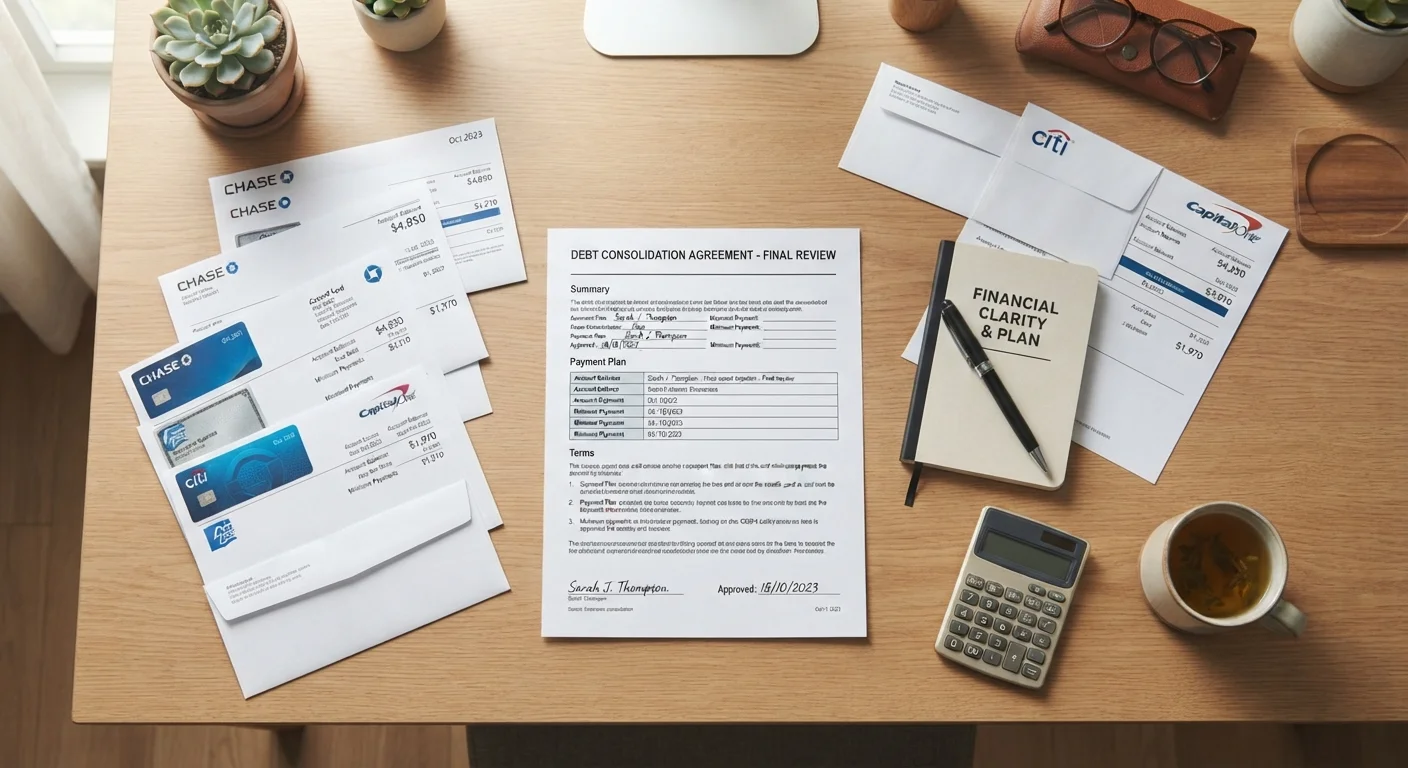
Photo: CoralScripts.com | Explore, Discover, Engage editorial
—— In This Article
Key Takeaways
- Debt consolidation combines multiple debts into a single loan or payment, often with one interest rate.
- It can lower your monthly payment and simplify repayment, but may extend the time you're in debt.
- Consolidation does not erase debt - the balance must still be repaid in full.
- Your credit score and debt habits determine whether consolidation actually saves you money.
- Always compare the total cost of a consolidation loan against your current debt repayment trajectory.
Simplifies repayment to a single monthly payment
Managing one due date and one creditor reduces the mental load and the risk of missing a payment across multiple accounts.
May lower your effective interest rate
Borrowers with strong credit may qualify for a personal loan rate meaningfully below the average rate on their existing credit card balances, reducing total interest paid.
Predictable, fixed repayment schedule
Most consolidation loans carry a fixed rate and a defined payoff date, making it easier to budget and track progress toward becoming debt-free.
Can reduce monthly cash flow pressure
Extending the repayment term often lowers the monthly obligation, freeing up cash - though this benefit must be weighed against higher long-term interest if the term is significantly lengthened.
Does not reduce the principal balance owed
Consolidation restructures debt; it does not forgive or reduce it. Every dollar borrowed must still be repaid, plus interest on the new loan.
Longer repayment terms increase total interest paid
A lower monthly payment spread over a longer period frequently results in more interest paid overall compared to aggressively paying down existing balances.
Qualification depends on creditworthiness
The most favorable consolidation rates are reserved for borrowers with good-to-excellent credit; those with damaged credit may not qualify for a rate that improves their situation.
Fees can offset interest savings
Origination fees on personal loans, balance transfer fees (typically 3-5% of the transferred amount), and prepayment penalties can erode or eliminate the projected savings.
Risk of accumulating new debt on cleared accounts
Paying off credit cards through consolidation leaves those lines of credit open. Without behavioral change, borrowers may charge them back up, compounding their total debt load.
What Debt Consolidation Actually Does
Debt consolidation is the process of combining several separate debt obligations - typically credit card balances, medical bills, or personal loans - into a single new loan or repayment arrangement. The goal is usually a lower APR, a single monthly payment, or both. For a plain-language breakdown of terms like APR and credit utilisation, see the Debt & Credit Glossary.
Two common vehicles for consolidation are personal loans (where a lender pays off your existing debts and you repay the loan at a fixed rate) and balance transfer credit cards (which move balances onto a card, often with a promotional 0% APR period). Debt management plans offered through nonprofit credit counseling agencies are a third route, particularly for those who don't qualify for traditional financing.
What consolidation does not do is reduce the principal you owe. The debt still exists - it's simply restructured. This distinction is crucial before making any decision. For a broader framework on evaluating any new debt instrument, the pre-borrowing checklist is a useful starting point.
The Genuine Advantages
When the conditions are right, debt consolidation offers real, measurable benefits:
Simplifies repayment to a single monthly payment
Managing one due date and one creditor reduces the mental load and the risk of missing a payment across multiple accounts.
May lower your effective interest rate
Borrowers with strong credit may qualify for a personal loan rate meaningfully below the average rate on their existing credit card balances, reducing total interest paid.
Predictable, fixed repayment schedule
Most consolidation loans carry a fixed rate and a defined payoff date, making it easier to budget and track progress toward becoming debt-free.
Can reduce monthly cash flow pressure
Extending the repayment term often lowers the monthly obligation, freeing up cash - though this benefit must be weighed against higher long-term interest if the term is significantly lengthened.
It's worth noting that consolidation can also affect your credit profile. Closing old accounts after paying them off reduces your available credit, which may temporarily increase your credit utilisation rate. Over time, however, consistent on-time payments on the consolidation loan typically support a stronger credit history.
20%+
Average credit card APR in the US
Federal Reserve data has tracked average credit card interest rates above 20% APR in recent years, making rate reduction through consolidation meaningful for qualifying borrowers.
3-5%
Typical balance transfer fee
Most balance transfer offers charge a fee of 3-5% of the transferred balance upfront, which should be factored into any interest savings calculation.
The Real Drawbacks
Consolidation is not a financial reset button. Understanding its limitations is just as important as recognising its benefits:
Does not reduce the principal balance owed
Consolidation restructures debt; it does not forgive or reduce it. Every dollar borrowed must still be repaid, plus interest on the new loan.
Longer repayment terms increase total interest paid
A lower monthly payment spread over a longer period frequently results in more interest paid overall compared to aggressively paying down existing balances.
Qualification depends on creditworthiness
The most favorable consolidation rates are reserved for borrowers with good-to-excellent credit; those with damaged credit may not qualify for a rate that improves their situation.
Fees can offset interest savings
Origination fees on personal loans, balance transfer fees (typically 3-5% of the transferred amount), and prepayment penalties can erode or eliminate the projected savings.
Risk of accumulating new debt on cleared accounts
Paying off credit cards through consolidation leaves those lines of credit open. Without behavioral change, borrowers may charge them back up, compounding their total debt load.
Borrowers who consolidate but continue adding to revolving balances often end up worse off - carrying both the new consolidation loan and fresh credit card debt. If that risk applies to your situation, structured repayment strategies like those compared in the debt avalanche vs. debt snowball guide may provide more durable discipline without taking on a new loan.
Debt Consolidation vs. Debt Settlement
These two terms are often confused but describe very different processes. Debt consolidation replaces existing debts with a new loan - your obligations are fulfilled in full. Debt settlement involves negotiating with creditors to accept less than the full amount owed, which typically causes significant credit score damage and may carry tax consequences on the forgiven amount. If you encounter services marketing "consolidation" with promises of reduced balances, scrutinise the offer carefully.
How to Evaluate Whether It Makes Sense for You
The core question is whether consolidation reduces your total repayment cost - not just the monthly payment. A lower monthly payment that stretches over five years instead of two may feel easier short-term but cost substantially more in cumulative interest.
Run the numbers on both scenarios: your current repayment trajectory (using the highest-rate-first or smallest-balance-first approach) versus a consolidation loan's full amortisation schedule. Factor in any origination fees, balance transfer fees, or prepayment penalties on the new instrument.
For a comprehensive view of how consolidation fits within broader debt management, the Understanding Debt and Credit reference covers credit scoring, debt types, and repayment strategies in depth.
This article is for general informational purposes only and does not constitute personalised financial, legal, or tax advice. Consult a qualified financial professional before making decisions about your specific circumstances.

Money Matters Editorial Team
Money Matters Editorial Team is the collective byline for our editorial team and contributor network. Articles published under this byline or an editorial pen name are researched, written, and reviewed according to our editorial standards for clarity, consistency, and independence before publication.
View author profile