
The Real Difference Between Adaptive and Standard Cruise Control
Standard cruise control holds speed. Adaptive cruise control does much more. Here's how each system works and what separates them.
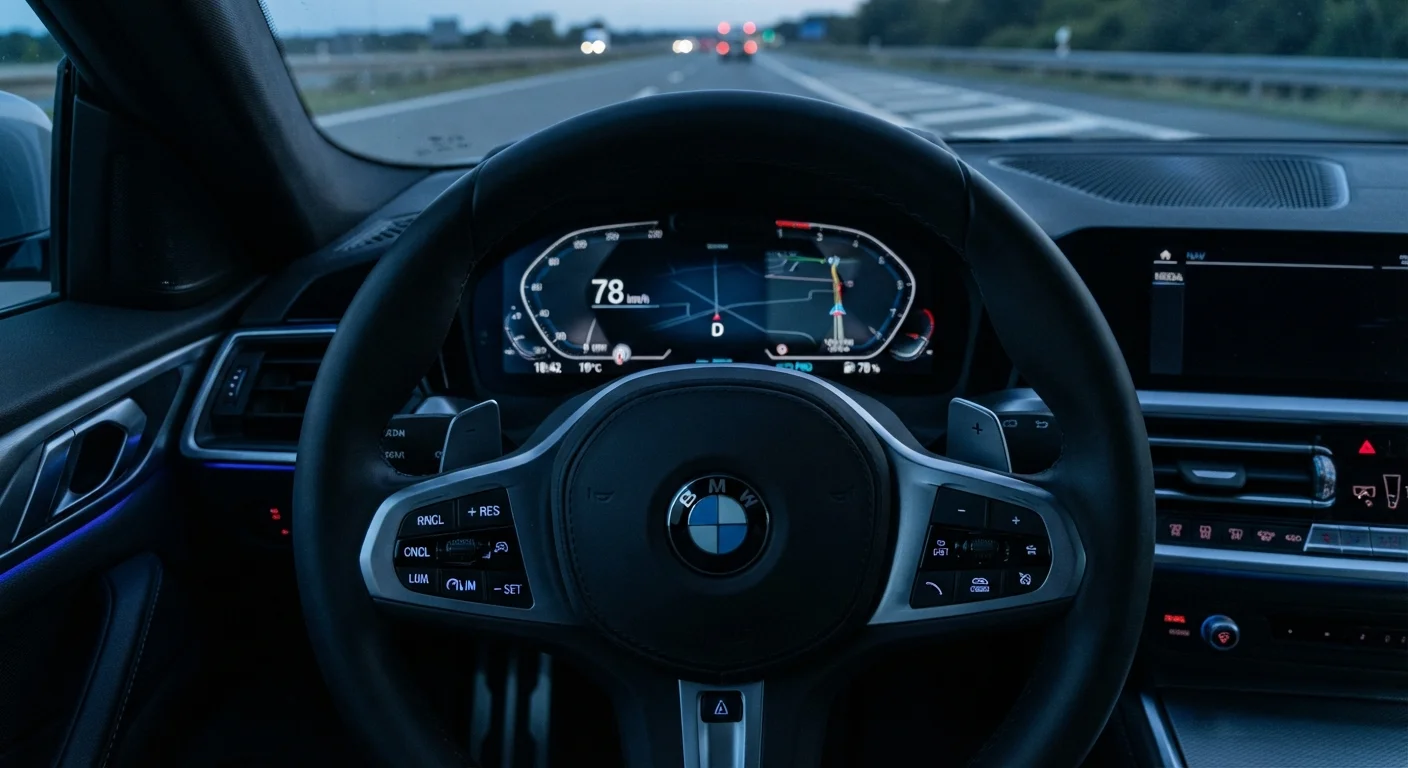
Photo: CoralScripts.com | Explore, Discover, Engage editorial
—— In This Article
Key Takeaways
- Standard cruise control holds a set speed but cannot react to vehicles ahead - the driver must brake manually.
- Adaptive cruise control uses radar or camera sensors to automatically adjust speed and maintain a safe following gap.
- ACC in some vehicles can bring the car to a complete stop and resume, a feature called stop-and-go capability.
- Both systems still require an alert, engaged driver - neither constitutes self-driving technology.
- ACC adds cost, sensor complexity, and potential repair expense compared to conventional cruise control.
How Standard Cruise Control Works
Standard cruise control, introduced to mainstream vehicles in the late 1950s, operates on a straightforward principle: the driver sets a desired speed, and the vehicle's throttle control system maintains it automatically. Once engaged, the system monitors vehicle speed via the drivetrain and makes small throttle adjustments to hold that figure steady against minor variations like gentle inclines.
What it cannot do is equally important to understand. Standard cruise control has no awareness of the road ahead. It does not know whether traffic has slowed, whether a slower vehicle has merged into your lane, or whether a curve or descent is approaching. The moment conditions change, the driver must manually apply the brakes - doing so immediately disengages the system. Pressing the accelerator temporarily overrides it without canceling the set speed.
The system is purely speed-reactive, not environment-reactive. For open, low-traffic highway miles, that's often entirely sufficient. But in variable traffic, it shifts all situational awareness and speed management back to the driver.
How Adaptive Cruise Control Works
Adaptive cruise control (ACC) adds a critical layer of sensor intelligence to the speed-holding foundation. Using forward-facing radar (most commonly), millimeter-wave sensors, cameras, or a combination of these, ACC continuously scans the road ahead and measures the distance and closing speed to any vehicle in its detection zone.
When a slower vehicle is detected within the set following gap - typically adjustable by the driver in increments of distance or time - the system automatically reduces throttle and applies gentle braking to maintain that gap. When the lane ahead clears, it smoothly accelerates back to the set speed. This logic loops continuously, making fine adjustments far faster and more consistently than a driver would in similar conditions.
More advanced implementations, often called full-speed-range ACC or stop-and-go ACC, extend this capability all the way to zero. The vehicle can come to a complete stop behind traffic and, in many cases, resume following when traffic moves - removing one of the most repetitive and tiring aspects of highway commuting. See how ACC fits within the broader landscape of driver aids in our overview of modern ADAS technologies.
| Criterion | Standard Cruise Control | Adaptive Cruise Control |
|---|---|---|
| Speed maintenance | Holds set speed only | Adjusts speed to match traffic |
| Forward sensing | None | Radar / camera-based detection |
| Automatic braking | No | Yes, within system limits |
| Stop-and-go capability | No | Available on full-speed-range systems |
| Following distance control | Driver-managed only | Automatically maintained |
| Weather vulnerability | Minimal | Sensors can be impaired by debris, snow, rain |
| Typical system cost | Low | Higher; varies by vehicle and sensor suite |
| Best environment | Open, low-traffic highways | Variable traffic, congested highways |
Sensor Technology and System Limits
The performance gap between these systems comes entirely from hardware. Standard cruise control requires no forward sensors - it relies only on wheel-speed data already present in any modern vehicle. ACC depends on calibrated sensors that must remain unobstructed and properly aligned to function accurately.
Sensor Obstruction Can Disable ACC
Dirt, ice, snow, or damage to front-mounted radar sensors can reduce or fully disable adaptive cruise control functionality. Most manufacturers locate these sensors behind the front grille or lower fascia. Regular inspection after winter driving or minor front-end impacts is advisable. Always consult your owner's manual for sensor location and maintenance guidance specific to your vehicle.
Adverse weather - heavy rain, snow accumulation on sensors, or dense fog - can degrade ACC detection range and accuracy. Most systems alert the driver when sensor coverage is compromised and may temporarily suspend adaptive functions, reverting behavior closer to standard cruise or disabling entirely. Neither system replaces attentive driving.
ACC also has defined detection limits. Stationary objects, vehicles cutting in at close range, or sharp curves can challenge sensor interpretation depending on system sophistication. Drivers should understand their specific vehicle's documented capabilities and limitations rather than assuming uniform performance across all ACC-equipped vehicles.
Practical Considerations: Cost, Complexity, and Use
Standard cruise control is a mature, low-cost technology included in most vehicles across price segments. Repairs are infrequent and straightforward. ACC, by contrast, adds radar modules, processing hardware, and integration with braking systems - components that cost more to replace or recalibrate after damage such as a minor front-end collision.
~77%
New US vehicles with at least one ADAS feature
According to NHTSA data, the majority of new vehicles sold in the US now include at least one active driver-assistance feature, with ACC among the most common.
152 ft
Stopping distance at 60 mph without braking assist
At highway speeds, reaction time alone can consume significant stopping distance - underscoring why automated gap maintenance has safety relevance beyond convenience.
For drivers whose routes are predominantly open highway with little congestion, the added complexity of ACC may provide marginal practical benefit over standard cruise. For those navigating heavy commuter traffic, the fatigue reduction and consistent spacing that ACC provides can represent a meaningful quality-of-life improvement over long driving days.
The key point is that neither system is autonomous. Both legally and functionally, the driver remains responsible for vehicle control at all times. ACC reduces workload in specific scenarios - it does not transfer responsibility. Misunderstanding this distinction is one of the more consequential misconceptions about modern driver-assistance technology.

Cars & Driving Editorial Team
Cars & Driving Editorial Team is the collective byline for our editorial team and contributor network. Articles published under this byline or an editorial pen name are researched, written, and reviewed according to our editorial standards for clarity, consistency, and independence before publication.
View author profile