
Car Marques That Disappeared: A History of Discontinued Automotive Brands
Pontiac, Oldsmobile, DeLorean — a look at car brands that no longer exist, why they folded, and what they left behind.
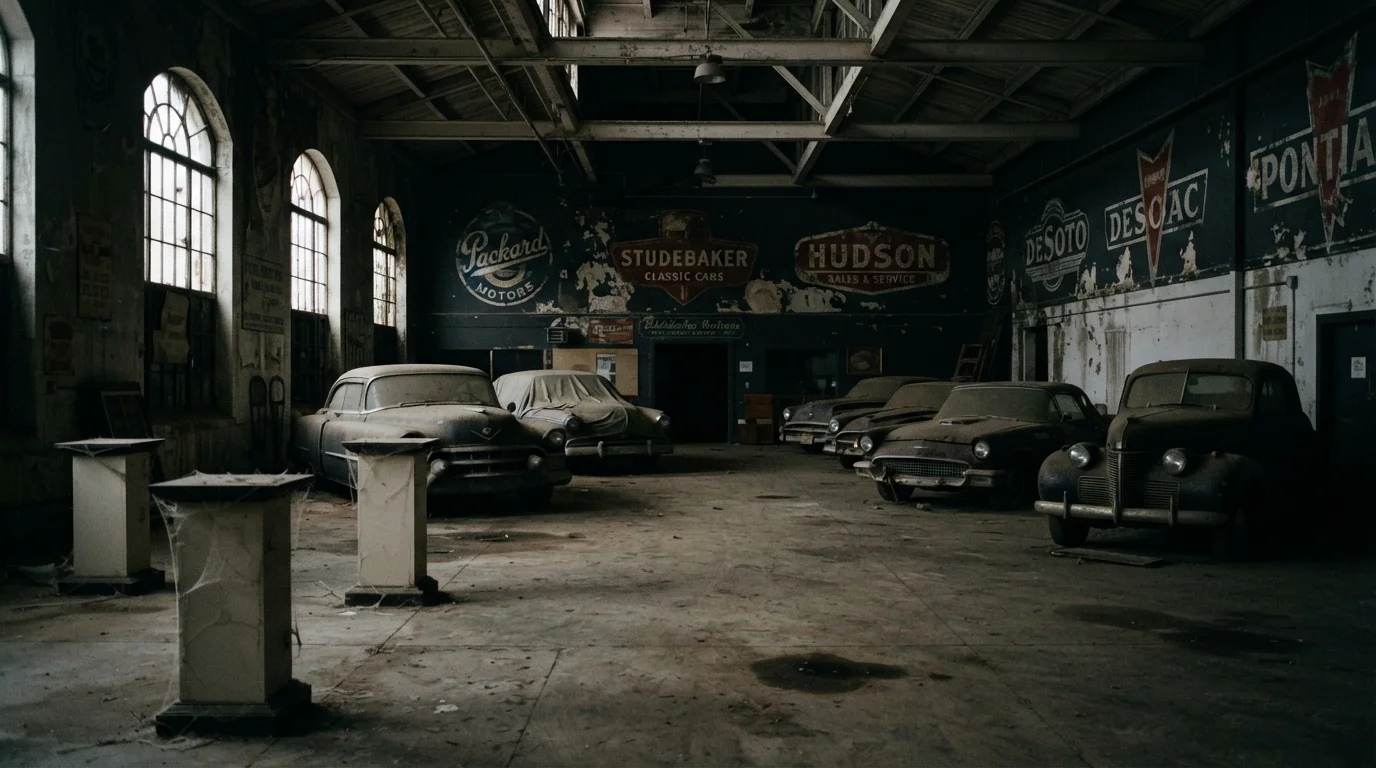
Photo: CoralScripts.com | Explore, Discover, Engage editorial
—— In This Article
Key Takeaways
- Many discontinued brands were killed by shifting consumer tastes, corporate restructuring, or financial crises rather than poor engineering.
- General Motors alone discontinued four major brands - Oldsmobile, Pontiac, Saturn, and Hummer - in the 2000s and 2010s.
- Some extinct marques, like DeLorean, left enduring cultural footprints far larger than their production numbers warranted.
- Brand discontinuation rarely erases heritage; parts, communities, and platform DNA often survive within successor vehicles.
- Understanding why brands disappear illuminates how corporate strategy, market positioning, and economics shape the automotive landscape.
When the Badge Goes Dark
The automotive industry has always been as much about corporate survival as it is about engineering. Behind every discontinued marque lies a story of market miscalculation, economic pressure, internal competition, or - occasionally - simple bad timing. From household names that sold millions of vehicles to niche manufacturers who produced just a few hundred cars, the history of extinct car brands reveals how fragile brand identity can be when profit margins tighten or corporate priorities shift.
The brands explored below span different eras, ownership structures, and market segments. What they share is an end: production ceased, dealerships closed, and the nameplate was retired - sometimes quietly, sometimes with considerable public mourning. For a broader view of how automakers structure their brand portfolios, see our guide to automaker alliances and mergers.
Oldsmobile (1897-2004)
Oldsmobile holds the distinction of being the oldest American automotive brand at the time of its discontinuation. Founded by Ransom E. Olds, it was one of General Motors' foundational marques and at various points in the 20th century was among the best-selling brands in the United States. The 1966 Toronado - one of the first front-wheel-drive American cars of the modern era - demonstrated genuine engineering ambition.
By the late 1990s, however, GM faced a chronic overlap problem. Oldsmobile occupied an ill-defined middle ground between Pontiac and Buick, and its customer base was aging without a clear strategy to attract younger buyers. GM announced the phase-out in 2000, and the final Oldsmobile rolled off the line in April 2004. The brand's demise was a preview of the broader portfolio contraction GM would undertake during its 2009 bankruptcy restructuring.
Oldsmobile's collapse was less about quality and more about a brand with nowhere left to go in GM's crowded lineup.
Pontiac (1926-2010)
Pontiac was arguably GM's most emotionally resonant brand at the time of its discontinuation. Built around a performance and youth-oriented identity - crystallized by the GTO in the 1960s and the Firebird Trans Am in the 1970s - Pontiac carried genuine enthusiast credibility that Oldsmobile and Buick never quite matched.
The brand struggled through the 1990s and 2000s as GM repeatedly repositioned it without committing the resources necessary for a true product revival. The 2004 GTO relaunch, based on a rebadged Australian Holden Monaro, sold poorly partly because it lacked the visual drama buyers expected. When GM filed for bankruptcy protection in 2009, Pontiac was among the brands marked for closure. The last Pontiac was built in early 2010. Its discontinuation remains one of the more debated decisions of the GM restructuring era.
Pontiac had the identity to survive; it lacked the product investment to make that identity believable in the showroom.
Saturn (1985-2010)
Saturn was conceived as a direct counter to the growing Japanese import threat of the 1980s. GM established it as a standalone subsidiary with its own manufacturing plant in Spring Hill, Tennessee, its own dealer culture, and a deliberately different retail philosophy - most notably, non-negotiable pricing intended to reduce buyer anxiety.
Early Saturns earned genuine loyalty, and the brand's community-focused marketing was innovative for its time. The problems emerged as GM progressively reduced Saturn's independence and failed to invest in competitive product development. By the mid-2000s, Saturn showrooms were selling rebadged Opel models rather than purpose-built vehicles. GM attempted to sell the brand to Penske Automotive Group in 2009, but the deal collapsed, and Saturn was wound down. It stands as a case study in what happens when a promising brand concept loses internal corporate conviction.
Saturn proved that a strong retail philosophy cannot substitute for sustained product investment over the long term.
DeLorean (1975-1982)
Few automotive brands carry a cultural weight so disproportionate to their actual production numbers as DeLorean. The DMC-12 - with its brushed stainless steel body and gull-wing doors - was the only model the DeLorean Motor Company ever produced, with approximately 9,000 units built between 1981 and 1982.
John DeLorean's ambitions for the car were considerable, but the vehicle that reached market was underpowered relative to its price point, using a Peugeot-Renault-Volvo (PRV) V6 engine that produced roughly 130 horsepower. Financial difficulties plagued the company from the start, compounded by production quality issues at the Belfast, Northern Ireland factory. DeLorean's 1982 arrest on drug trafficking charges - charges of which he was ultimately acquitted - ended any realistic possibility of revival. The brand's enduring fame owes much to the Back to the Future film franchise, which transformed the DMC-12 into a cultural icon.
The DMC-12 became immortal through cinema while the company that built it collapsed within two years of its launch.
Mercury (1938-2011)
Mercury occupied Ford Motor Company's mid-tier market position for over seven decades, sitting between the volume-oriented Ford brand and the premium Lincoln nameplate. At its strongest - particularly through the 1950s and 1960s - Mercury produced genuinely distinctive vehicles, including the Turnpike Cruiser and the Cougar, which established a musclecar identity of its own.
The brand's gradual decline tracked a familiar trajectory: insufficient product differentiation from Ford, aging customer demographics, and a sustained failure to carve out a segment that buyers couldn't find elsewhere in Ford's lineup. By the 2000s, most Mercury models were thinly differentiated versions of Ford vehicles with alternative trim packages. Ford announced the brand's discontinuation in June 2010 as part of a broader financial recovery effort, with the final Mercury produced in January 2011. For context on how luxury positioning shapes brand survival, our article on luxury marques and their market positioning is instructive.
Mercury's fundamental problem was that it spent its final decades selling Fords with a different badge and a slightly higher price.
Hummer (1992-2010, revived 2021 as a GMC sub-brand)
Hummer began as a civilian version of the AM General HMMWV (High Mobility Multipurpose Wheeled Vehicle) military platform, popularized in part by its visibility during the Gulf War. GM acquired the brand in 1999 and expanded it with the H2 and H3 models, targeting buyers who wanted extreme off-road capability and imposing visual presence in an increasingly SUV-dominated market.
The brand's collapse was swift and almost entirely tied to fuel economy. When gasoline prices spiked sharply in 2007 and 2008, large-displacement vehicles with poor efficiency became difficult to sell and easy to criticize. GM attempted to sell Hummer to a Chinese manufacturer, Tengzhong Heavy Industrial Machinery, but Chinese regulators blocked the transaction. The brand was discontinued in 2010 during GM's bankruptcy. It was later revived as an electric sub-brand under GMC - a pivot that underscores how dramatically market conditions can reframe what a nameplate means.
Hummer's fall and electric rebirth illustrate how sharply consumer values and regulatory pressure can reshape a brand's viability.
What These Stories Tell Us About the Industry
Discontinued brands are not simply cautionary tales about mismanagement. They reflect the extraordinary difficulty of maintaining a coherent brand identity across decades of changing consumer expectations, regulatory environments, and competitive landscapes. Some marques outlived their original purpose; others were casualties of mergers that made them redundant. A few simply ran out of capital before their ideas could mature.
Vintage Ownership: Verify Parts Availability First
If you're considering purchasing a vehicle from a discontinued marque, research parts availability thoroughly before committing. Some defunct brands have strong aftermarket support communities; others have extremely scarce components that make maintenance impractical or expensive. Consulting a specialist marque club or registrar before purchase is strongly advisable.
The vehicles these brands produced often retain devoted communities of owners, and their engineering decisions continue to echo in modern platform development. Pontiac's performance DNA, for instance, lived on informally in certain Chevrolet and Cadillac models that followed the brand's 2010 discontinuation. For readers interested in how surviving brands manage identity through similar pressures, our article on how car brands reinvent themselves offers useful context. And for a comprehensive historical reference across active and legacy manufacturers, the world's major automotive brands reference guide is a useful companion.

Cars & Driving Editorial Team
Cars & Driving Editorial Team is the collective byline for our editorial team and contributor network. Articles published under this byline or an editorial pen name are researched, written, and reviewed according to our editorial standards for clarity, consistency, and independence before publication.
View author profile