
What a Business Model Actually Is (and Why It Matters More Than Your Idea)
Unpack the concept of a business model—how it differs from a business plan, and why getting it right underpins every startup decision.
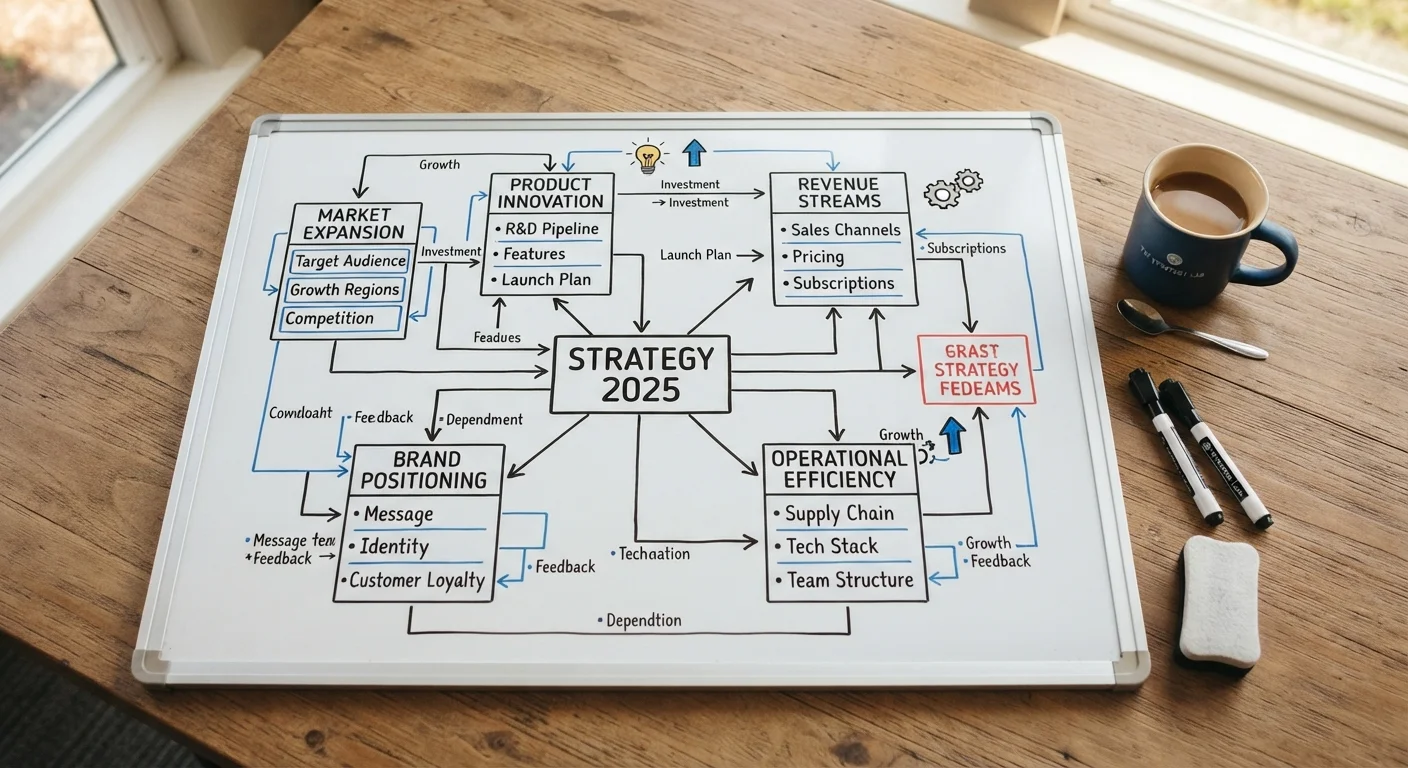
Photo: CoralScripts.com | Explore, Discover, Engage editorial
—— In This Article
Key Takeaways
- A business model defines how your company creates, delivers, and captures value — not just what it sells.
- Ideas are plentiful; a sound business model is what separates viable ventures from wishful thinking.
- Business models and business plans are distinct: the model is the logic, the plan is the documentation.
- Most failed startups had compelling ideas but flawed or untested business models.
- Business models can and should evolve as you learn more about your customers and market.
The Idea Is the Easy Part
Every business begins with an idea — a problem spotted, a gap identified, a frustration turned into a concept. Ideas are the currency of entrepreneurship conversations, and they're abundant. What's scarce is the structural thinking that determines whether an idea can actually sustain a business.
That structural thinking has a name: the business model. Strip away the pitch deck, the mission statement, and the financial projections, and what remains is the business model — the core logic that answers how your venture actually works. Not what it does, but how it does it in a way that's economically viable.
Confusing an idea with a business model is one of the most common and costly mistakes early-stage founders make. The two are not interchangeable. Uber's idea was "on-demand rides via smartphone." Its business model — a two-sided marketplace connecting drivers and riders, taking a percentage of each transaction, with surge pricing to balance supply and demand — is what made it a scalable company. The idea was the spark. The model was the engine.
“A business model describes the rationale of how an organization creates, delivers, and captures value.”
— Alexander Osterwalder, Co-creator of the Business Model Canvas and co-author of Business Model Generation
What a Business Model Actually Covers
A useful way to think about a business model is through three questions:
- What value do you create? What problem do you solve, and for whom? This is your value proposition — the reason a customer chooses you over alternatives.
- How do you deliver that value? Through what channels, with what resources, through which activities? This is your operational architecture.
- How do you capture value? What does the customer pay, how often, and through what mechanism? This is your revenue model — the financial layer that makes the whole system sustainable.
A weakness in any one of these dimensions undermines the whole. A company can have a genuinely useful product (strong value creation) and efficient operations (effective delivery) but collapse because it can't capture enough value to cover its costs. Conversely, aggressive revenue extraction from a poorly designed product kills customer loyalty and eventually the business itself.
~42%
Startups that fail due to no market need
CB Insights analysis of startup post-mortems consistently identifies "no market need" — a model-level failure — as the leading cause of startup failure.
9 in 10
Startups that don't survive long-term
Various longitudinal studies and industry analyses estimate that roughly 90% of startups fail, with business model viability cited as a primary factor alongside funding and team issues.
Business Model vs. Business Plan: A Critical Distinction
These terms are often used interchangeably, but they describe fundamentally different things. A business model is the logic — the hypothesis about how the business works. A business plan is the documentation of that logic, along with financial projections, market analysis, and operational details.
The practical implication: you need a coherent business model before a business plan can be credible. Writing a detailed plan around a model you haven't tested is an exercise in sophisticated guesswork. That's why frameworks like the Lean Startup methodology emphasize validating core model assumptions early, through small experiments rather than lengthy planning cycles.
A business plan also tends to be static — written for a moment in time, often for a specific audience like investors or lenders. A business model is dynamic; it should be revisited and refined as you learn more about what your customers actually want and what it genuinely costs to serve them.
Test Your Model Before You Build
Before investing heavily in product development or operations, sketch your business model and identify its riskiest assumptions — the ones that, if wrong, would invalidate the entire venture. Then design the smallest possible test to check those assumptions. This approach can save months of effort and significant capital. See the framework for validating a business idea for practical techniques.
Why the Model Matters More Than the Idea
Research on startup failure consistently points not to bad ideas but to flawed models. Common failure modes include: unit economics that never work at scale, customer acquisition costs that exceed lifetime value, a revenue mechanism customers simply won't pay for, or a delivery process too expensive to sustain.
This is why validating your assumptions before committing resources is so critical. The question isn't just "do people like this idea?" — it's "will they pay for it in a way that covers our costs and generates a margin?"
Consider too that the same idea can succeed or fail depending entirely on the model chosen. A software product sold as a one-time license operates under entirely different economics than the same product offered as a monthly subscription. Neither model is inherently superior — the right choice depends on your customer segment, competitive landscape, and cost structure. Understanding these trade-offs is what separates founders who think strategically from those who simply build and hope.
Your business model also shapes every downstream decision — from how you think about funding to how you hire, price, and grow. Getting it right early, even roughly, gives every other decision a coherent foundation to stand on.
Frequently Asked Questions

Work & Business Editorial Team
Work & Business Editorial Team is the collective byline for our editorial team and contributor network. Articles published under this byline or an editorial pen name are researched, written, and reviewed according to our editorial standards for clarity, consistency, and independence before publication.
View author profile