
Sole Trader, Partnership, or Limited Company: Choosing the Right Structure
A clear breakdown of common business legal structures, what each means for liability, tax, and growth—without the legal jargon.
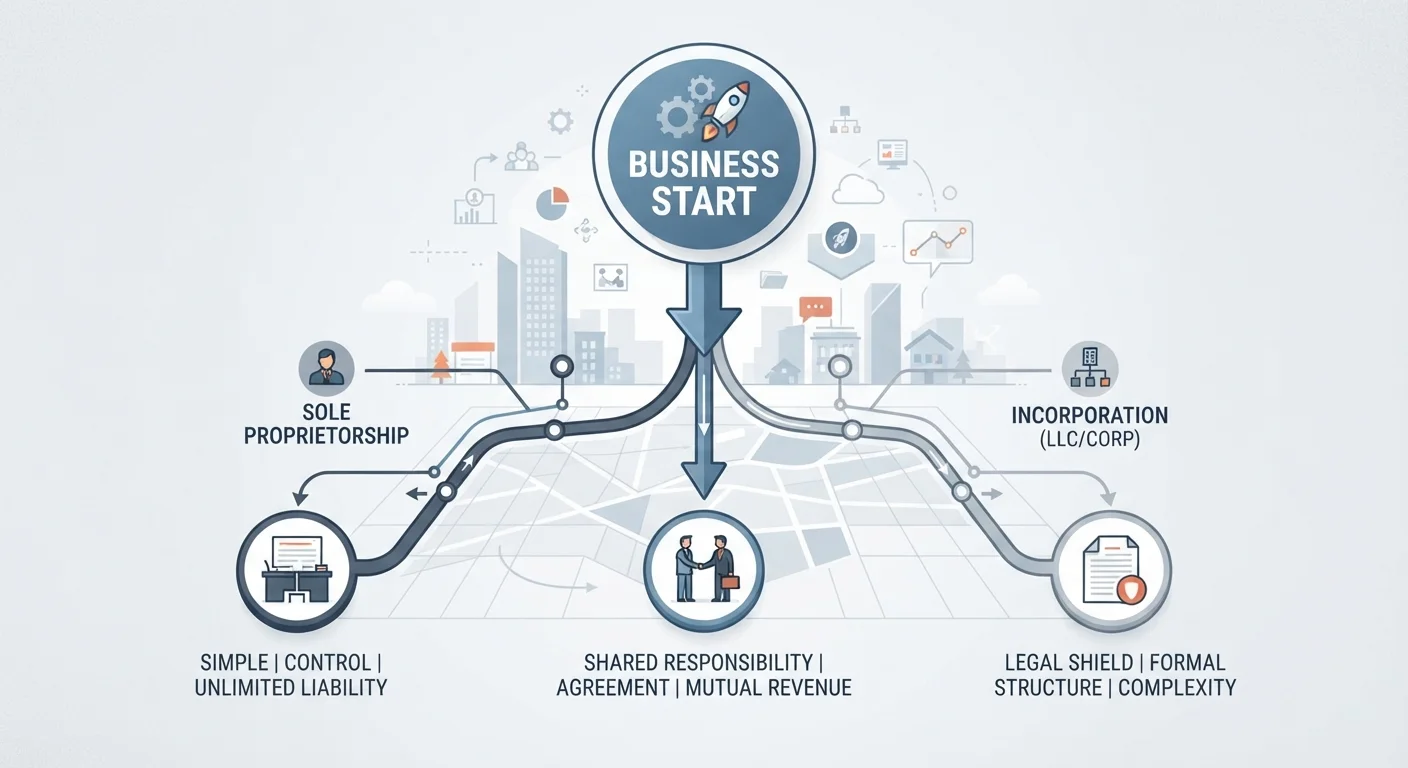
Photo: CoralScripts.com | Explore, Discover, Engage editorial
—— In This Article
Key Takeaways
- Sole trader status is the simplest structure but offers no liability protection from personal assets.
- Partnerships distribute both responsibility and risk among two or more individuals under a shared legal framework.
- A limited company separates business and personal finances, offering liability protection but requiring more administration.
- Tax treatment, growth ambitions, and risk tolerance should all factor into the structure decision.
- Switching structures later is possible but can be complex—getting it right early saves friction.
Why Business Structure Matters More Than Most People Realize
Before a business earns its first dollar, one foundational decision shapes nearly everything that follows: how it's legally structured. The choice between operating as a sole trader, entering a partnership, or forming a limited company determines how profits are taxed, who is liable when things go wrong, and how easily the business can attract investment or scale. Yet many founders choose based on what's easiest to set up rather than what's strategically sound.
This article cuts through the complexity to explain what each structure actually means in practice—covering liability, tax, admin burden, and growth implications—so you can make an informed decision from the start. If you're also thinking about how you'll fund the venture, our comparison of bootstrapping versus outside investment is worth reading alongside this.
| Sole Trader | General Partnership | Limited Company | |
|---|---|---|---|
| Personal liability | Unlimited personal liability | Joint and several liability | Limited to investment |
| Tax treatment | Pass-through personal income | Pass-through personal income | Corporate rate; varies by structure |
| Setup complexity | Minimal | Low (agreement advised) | Moderate to high |
| Ongoing admin | Low | Low to moderate | Significant |
| Ability to raise equity | Not possible | Limited | Yes, via share issuance |
| Credibility with lenders | Lower | Moderate | Generally higher |
| Profit retention in business | Not applicable | Not applicable | Possible at corporate rate |
Sole Trader: Maximum Simplicity, Maximum Personal Exposure
Operating as a sole trader (sometimes called a sole proprietor) means you and your business are legally the same entity. There's no formal registration required beyond obtaining any applicable licenses and reporting self-employment income on your tax return. You keep all profits, make every decision, and answer to no one else.
The trade-off is personal liability. If the business accumulates debt or faces a lawsuit, your personal assets—savings, property, vehicles—are fully exposed. This makes the structure poorly suited to high-risk industries or ventures that rely on significant borrowing.
From a tax standpoint, all business profit is treated as personal income, which can push higher-earning sole traders into upper income tax brackets. There's no ability to retain earnings in the business at a lower corporate rate. For many freelancers, consultants, and small service providers with limited liability exposure, this simplicity is a reasonable trade. For those planning to grow, it tends to become a constraint.
Consider Your Exit Strategy Early
The structure you choose affects how you can eventually sell or transfer the business. Limited companies are generally easier to sell as going concerns, since ownership transfers via shares rather than the legal dissolution of a personal business. If you have long-term exit ambitions, factor that into your initial structure decision rather than revisiting it under pressure later.
Partnership: Shared Ownership, Shared Risk
A general partnership forms when two or more people go into business together without incorporating. Like a sole trader arrangement, each partner is personally liable for the business's debts—including debts incurred by their co-founders. This joint and several liability is one of the most misunderstood risks in business: one partner's poor decision can expose everyone's personal assets.
Profits pass through to partners as personal income, and each files accordingly. The key document governing a partnership is the partnership agreement, which—while not always legally required—is strongly advisable. It should define ownership stakes, profit distribution, decision-making authority, and what happens if a partner exits.
A limited liability partnership (LLP) is a hybrid option that gives partners some protection from each other's liabilities, though it involves more formal registration. LLPs are common in professional services firms. If you're co-founding a business with a partner, understanding how to document your business plan early helps ensure both parties are aligned before disputes arise.
Limited Company: Separation, Credibility, and Complexity
Forming a limited company—specifically a C-corporation or S-corporation in the US context, or a private limited company elsewhere—creates a legally distinct entity from its owners. Shareholders' personal liability is generally limited to their investment. This separation is the defining advantage: the business can take on debt, face litigation, or fail without directly threatening founders' personal finances (absent fraud or personal guarantees).
The tax picture is more nuanced. A C-corp pays corporate income tax, and dividends to shareholders are taxed again at the individual level—what's often called double taxation. An S-corp avoids this by passing income through to shareholders, but comes with ownership restrictions. The right choice depends heavily on your tax situation and exit strategy; qualified tax counsel is essential here.
Administrative requirements are substantially greater: formal registration, bylaws, annual filings, board meetings, and separate business accounts. This overhead is often worthwhile for businesses that plan to seek outside investment—since equity can be issued to investors—or for those operating in sectors with meaningful liability exposure. Those considering franchise ownership will find limited company structures particularly relevant; the trade-offs of franchise ownership often intersect with entity selection.
~16M
US sole proprietorships filing annually
IRS data consistently shows sole proprietorships are the most common business structure in the United States by filing volume.
~1.8M
Active US S-corporations
According to IRS Statistics of Income data, S-corporations represent a significant share of incorporated small businesses due to their pass-through tax treatment.
Making the Call: What to Weigh Before You Decide
The right structure depends on four core dimensions:
- Liability exposure: High-risk industries or ventures with significant borrowing warrant the protection a limited company provides.
- Tax efficiency: Higher earners may benefit from retaining profits inside a corporate entity at a lower rate. Lower earners often find pass-through simplicity preferable.
- Growth and investment plans: If you intend to raise equity capital, a limited company is generally required. Investors rarely back unincorporated entities.
- Administrative capacity: Sole trader and partnership structures demand far less paperwork. If compliance overhead is a real constraint, start simple and upgrade as you grow.
Structure changes are possible—many businesses begin as sole traders and incorporate once revenue justifies it—but the transition involves legal, tax, and operational complexity. Getting sound professional advice at the outset, from a qualified accountant or business attorney, is money well spent.
This article is for general informational and educational purposes only and does not constitute legal, tax, or financial advice. Consult a qualified professional for guidance specific to your circumstances.

Work & Business Editorial Team
Work & Business Editorial Team is the collective byline for our editorial team and contributor network. Articles published under this byline or an editorial pen name are researched, written, and reviewed according to our editorial standards for clarity, consistency, and independence before publication.
View author profile