
Career Development from Entry Level to Senior: What Changes at Each Stage
What drives growth early in a career often differs significantly from what matters at mid and senior levels. Understand the shift in expectations.
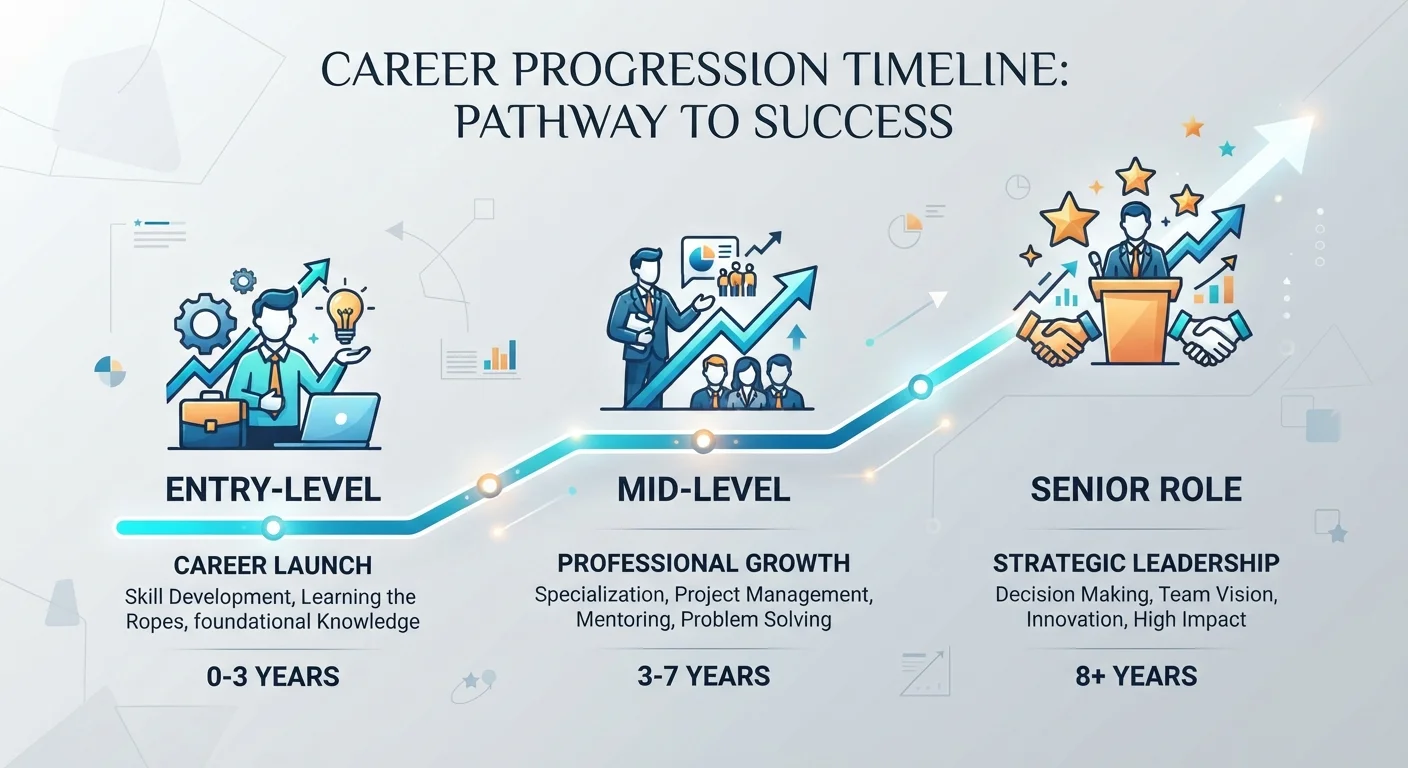
Photo: CoralScripts.com | Explore, Discover, Engage editorial
—— In This Article
Key Takeaways
- Each career stage demands a fundamentally different set of skills, not just more of the same ones.
- Entry-level success is driven by reliable execution; senior-level success requires shaping strategy and enabling others.
- The mid-career transition is often the hardest: professionals must shift from doing to influencing.
- Stalled careers frequently result from staying in the mode that worked at an earlier stage.
- Relationships and visibility matter progressively more at each successive level.
Why Career Stages Aren't Just About Seniority
Career development is often described as a ladder, but that metaphor obscures what actually changes as professionals advance. Moving from entry-level to senior isn't simply about accumulating experience or years on the job — it involves a genuine shift in what organizations expect, how success is measured, and what skills need to be foregrounded.
Each stage requires a distinct operating model. The habits and strengths that make someone effective early in their career can quietly become constraints if left unexamined. Understanding these shifts before they happen — rather than after stagnation sets in — is one of the clearest advantages a professional can have.
For a broader view of how structural changes in hiring and advancement are reshaping these dynamics, see how workplace trends are reshaping career trajectories.
70%
Skills needed changing within 5 years
The World Economic Forum has estimated that a significant majority of core job skills will change within five years as automation and AI reshape role requirements.
~50%
Managers lacking formal management training
Research from Gallup has suggested that roughly half of managers report receiving little to no formal training before taking on people management responsibilities.
3–5x
Value of sponsorship vs. mentorship for advancement
Multiple organizational studies have found that active sponsorship — advocacy from senior leaders — correlates more strongly with promotion rates than mentorship alone.
The Entry-Level Stage: Building Credibility Through Execution
Early-career professionals are evaluated primarily on reliability and craft. The core question organizations ask is simple: can this person consistently deliver quality work on time? Technical skills, attention to detail, and a willingness to learn from feedback are the currencies of this stage.
Credibility at this level is earned incrementally. Each completed project, well-handled task, and proactive question builds the foundation that later career moves depend on. Visibility here is less about self-promotion and more about consistent output that others can trust.
Key development priorities at the entry level include:
- Mastering the core technical or functional skills of the role
- Learning organizational norms, communication styles, and decision-making processes
- Building relationships with peers and immediate managers
- Demonstrating initiative within defined scope — not overreaching, but not waiting to be asked
In the first year of any role, prioritize understanding how decisions actually get made — not just how the org chart says they do. This political map is invisible in job descriptions but essential to navigating effectively.
Early-career professionals who decode informal influence structures adapt faster and avoid missteps that can set back their credibility before it's fully established.
At the mid-career stage, deliberately seek assignments that put you in cross-functional rooms — even if you're not the lead. Presence and pattern recognition across functions compounds into strategic judgment over time.
Senior-level decision-making requires understanding how different parts of an organization interact. Building that fluency early shortens the gap between mid-level execution and senior-level strategy.
One underrated asset at this stage is finding the right mentor, sponsor, or coach early. These relationships accelerate learning in ways that no job description or training program can replicate.
The Mid-Level Stage: Expanding Scope and Influence
At the mid-career point — typically individual contributors who have mastered their domain or managers leading small teams — the performance bar shifts meaningfully. Execution remains important, but it's no longer sufficient. Organizations now expect professionals to shape outcomes beyond their immediate responsibilities.
This stage is characterized by growing ambiguity. Problems become less defined, stakeholders become more numerous, and the right answer is rarely obvious. The ability to navigate complexity, manage up and across the organization, and bring others along becomes as important as personal output.
Core transitions at the mid-level include:
- Shifting from solving individual problems to identifying and framing the right problems
- Building cross-functional relationships and informal influence
- Developing a point of view — being known for something beyond task completion
- Beginning to develop others, whether through formal management or informal mentorship
Mid-Career: Invest in Your Visibility Strategy
At the mid-level, many professionals underestimate how much internal visibility shapes advancement. Doing excellent work in isolation is rarely enough — ensure your contributions are legible to stakeholders outside your immediate team. This doesn't mean self-promotion; it means making the impact of your work visible and interpretable to those who influence decisions about your career.
Professionals at this stage often face a decision between lateral moves and vertical promotions — and the right answer depends far more on context than conventional wisdom suggests.
The Senior Stage: Leading Systems, Not Just Tasks
Senior professionals — whether individual contributors at the principal or staff level, or leaders managing managers — are accountable for outcomes at a system level. The work is no longer about producing great output personally; it's about creating the conditions for others to produce great outcomes and ensuring the organization moves in the right direction.
At this level, strategic thinking, organizational influence, and long-horizon judgment define performance. Senior professionals are expected to operate with minimal direction, anticipate second-order effects of decisions, and take ownership of outcomes they don't directly control.
What distinguishes genuinely senior performance:
- Defining and communicating strategy, not just executing it
- Building institutional capability — processes, culture, team strength — that outlasts any individual contribution
- Managing ambiguity and uncertainty without escalating prematurely
- Being a visible advocate for others' careers and organizational health
“The most dangerous career assumption is that what got you here will get you there. Each level of leadership requires you to redefine what success looks like — and that redefinition is uncomfortable by design.”
— Marshall Goldsmith, Executive coach and author on leadership transitions
The Transition Points That Define Career Momentum
The gaps between stages are where careers most often stall. Each transition demands that professionals actively unlearn habits that served them well and adopt new ones that feel less natural — at least initially.
The early-to-mid transition requires letting go of the comfort of clear tasks and learning to operate in ambiguity. The mid-to-senior transition requires relinquishing personal execution as the primary measure of contribution. Both are identity shifts, not just skill upgrades.
Applying the Wrong Operating Model Is the Hidden Career Risk
The most common reason capable professionals stall is not a skills gap in the conventional sense — it's applying the success formula from their previous stage to their current one. A senior manager who still measures their own performance primarily by personal output, or an entry-level professional who operates as if organizational politics don't apply to them, will find advancement elusive despite genuine capability. Honest self-assessment at each transition is not optional — it's the core work.
Professionals who recognize they've plateaued — rather than simply hit a temporary slowdown — benefit from an honest audit of whether they're applying last stage's operating model to this stage's demands. The anatomy of a career plateau is worth understanding in depth before assuming the problem is external.
What Derails Growth at Each Stage
Understanding what stunts progression is as valuable as knowing what accelerates it.
- At the entry level:
- Overconfidence before credibility is established, poor responsiveness to feedback, and treating relationships as transactional rather than developmental.
- At the mid level:
- Continuing to over-index on individual contribution, avoiding the discomfort of influencing without authority, and failing to build organizational visibility.
- At the senior level:
- Micromanaging rather than enabling, protecting status rather than investing in others' growth, and losing touch with emerging trends or ground-level realities.
For professionals considering whether a shift in direction — rather than upward movement — might be the right response to stagnation, the question of career change versus career pivot is worth examining carefully before acting.
Career Growth Hub
A curated collection of articles covering career transitions, advancement strategies, and professional development at each stage of a working career.
Jobs & Career Paths
Explore job search guidance, career path frameworks, and workplace navigation resources for professionals at all levels.
Workplace Trends
Track the emerging structural shifts — from skills-based hiring to hybrid work — that are actively reshaping how careers are built and managed.
This article is intended for general informational and educational purposes. Career trajectories vary significantly by industry, organization, and individual circumstance. Consult a qualified career professional for guidance tailored to your specific situation.

Work & Business Editorial Team
Work & Business Editorial Team is the collective byline for our editorial team and contributor network. Articles published under this byline or an editorial pen name are researched, written, and reviewed according to our editorial standards for clarity, consistency, and independence before publication.
View author profile