
The Complete Guide to Planning Any Type of Trip From Start to Finish
An end-to-end resource covering destination research, budgeting, booking, packing, documentation, and on-the-road adjustments for any kind of journey.
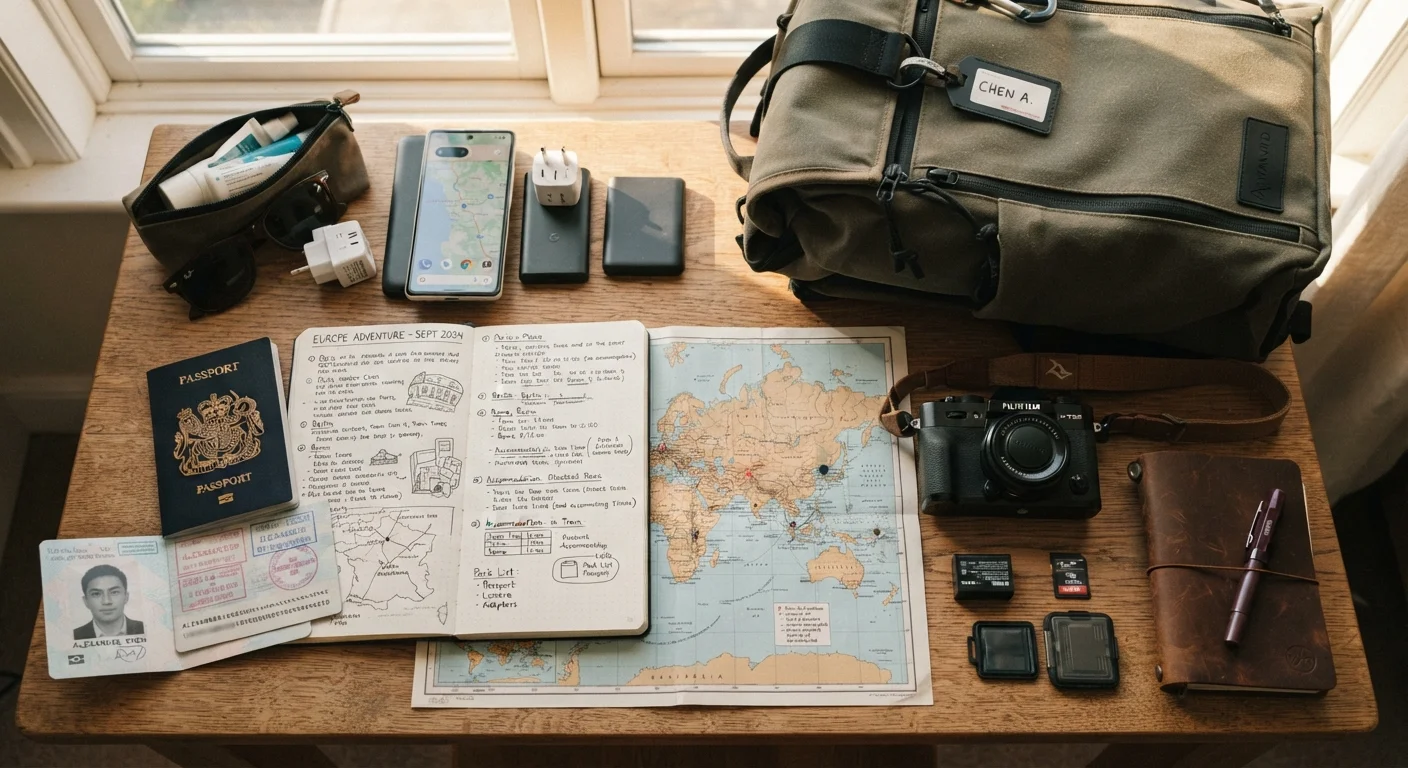
Photo: CoralScripts.com | Explore, Discover, Engage editorial
—— In This Article
Key Takeaways
- Match your destination and itinerary style to your actual tolerance for pace and uncertainty.
- Verify visa, vaccination, and entry requirements through official government sources before booking.
- A line-item budget built before departure prevents the most common cause of trip stress.
- Packing light consistently outperforms over-packing for nearly every travel scenario.
- Build buffer time into every itinerary so unexpected delays don't derail your plans.
- Adaptability is a skill — pre-plan contingencies rather than reacting to disruptions in the moment.
Choosing Your Destination and Travel Style
Every well-planned trip begins with a single honest question: what kind of traveler are you on this trip? Your answer shapes every decision that follows. A destination that thrills a spontaneous explorer can exhaust someone craving a week of genuine rest.
Start by defining a few non-negotiables — climate preference, desired activity level, language comfort, and whether you prioritize breadth (many places) or depth (fewer, explored thoroughly). Our guide to slow travel vs. itinerary-packed trips breaks down the real-world trade-offs between both approaches before you commit.
For domestic travelers, US destinations offer extraordinary range — from national park road trips to coastal city weekends — without the documentation burden of international travel. For those ready to cross borders, the international travel hub provides destination-specific guidance worth consulting early in the research phase.
Align your destination complexity with your available planning bandwidth. A first international trip to a country with significant language barriers or limited tourist infrastructure requires considerably more pre-departure research than a well-trodden route.
Misjudging destination complexity is one of the most common sources of traveler frustration — particularly for less-experienced international travelers who underestimate the cognitive load of navigating unfamiliar systems.
When booking accommodation for a multi-stop trip, hold off on confirming non-refundable properties until your flight itinerary is finalized and paid for.
Flight schedule changes or cancellations can shift your arrival day or city, leaving you locked into accommodation you cannot use — a costly and avoidable mistake.
Researching Entry Requirements and Safety
Once you have a shortlist of destinations, entry requirements and current safety conditions must be verified — not assumed. Visa rules, passport validity minimums, and required vaccinations change with little notice and vary by nationality.
Always consult the U.S. Department of State's travel advisories and the destination country's official immigration portal as your primary sources. For health-related entry requirements, the CDC's Travelers' Health site offers country-specific vaccination and medication guidance, though any personal health decisions should be made with a qualified healthcare provider.
For a practical framework on gathering reliable destination intelligence — including what to do when travel advice conflicts — see our guide to researching a destination without being overwhelmed.
Always Verify Entry Requirements Officially
Visa exemptions, passport validity rules, and vaccination requirements can change with limited public notice. Never rely solely on third-party travel sites or social media posts for this information. Cross-check all entry requirements against the U.S. Department of State website and the destination country's official immigration authority within 30 days of departure. Travelers who arrive with incorrect documentation may be denied boarding or entry, with no guarantee of reimbursement for non-refundable bookings.
Building a Realistic Budget
A trip budget that accounts for every category — not just flights and hotels — is the single most effective stress-reduction tool available to any traveler. Begin with your largest fixed costs: transportation and accommodation. Then layer in variable daily costs: meals, local transport, entrance fees, and activities. Finally, add a contingency buffer of roughly 10–15% of your total estimated spend for emergencies, delays, or worthwhile opportunities you didn't anticipate.
42%
Travelers who exceed their original trip budget
According to a survey by the U.S. Travel Association, nearly half of leisure travelers spend more than originally planned, most commonly on dining and activities.
10–15%
Recommended contingency buffer on travel budgets
Travel planning professionals commonly advise reserving a 10–15% buffer above estimated total spend to cover unexpected costs without financial stress.
Research average daily costs using destination-specific travel forums and government tourism statistics rather than relying on broad travel site aggregates, which often skew toward higher-spend traveler profiles. Currency exchange rates affect purchasing power significantly — monitor trends and understand the fee structure of any card or exchange service you plan to use, though specific product recommendations should come from your own financial research.
Booking Flights, Accommodation, and Ground Transport
Sequencing bookings correctly reduces both cost and coordination friction. Book international flights first once your dates are firm, since airfare is typically the least flexible cost and has the longest lead time. Accommodation can follow, with flexibility on the exact property depending on your style — hotels, vacation rentals, hostels, and guesthouses each carry distinct trade-offs in price, privacy, and local integration.
Ground transport planning is frequently underestimated. Research whether your destination's public transit is practical for visitors, whether an international driving permit is required to rent a vehicle, and what ride-share availability looks like outside major cities. For multi-city itineraries, inter-city rail or bus often offers a better combination of cost and experience than domestic flights.
Book refundable rates when plans are uncertain
If your travel dates or destination could shift, prioritize refundable or flexible booking options even when the upfront rate is slightly higher. The cost difference is almost always smaller than the penalty for canceling a non-refundable booking. Review each property's specific cancellation window — policies vary significantly between providers.
Confirm all booking cancellation and change policies before paying. Travel insurance that covers trip interruption and medical evacuation is worth evaluating for international travel and any high-cost itinerary — review policy terms carefully with the insurer directly.
Packing Smart: What to Bring and What to Leave
The packing principle that holds across virtually every travel scenario: bring less than you think you need, and choose versatile items over single-use ones. A bag you can carry onto a plane eliminates checked baggage fees, lost-luggage risk, and the time cost of baggage claim at every stop.
Build your packing list around the specific activities and climate of your destination rather than worst-case hypotheticals. Key categories to address deliberately: documents (passport, visa confirmations, insurance cards — carry both physical and digital copies), medications and basic first aid, destination-appropriate clothing, power adapters, and any gear tied to planned activities.
Digital and Physical Document Copies Both Matter
Store digital copies of your passport, visa, insurance policy, and booking confirmations in a secure cloud location accessible from any device. Also carry a printed set in a separate bag from your originals. If your phone is lost or stolen abroad, physical backups can significantly speed up the recovery process with embassies and local authorities.
Your complete itinerary and booking confirmations should be accessible offline, whether printed or saved to your device, since connectivity cannot be guaranteed at every point in a journey.
Staying Flexible and Adapting on the Road
Even the most thorough pre-trip planning meets real-world conditions that require adjustment. Flights get canceled, weather closes attractions, and better opportunities present themselves. The travelers who navigate disruption most smoothly are those who planned contingencies in advance rather than improvising under pressure.
Structure your itinerary with built-in breathing room. Our guide to building an itinerary that leaves room to breathe addresses how to design a schedule that covers priorities without turning every day into a logistics race.
Carry key contact information — accommodation, airline, travel insurance, and the nearest U.S. embassy or consulate for international travel — in an easily accessible format. Stay informed about local conditions through official tourism and government channels rather than social media alone. Adaptability, when grounded in solid preparation, is what transforms a disruption into a manageable detour rather than a derailed trip.

Travel & Places Editorial Team
Travel & Places Editorial Team is the collective byline for our editorial team and contributor network. Articles published under this byline or an editorial pen name are researched, written, and reviewed according to our editorial standards for clarity, consistency, and independence before publication.
View author profile