
Remote Work, Hybrid, and On-Site: What Each Arrangement Looks Like in Practice
The terminology around work arrangements varies widely. This reference breaks down what each model typically means for schedules, autonomy, and expectations.
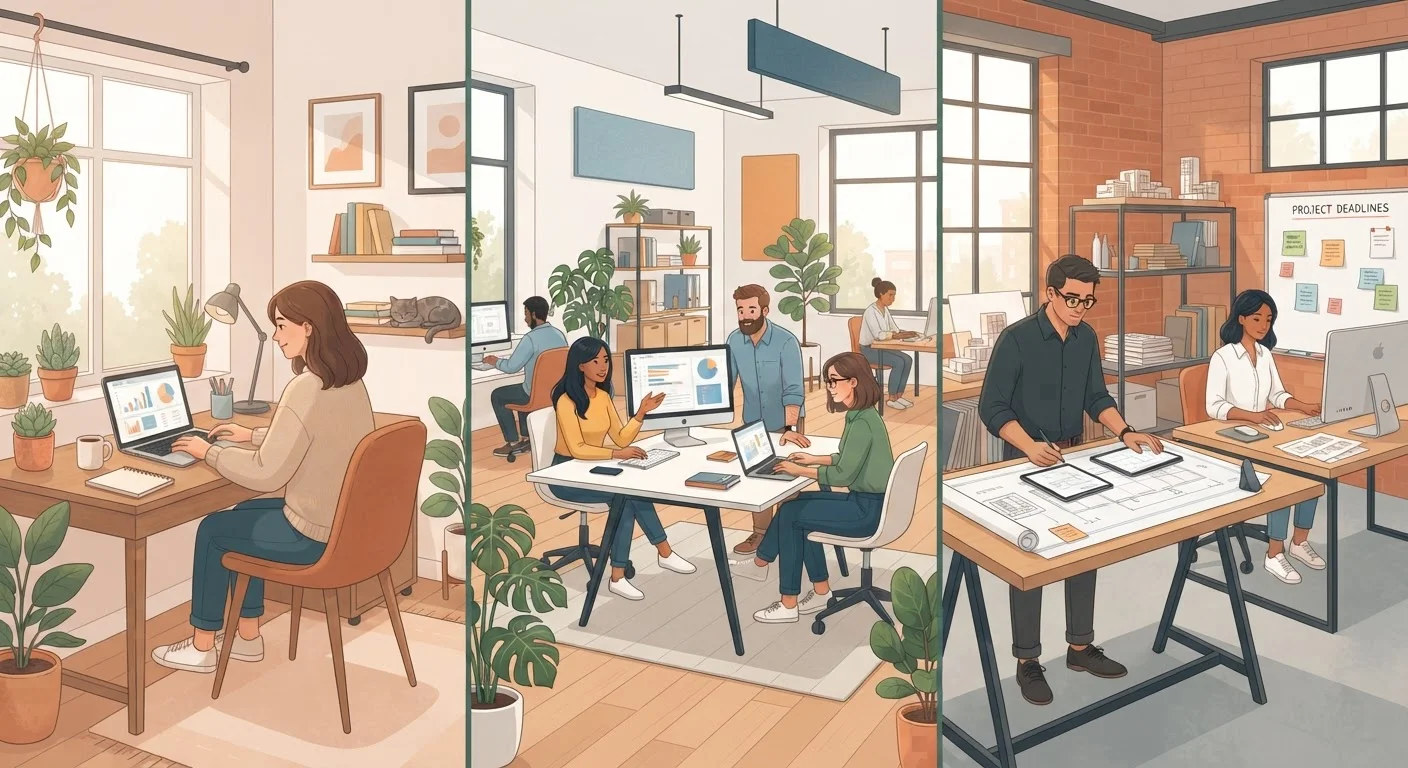
Photo: CoralScripts.com | Explore, Discover, Engage editorial
—— In This Article
Why the Terminology Matters
When a job posting says "hybrid" or "flexible," it doesn't mean the same thing everywhere. One employer's hybrid is three days a week in the office; another's is one. An "on-site" role at a tech firm may allow occasional remote days, while the same label at a hospital means exactly what it says. Understanding these distinctions before accepting an offer - or writing a résumé - saves real frustration later.
This reference breaks down what each arrangement typically looks like in daily practice, covering schedule structure, autonomy, collaboration norms, and what employees are generally expected to manage on their own. For a broader look at how workplaces are evolving, see Workplace Trends.
| Fully Remote Definition | No required physical office location; all work performed off-site |
| Hybrid Definition | Split time between remote and in-office, per employer terms |
| On-Site Definition | Physical presence required at employer's location during work hours |
| Most Variable Model | Hybrid - terms differ significantly across organizations |
| Key Hybrid Variable | Number of required in-office days per week or month |
| Primary Remote Communication Mode | Asynchronous (text, email, recorded video) |
Fully Remote: The Full-Distance Model
In a fully remote arrangement, employees have no required physical location. Work happens from home, a co-working space, or anywhere with a reliable internet connection. There is no expectation of commuting to a central office - for some roles, the employer may not even have one.
What this looks like day-to-day: Communication is heavily text-based - Slack channels, email threads, recorded video updates. Meetings happen over video calls, sometimes across time zones. Output and deliverables tend to matter more than hours logged, though expectations vary widely by employer.
Autonomy and accountability: Remote roles place high demand on self-direction. Employees manage their own schedules, workspaces, and interruptions. The tradeoff for flexibility is that visibility is harder to establish - which affects career development in ways that aren't always obvious upfront. See Remote Work Myths That Research Has Since Complicated for a nuanced look at common assumptions.
Communication model: Most remote-first teams rely on asynchronous communication - messages sent without expecting an immediate reply. This works well for focused work but requires deliberate norms. The Asynchronous vs. Synchronous Work article explores these trade-offs in depth.
Fully Remote
A work arrangement in which employees have no requirement to work from a specific physical location. All work is performed off-site, typically from home or a personal workspace of the employee's choosing.
Hybrid Work
An arrangement where employees divide their working time between a remote location and an employer's physical office. The specific split, schedule structure, and flexibility vary by organization and role.
On-Site Work
A traditional arrangement requiring physical presence at an employer's designated location during working hours. Common in roles where tasks cannot be performed remotely, such as manufacturing, healthcare, or retail.
Asynchronous Communication
Messaging or collaboration that does not require immediate response - such as email, recorded video, or threaded messages. Common in remote and distributed teams operating across time zones.
Team-Anchored Hybrid
A hybrid model where in-office requirements are set by individual teams rather than company-wide policy, enabling coordination at a local level.
Distributed Team
A group of employees who work across multiple locations - sometimes spanning cities, time zones, or countries - rather than from a shared central office.
Hybrid: The Shared Middle Ground
Hybrid arrangements split time between a remote location and an employer's physical space. They are the most varied category - and the one most prone to misunderstanding during hiring.
Common hybrid models include:
- Fixed hybrid: Set in-office days for the entire organization (e.g., Tuesday and Thursday). Predictable, easy to coordinate, but less flexible for individuals.
- Flexible hybrid: Employees choose which days to come in, often within a minimum requirement. Offers more personal control but can make collaboration harder to schedule.
- Team-anchored hybrid: In-office requirements tied to team schedules, not company-wide mandates. Coordination is local rather than top-down.
What to ask before accepting: How many days per week or month are required? Are those days fixed or flexible? Is there a minimum notice period to change them? Who decides - the company, the team, or the individual? These specifics shape the actual day-to-day experience more than the label "hybrid" ever will.
Hybrid work also tends to create unintended dynamics around who is visible to leadership. Employees who come in more often may receive more informal face time, which can affect advancement - a consideration worth factoring into career growth planning.
"Hybrid" Is Not a Standardized Term
Unlike "on-site" or "fully remote," which describe presence in binary terms, "hybrid" encompasses an enormous range of arrangements. Two positions both advertised as hybrid might require anywhere from one to four in-office days per week. Always request specific details - days required, whether they are fixed or flexible, and whether those terms can change - before accepting a role.
On-Site: What In-Person Expectations Actually Entail
On-site roles require employees to be physically present at a designated location during working hours. This covers a wide range: a manufacturing floor, a clinical setting, a retail branch, or a corporate headquarters. The defining feature is that the work cannot be relocated.
Schedule structure: On-site roles often have the clearest boundaries - set start and end times, defined break periods, and predictable physical routines. For many people, this structure is a genuine preference, not a limitation.
Collaboration and oversight: In-person work allows for spontaneous conversation, real-time problem-solving, and direct supervision. It also means less control over your environment - open offices, shared equipment, commuting time, and workplace social dynamics are part of the picture.
Who this suits: Roles requiring hands-on work, regulated safety conditions, or high-frequency real-time coordination are typically on-site by necessity, not preference. Some employees also thrive with the external structure and clear separation between work and personal life that on-site arrangements provide - a contrast worth examining through the lens of work-life integration.
If you're evaluating work arrangements as part of a job search, Key Terms Every Employee Should Understand can help you parse the language employers use - and what it signals about their culture.
~60%
U.S. workers in hybrid or remote-capable roles
Gallup data has consistently found that a significant majority of remote-capable workers prefer some form of hybrid arrangement over fully on-site work.
3 days
Median in-office days for hybrid workers
Research from multiple workplace surveys suggests three days per week is the most common hybrid baseline, though actual requirements vary widely.
1 in 5
Remote workers report difficulty with career visibility
Studies on remote work and advancement have found that workers off-site perceive challenges in being seen by leadership compared to in-person peers.

People & Communities Editorial Team
People & Communities Editorial Team is the collective byline for our editorial team and contributor network. Articles published under this byline or an editorial pen name are researched, written, and reviewed according to our editorial standards for clarity, consistency, and independence before publication.
View author profile