
Dating Apps vs. Meeting People Organically: What the Research Actually Says
A balanced look at how online dating and in-person connection differ in outcomes, satisfaction, and long-term compatibility.
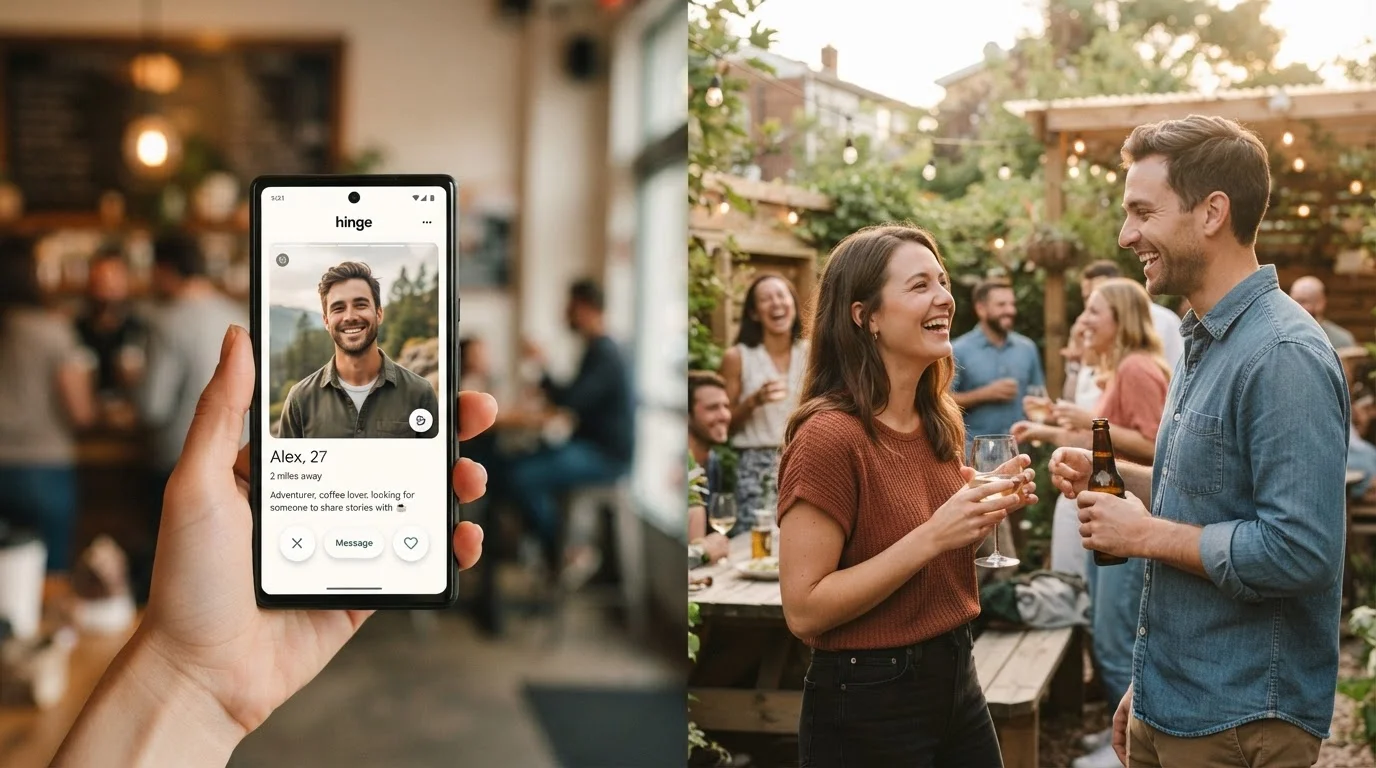
Photo: CoralScripts.com | Explore, Discover, Engage editorial
—— In This Article
Key Takeaways
- Research shows that marriages beginning online are not systematically less stable than those formed in person.
- Dating apps excel at expanding your potential pool but can introduce paradox-of-choice fatigue and superficial filtering.
- Organic meetings carry built-in social context - shared friends, settings, or activities - which can accelerate trust.
- Satisfaction with either method depends heavily on individual personality, life stage, and realistic expectations.
- Most daters today use a combination of approaches rather than relying exclusively on one.
What Research Actually Tells Us About How Couples Meet
For most of human history, romantic partnerships emerged from proximity - neighbors, churchgoers, coworkers, friends of friends. That began shifting measurably around 2010, and by the late 2010s, research from sociologists at Stanford found that meeting online had overtaken every other method as the most common way American couples connected. That shift is significant, but it doesn't automatically answer the question people really want answered: does it matter?
Studies examining relationship quality and longevity suggest that the channel through which couples meet has a modest, often inconsistent effect on long-term outcomes once researchers control for other variables like age, education, and intentionality. A well-cited 2013 study published in the Proceedings of the National Academy of Sciences found that marriages formed online reported slightly higher satisfaction and lower separation rates - though researchers were careful to note the differences were small and the population self-selecting. More recent work has largely reinforced that neither path has a decisive edge when it comes to durability. What matters more is what happens after the introduction.
39%
US couples who met online
Stanford sociologist Michael Rosenfeld's research found that by around 2017, roughly 39% of heterosexual couples in the US met through an internet platform - more than any other method.
~50%
Same-sex couples meeting online
The same research found that for same-sex couples, the proportion meeting online was even higher, exceeding 50%, reflecting more limited organic alternatives in many communities.
Modest
Difference in relationship quality by meeting method
Multiple peer-reviewed studies have found that when controlling for demographic factors, meeting online versus in person accounts for only modest differences in relationship satisfaction or stability.
For readers navigating these questions at different life stages, our piece on how priorities shift across decades of dating offers useful context about how method preferences often evolve over time.
The Real Tradeoffs: Pool Size, Filtering, and First Impressions
Dating apps offer something genuinely unprecedented: access to a large pool of people actively seeking a partner. For someone in a rural area, a member of a smaller community, or anyone with a demanding schedule, this is not a trivial advantage. At the same time, that abundance introduces its own friction.
Behavioral research on choice architecture suggests that too many options can paradoxically reduce satisfaction with any single choice - a phenomenon sometimes called choice overload. When every profile is interchangeable and the next swipe is frictionless, it can be harder to invest meaningfully in any one person. The profile format also rewards certain qualities: attractiveness in photographs, articulate self-description, and the ability to seem interesting in a few hundred characters. People who are warm, funny, or trustworthy in person but struggle to translate those qualities to a profile may be systematically underrepresented.
Organic meetings, by contrast, come loaded with context. You already know that the person is a friend of someone you trust, or that they show up every week to the same community garden. That shared environment creates what researchers sometimes call "ambient familiarity" - repeated low-stakes exposure that builds comfort before any explicit romantic interest is declared. The downside is obvious: you can only meet people whose paths already cross yours, which can limit diversity of background, perspective, and even geography.
| Criterion | Dating Apps | Meeting Organically |
|---|---|---|
| Pool size | Very large, geographically broad | Limited to existing social orbit |
| Initial context | Profile-based, curated self-presentation | Shared environment or mutual connections |
| Pace of connection | Rapid matching, but slow trust-building | Slower start, often faster trust once begun |
| First-impression bias | Heavily photo and text dependent | Body language and tone available from the start |
| Long-term relationship outcomes | Comparable to organic per recent research | Comparable to app-based per recent research |
| Accessibility for introverts | Higher - lower-pressure initial contact | Lower - requires active social participation |
| Risk of choice fatigue | Higher due to volume of options | Lower - fewer simultaneous candidates |
Understanding compatibility more deeply - beyond the surface signals either channel provides - is worth exploring. Our piece on common misconceptions about compatibility challenges some widely held but unreliable assumptions.
Emotional Experience and the Communication Gap
How a relationship begins can shape its early emotional texture. App-based connections often require an explicit moment of mutual acknowledgment - a match, a first message - which creates a self-conscious frame from the start. Both people know they are being evaluated for romantic potential, which can produce guardedness or performance rather than natural self-expression.
Organic meetings tend to unfold with less initial pressure. A friendship or acquaintance that gradually develops romantic dimensions allows people to show up more authentically before the stakes are named. That said, ambiguity carries its own costs: uncertainty about whether interest is mutual, reluctance to risk a friendship or a professional relationship, and the potential for a longer, less efficient path to clarity.
First interactions - wherever they happen - set communication patterns that tend to persist. Our article on how early communication shapes relationship dynamics looks at what makes those first conversations meaningful rather than performative. And if you're new to dating or returning after time away, a grounded introduction to the modern dating landscape can help orient you to both environments.
This article is for general informational purposes and reflects published research trends. Individual experiences vary widely, and no single approach to dating guarantees any particular outcome.

People & Communities Editorial Team
People & Communities Editorial Team is the collective byline for our editorial team and contributor network. Articles published under this byline or an editorial pen name are researched, written, and reviewed according to our editorial standards for clarity, consistency, and independence before publication.
View author profile