
Dollar-Cost Averaging: The Discipline Behind Investing in Any Market
Investing fixed amounts on a regular schedule can reduce the emotional weight of market timing. Learn how dollar-cost averaging works and its real limitations.
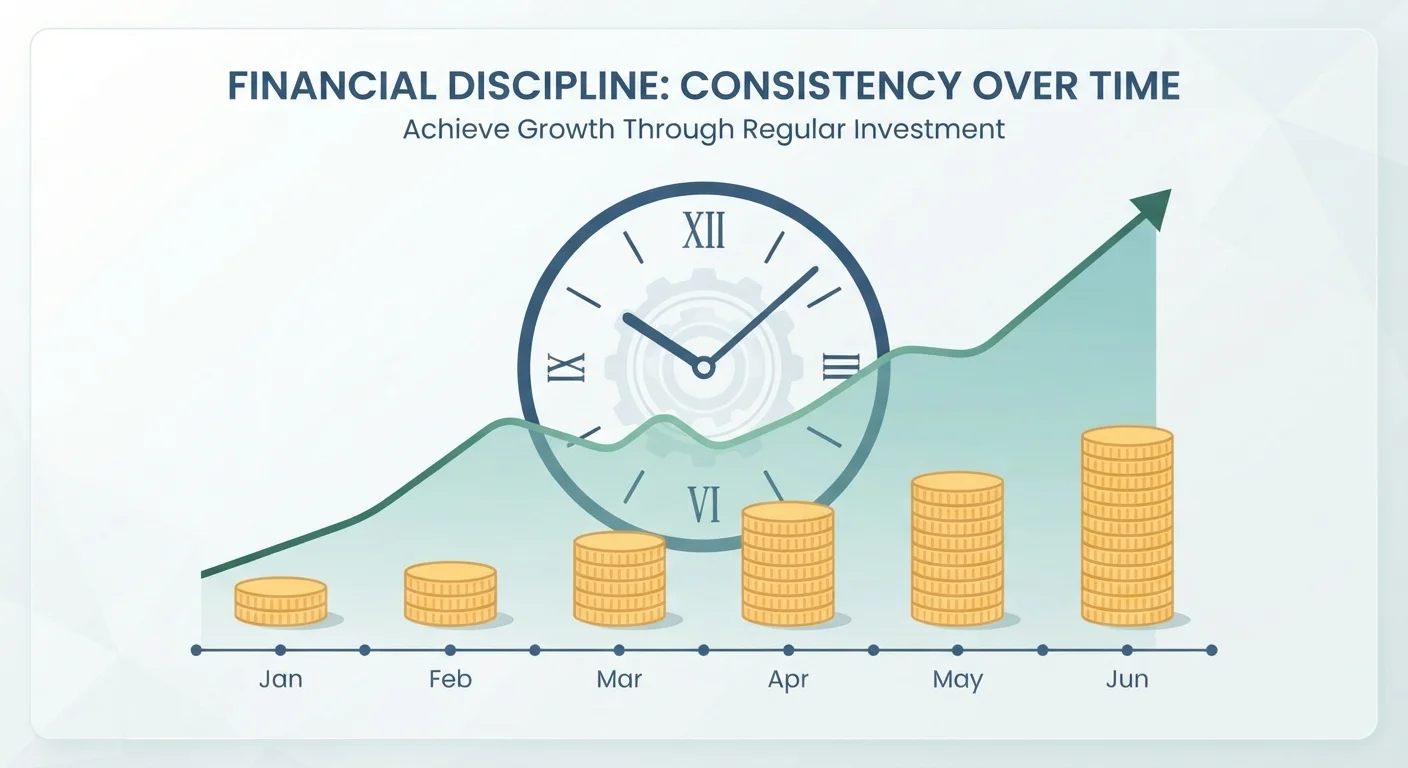
Photo: CoralScripts.com | Explore, Discover, Engage editorial
—— In This Article
Key Takeaways
- Dollar-cost averaging (DCA) means investing a fixed dollar amount on a regular schedule, regardless of market conditions.
- DCA reduces the risk of investing a lump sum at a market peak by spreading purchases over time.
- The strategy works best when maintained consistently through both rising and falling markets.
- DCA does not guarantee profit and may produce lower returns than lump-sum investing in a rising market.
- Transaction fees and behavioral discipline are two practical considerations that affect real-world outcomes.
Reduces impact of market timing mistakes
By spreading purchases over time, DCA prevents the costly error of investing a large sum just before a market decline. No investor can predict market peaks reliably, and DCA sidesteps the need to try.
Lowers average cost per share in volatile markets
When prices fluctuate, buying at regular intervals means purchasing more shares when prices drop, naturally pulling the average cost per share below the arithmetic mean price over the period.
Builds investing discipline through automation
Scheduled contributions convert investing from an active decision into a default behavior. This consistency is one of the strongest predictors of long-term wealth accumulation.
Accessible to investors with limited capital
DCA doesn't require a large lump sum to start. Investors can begin with amounts as modest as their budget allows and scale contributions as income grows.
Reduces emotional decision-making
Removing the pressure to time the market lowers anxiety around short-term volatility, making it easier for investors to stay the course during drawdowns.
May underperform lump-sum investing in rising markets
Research has consistently found that investing a lump sum immediately outperforms DCA roughly two-thirds of the time in markets that trend upward, because capital is put to work sooner. DCA trades potential return for reduced timing risk.
Does not eliminate investment loss
DCA reduces the risk of poor timing, but it does not protect against sustained market declines. If the underlying asset loses value over the entire contribution period, DCA results in repeated purchases of a depreciating asset.
Requires sustained behavioral follow-through
The strategy's benefits depend on maintaining contributions through market downturns - precisely when investor psychology pushes toward stopping. Without genuine discipline, DCA's structural advantages collapse.
Transaction costs can erode small, frequent purchases
In accounts or platforms that charge per-trade fees, dividing a fixed amount into many small purchases can generate proportionally high costs. Evaluating the fee structure of your investment account is essential.
What Dollar-Cost Averaging Actually Means
Dollar-cost averaging (DCA) is the practice of investing a fixed dollar amount into a given asset or fund at regular intervals - weekly, biweekly, or monthly - regardless of whether prices are up or down. Rather than trying to identify an optimal entry point, you buy more shares when prices are low and fewer when prices are high. Over time, this can result in a lower average cost per share than if you had invested sporadically based on gut feel.
A common real-world example is a workplace 401(k) plan. Each pay period, a set percentage of your paycheck flows into your investment account automatically. You're not timing the market - you're participating in it consistently. That consistency is where the value lives. Understanding how this interacts with growth mechanics is essential; see our article on how compound interest amplifies long-term growth for the bigger picture.
The Advantages of DCA
Dollar-cost averaging offers several meaningful structural benefits, particularly for investors contributing regularly from earned income.
Reduces impact of market timing mistakes
By spreading purchases over time, DCA prevents the costly error of investing a large sum just before a market decline. No investor can predict market peaks reliably, and DCA sidesteps the need to try.
Lowers average cost per share in volatile markets
When prices fluctuate, buying at regular intervals means purchasing more shares when prices drop, naturally pulling the average cost per share below the arithmetic mean price over the period.
Builds investing discipline through automation
Scheduled contributions convert investing from an active decision into a default behavior. This consistency is one of the strongest predictors of long-term wealth accumulation.
Accessible to investors with limited capital
DCA doesn't require a large lump sum to start. Investors can begin with amounts as modest as their budget allows and scale contributions as income grows.
Reduces emotional decision-making
Removing the pressure to time the market lowers anxiety around short-term volatility, making it easier for investors to stay the course during drawdowns.
~2/3
Frequency lump-sum beats DCA over 12 months
Analysis by Vanguard found that in US, UK, and Australian markets, immediately investing a lump sum outperformed a 12-month DCA approach about two-thirds of the time.
401(k)
Most common real-world DCA vehicle
Automatic payroll deductions into employer-sponsored retirement accounts are the most widespread application of dollar-cost averaging in the United States, used by tens of millions of workers.
Beyond the numbers, DCA supports consistent financial habits. The automatic, rule-based nature of the strategy removes market-watching from the equation - a key advantage for investors prone to hesitation. This behavioral dimension pairs naturally with the broader discipline discussed in our guide on habits that build long-term financial consistency.
The Limitations You Should Understand
DCA is not without drawbacks. Approaching it honestly is essential to using it well.
May underperform lump-sum investing in rising markets
Research has consistently found that investing a lump sum immediately outperforms DCA roughly two-thirds of the time in markets that trend upward, because capital is put to work sooner. DCA trades potential return for reduced timing risk.
Does not eliminate investment loss
DCA reduces the risk of poor timing, but it does not protect against sustained market declines. If the underlying asset loses value over the entire contribution period, DCA results in repeated purchases of a depreciating asset.
Requires sustained behavioral follow-through
The strategy's benefits depend on maintaining contributions through market downturns - precisely when investor psychology pushes toward stopping. Without genuine discipline, DCA's structural advantages collapse.
Transaction costs can erode small, frequent purchases
In accounts or platforms that charge per-trade fees, dividing a fixed amount into many small purchases can generate proportionally high costs. Evaluating the fee structure of your investment account is essential.
DCA vs. Lump-Sum: A Key Nuance
The comparison between DCA and lump-sum investing depends heavily on the availability of capital. For investors who receive money incrementally - through a salary, for example - DCA is not a choice against lump-sum investing; it simply reflects reality. The lump-sum vs. DCA debate is most relevant when an investor has a large sum available at once, such as an inheritance or bonus. In that context, the data generally favors investing the full amount promptly, though personal risk tolerance remains a legitimate factor in the decision.
Fees are another practical concern. If each investment transaction incurs a fixed commission, frequent small purchases can erode returns meaningfully. Low-cost or no-commission platforms have reduced this problem, but it's worth evaluating. Our piece on hidden costs that quietly erode investment returns covers how fees compound over time - a factor DCA practitioners should not ignore.
Making DCA Work in Practice
The mechanics of DCA are straightforward; the discipline is where most investors stumble. A few principles support sustainable execution:
- Automate contributions: Remove the decision from your routine by scheduling transfers to your investment account on payday. For strategies that work on autopilot, see our guide on building savings habits that actually stick.
- Don't pause during downturns: The temptation to stop contributing when markets fall is precisely when DCA's advantage - buying more shares at lower prices - applies most.
- Confirm your foundation first: DCA assumes you have stable cash flow to contribute. If you haven't established an emergency fund, prioritizing liquidity before investing is prudent. Our article on balancing an emergency fund with an investment account can help clarify that decision.
This article is for general informational and educational purposes only. It does not constitute personalized financial, investment, or tax advice. Consult a licensed financial professional before making decisions about your own investment strategy.

Money Matters Editorial Team
Money Matters Editorial Team is the collective byline for our editorial team and contributor network. Articles published under this byline or an editorial pen name are researched, written, and reviewed according to our editorial standards for clarity, consistency, and independence before publication.
View author profile